Play 41Outbound
Pain-Qualified Segments from Calls
Pain-Qualified Segments from Calls is a six-step outbound play for email and LinkedIn, from “Gather the calls and the customers” to “Build the list and the opener”. It uses Fireflies, HubSpot, Claude, AI Ark, Clay and three more tools.

Kenny Damian, Co-founder & Head of GTM
- Motion
- Outbound
- Channel
- Email, LinkedIn
- Steps
- 6
- Tools
- 8
The workflow
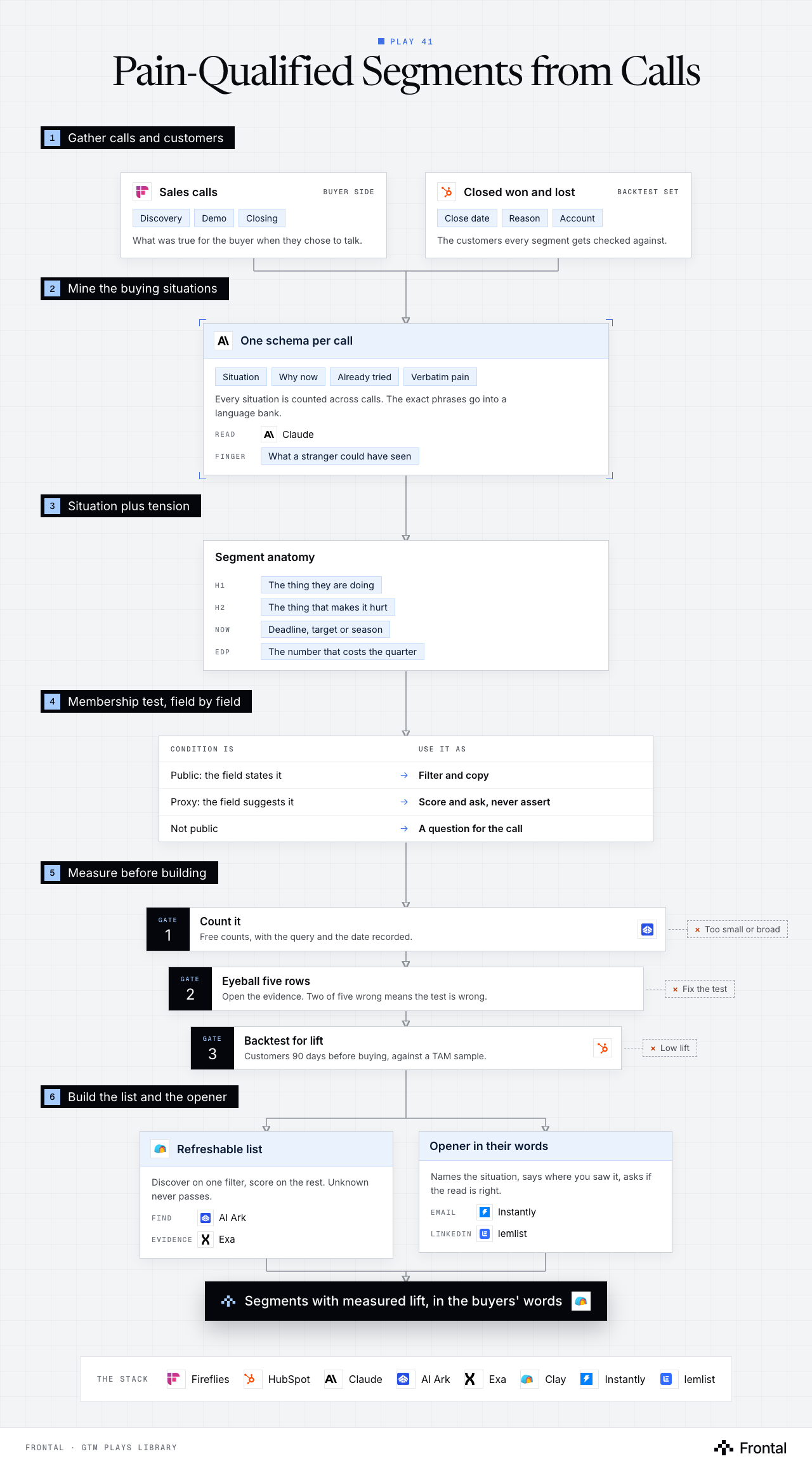
The diagram as text
1Gather calls and customers
- Sales calls (buyer side): Discovery, Demo and Closing. What was true for the buyer when they chose to talk. Tool: Fireflies.
- Closed won and lost (backtest set): Close date, Reason and Account. The customers every segment gets checked against. Tool: HubSpot.
2Mine the buying situations
- One schema per call: Situation, Why now, Already tried and Verbatim pain. Every situation is counted across calls. The exact phrases go into a language bank. Read: Claude. Finger: What a stranger could have seen.
3Situation plus tension
- Segment anatomy. H1: The thing they are doing. H2: The thing that makes it hurt. Now: Deadline, target or season. EDP: The number that costs the quarter.
4Membership test, field by field
- Condition is → Use it as
- Public: the field states it → Filter and copy
- Proxy: the field suggests it → Score and ask, never assert
- Not public → A question for the call
- Condition is → Use it as
5Measure before building
- Gate 1: Count it: Free counts, with the query and the date recorded. Dropped: Too small or broad. Tool: AI Ark.
- Gate 2: Eyeball five rows: Open the evidence. Two of five wrong means the test is wrong. Dropped: Fix the test.
- Gate 3: Backtest for lift: Customers 90 days before buying, against a TAM sample. Dropped: Low lift. Tool: HubSpot.
6Build the list and the opener
- Refreshable list: Discover on one filter, score on the rest. Unknown never passes. Find: AI Ark. Evidence: Exa. Tool: Clay.
- Opener in their words: Names the situation, says where you saw it, asks if the read is right. Email: Instantly. LinkedIn: lemlist.
- Outcome: Segments with measured lift, in the buyers' words. Tool: Clay.
The stack: Fireflies, HubSpot, Claude, AI Ark, Exa, Clay, Instantly, lemlist.
The play in six steps
Step 1: Gather the calls and the customers
The best segments come from what was true for real buyers at the moment they decided to talk or buy.
- Pull sales call transcripts from Fireflies. Calls with the buyers themselves outrank internal kickoffs, which only capture what the team believes.
- Export closed-won and closed-lost deals from HubSpot with close dates and reasons. This is the backtest set.
- Tag every line of context with where it came from. Anything unsourced is an assumption.
Step 2: Mine the buying situations
Each call is read for the situation, not the industry, and for the words the buyer used to describe it.
- Claude extracts, per call: the situation, why now, what they already tried, and verbatim pain lines with the speaker.
- Record the outside-in fingerprint: what a stranger could have seen beforehand, such as a job post, a filing, a tool or a hire.
- Batch large call sets across parallel runs with one shared schema.
- Count every situation. Came up in 12 of 100 calls is a finding; came up a lot is not.
- Build a language bank of the exact phrases buyers used for the pain.
Step 3: Write each segment as a situation and a tension
One signal is noise that every vendor fires on. Two facts pulling against each other is the pain.
- Situation: one sentence about something that happened to them, not something they are.
- Tension: the thing they are doing, pulling against the thing that makes it hurt.
- Example: adding sales reps, with nobody running the system they will work in.
- Amplifier: the deadline, target or season that makes it hurt now.
- Existential data point: the number that, past a threshold, costs someone the quarter. No such number means the segment is incremental, and the doc says so.
- Kill segments that are vague, ungrounded, a single signal, or a pain the offer does not fix.
Step 4: Write the membership test field by field
A segment is only real if the next person can rebuild it from the spec alone.
- Every condition gets a source, a field, an operator and a threshold.
- Mark each one public, proxy or not public.
- Public: the field states it. Use it to filter and in copy.
- Proxy: the field suggests it. Use it to score and to ask, never state it as fact.
- Not public: drop it from the test and turn it into a question for the call.
- A segment whose core tension rests on a not-public condition is a discovery question, not a segment.
Step 5: Measure before building
Three checks turn a hypothesis into a measured segment.
- Count it with free or near-free counts, such as an AI Ark preview, and record the query and the date.
- Open five rows the test says are in and check each one is really in the situation. If two of five fail, fix the test before counting further.
- Backtest: what share of recent closed-won accounts were in the situation in the 90 days before they bought, against a random sample of the TAM.
- The ratio is the lift. Low lift means a firmographic in disguise.
- Label each segment measured, partly measured or hypothesis.
Step 6: Build the list and the opener
The measured segments become a refreshable list and a message written in the buyers' own words.
- Discover rows on one filter, then score on the rest. Stacking discovery filters collapses the list.
- Build in Clay with AI Ark for companies and people and Exa for evidence that needs the web. Allowed answers include unknown, and unknown never counts as a pass.
- Set a refresh cadence from how long a row stays true.
- Open on the situation, using vocabulary from the language bank, say what you saw and where, and ask if the read is right.
- Send by email through Instantly and on LinkedIn through lemlist. Never quote one buyer to another.
Tools used
The eight tools this play names. Each links to the other plays that use it.
Related plays
Target-Account Exec Posts
6 steps · LinkedIn, Email, CRM
Competitor Post Engagers
6 steps · LinkedIn, Email, CRM
Closed-Lost Revival
7 steps · Email, LinkedIn, Call, CRM

Have us run this play
Tell us what you're trying to hit this quarter, and we'll suggest where to start.