Key Takeaways
- A Clay GTM engineer builds and runs your go-to-market systems inside Clay: account lists, enrichment, buying signals, CRM sync and lead routing. Clay’s own shorthand for the role is “RevOps + data + building.”
- Open the role when you have product-market fit and a repeatable sales process worth automating. Clay’s own hiring guide calls a funding round the wrong trigger.
- Clay listed $140,000 to $265,000, plus equity, across its three GTM engineering openings in November 2026.
- Hire on evidence: a structured interview, a take-home on your own data and one scoring rubric. Clay certification helps you shortlist, but it doesn’t replace your own test.
By Clay’s count, about 100 GTM engineer job listings go live every month. Clay’s own listing calls Clay experience “highly preferred.” The trouble is that “Clay experience” can mean one enrichment table built for one campaign. It can also mean a company’s whole inbound routing, run in Clay. You want to know which kind of candidate you’re talking to before the second interview.
This guide covers what a Clay GTM engineer does in a normal week and which skills are worth paying for. You’ll also get a job description you can copy, an interview process with a scoring rubric, a take-home built in Clay and the places candidates gather.
We see the role up close at Frontal, the go-to-market partner for B2B tech companies, where our GTM engineers work as an extension of our clients’ teams. As a Clay Elite Studio Partner, our team builds tables, waterfalls and signal workflows inside clients’ own Clay workspaces. Every Clay detail in this guide comes from Clay’s own pages, read on November 20, 2026.
What a Clay GTM Engineer Does
A Clay GTM engineer builds the systems your sales and marketing teams run on, with Clay as the main workbench. Clay says it coined the GTM engineer title in 2023. In its April 2026 guide, Clay splits the work into three rungs: data foundation, data modeling and data activation.
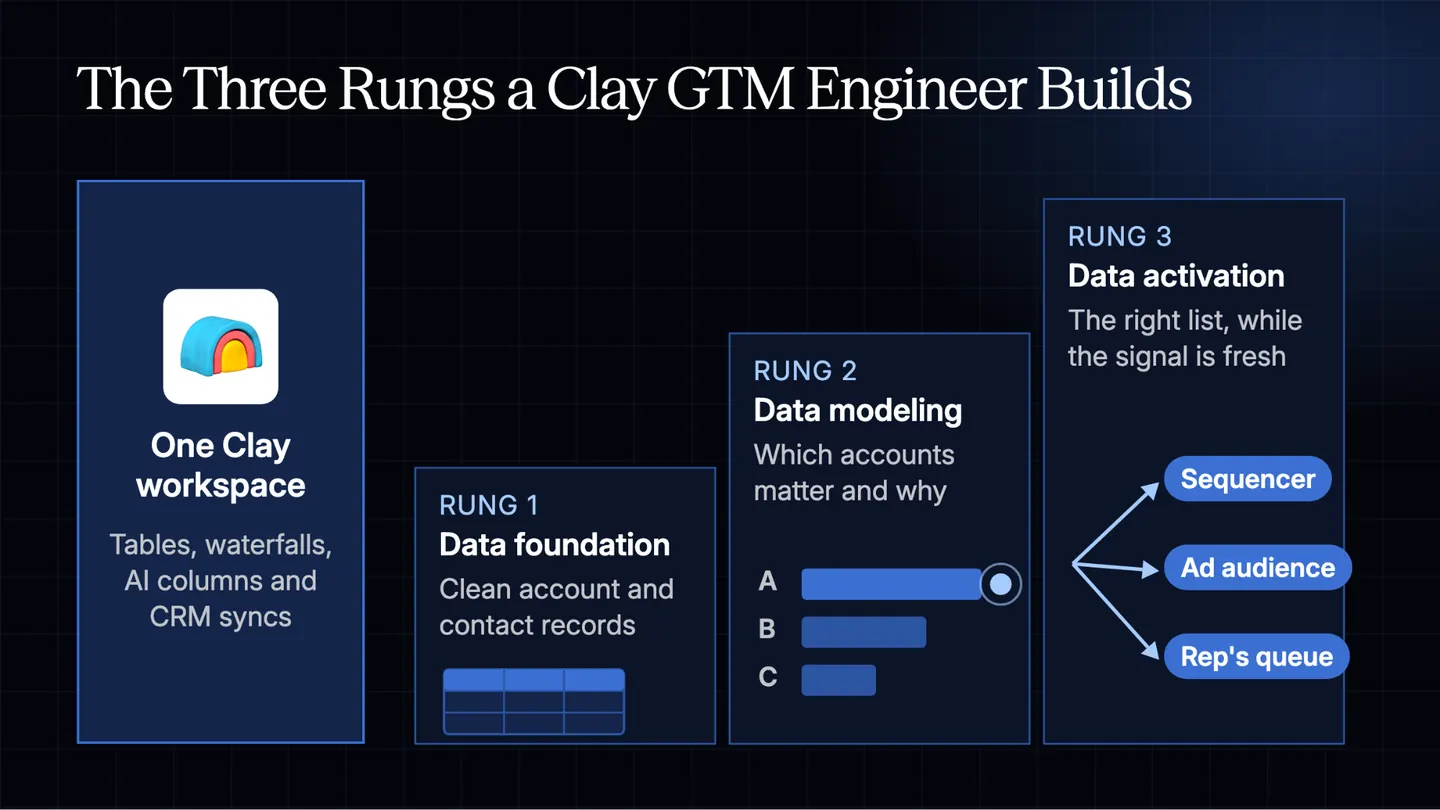
Clay splits the job into three rungs, and all three run in one workspace.
In plain terms, the foundation is clean account and contact records. Modeling decides which accounts matter and why, through tiers, scores and buying signals. Activation gets the right list into a sequencer, an ad audience or a rep’s queue while the signal is still fresh.
What makes it the Clay version of the job is where the building happens. Tables, enrichment waterfalls, AI research columns and CRM syncs all live in one Clay workspace, and the GTM engineer owns it. Clay’s November hiring guide says its own GTM engineers want to spend “around 70%” of their time building.
In an r/sales thread from August 2025, the top reply called the role “a bit made up,” and another reply said a GTM engineer is just RevOps. That’s one Reddit thread, so treat it as anecdote. The skeptics are right that the ops knowledge overlaps with RevOps. What the job adds is the building: APIs, webhooks, scripts and AI agents.
The wider discipline of GTM engineering runs the same three rungs in any toolset, from n8n and Zapier to custom code. This guide stays inside Clay.
A Week Inside Clay: The Day-to-Day Work
Day to day, Clay GTM engineering turns the three rungs into one job: moving data from its sources to the people who sell. Clay’s April guide says most companies stumble on the data foundation. They either run campaigns on dirty data or “waste 80% of their time on data hygiene,” with only 20% left for strategic work. The hire’s job is to automate as much of that hygiene work as your data allows.
Here’s how the common tasks map to Clay features. The plan column uses the plan descriptions on Clay’s pricing page as read on November 20, 2026.
| The work | Clay feature it runs on | Lowest plan that lists it |
|---|---|---|
| Build target account and contact lists | Tables with multi-provider waterfalls | Free, up to 200 rows per table |
| Answer questions no data provider sells, such as “does this company publish prices?” | Claygent, “Clay’s AI agent with access to web research” | Free |
| Watch for job changes and other buying signals | Job change and signal tracking | Launch |
| Send enriched contacts into email sequences | Email campaign integrations | Launch |
| Write results back to the CRM | CRM auto-sync and enrichment | Growth |
| Connect a tool that has no native integration | HTTP API integrations and webhook automation | Growth |
| Send lists to ad platforms | Audience pushes to ads platforms | Growth |
The plan column matters when you hire. On Launch, a new hire can build lists and send them to a sequencer. CRM sync, HTTP API calls and webhooks need Growth. Without them, more data moves between Clay and the CRM through hand-run exports and imports, the manual work you hired them to remove.
A real week also includes the unglamorous parts. When a provider changes its output, a waterfall needs fixing, and when a rep asks for a new field, someone has to add it. Somebody also checks how fast the month’s credits are going. If your team still builds prospect lists by hand, the sources behind each outbound list are the first thing a GTM engineer would automate.
When to Open the Role
Clay’s November 2026 hiring guide warns against using a funding round as the trigger. It names two conditions instead: product-market fit, and a revenue process that needs to be systemized. Before product-market fit, the process changes every month, so there’s nothing stable to automate.
A quick test helps. Write down the first three things the hire would build. If each one is a running system with someone downstream who depends on it, such as inbound routing or a weekly account refresh, you probably have a role.
If the list is one table for one campaign, you have a project. A project rarely keeps a senior builder busy for long. For anything in between, such as two running systems, or three small ones, weigh how much weekly upkeep they need.
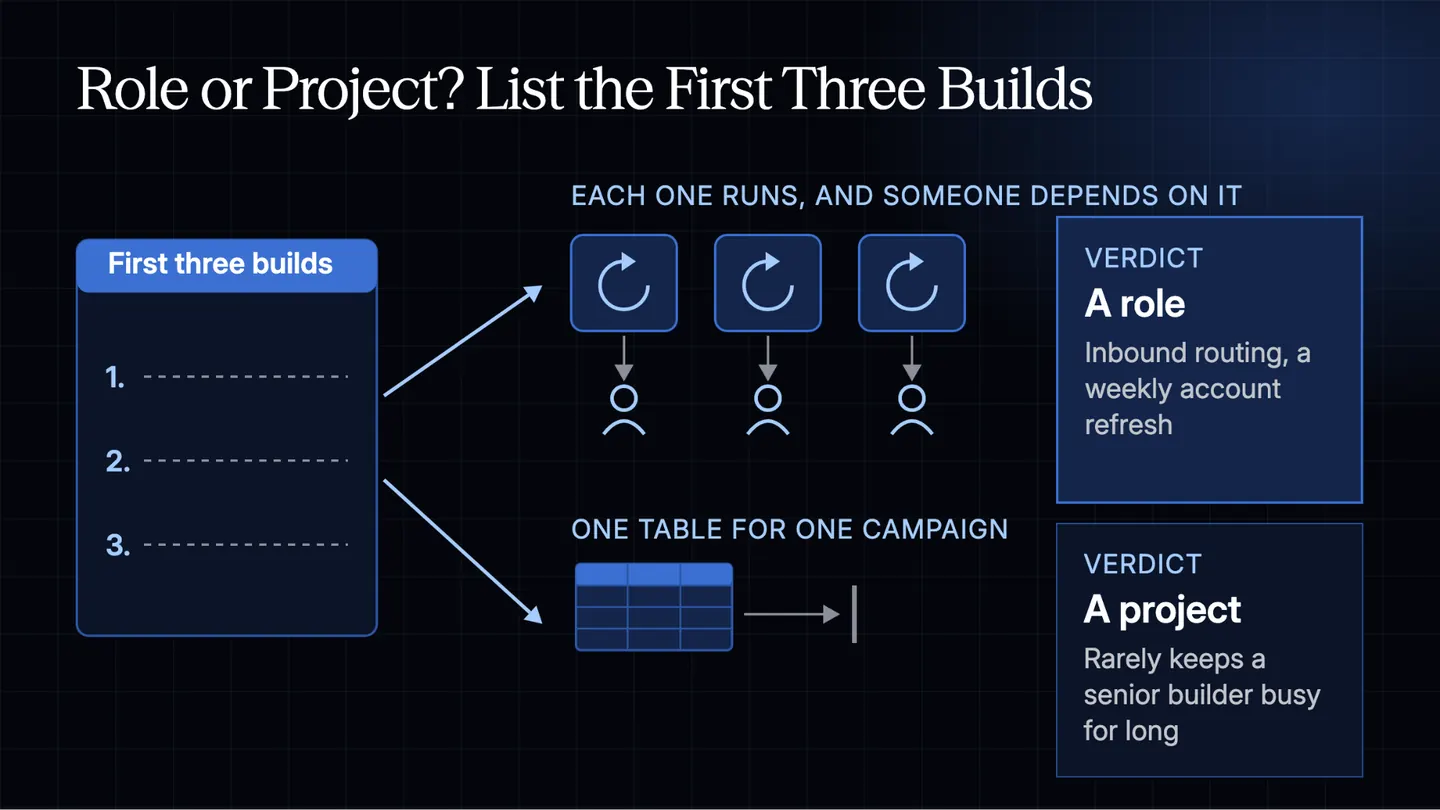
Three running systems with someone downstream usually make a role.
Where the role sits matters too. Clay’s April guide calls a GTM engineer inside RevOps “the dominant pattern,” with a seat inside Growth as the second model. Its advice for most companies is short: “Start in ops, federate later.”
Can’t name three systems for that ops seat to own yet? Every outbound program your team still runs by hand, like the step-by-step ones in our free Plays library, is a candidate system to automate.
The Skills to Hire For
Clay sets a clear technical floor: “working ability in at least one of Python, JavaScript, SQL, or TypeScript, plus experience connecting systems through APIs and webhooks.” It adds, “We don’t require a CS degree or prior Clay experience.”
For what Clay calls functional GTM engineers, it looks for more than three but fewer than ten years of total work experience. Those years should pair two backgrounds, such as sales operations with solutions engineering, or a commercial role with GTM analytics.
Use these as your screening checks:
- Builds systems, not one-off lists, and can walk you through a workflow they built, what broke and how they fixed it.
- Codes enough to call an API, read the JSON that comes back and set up a webhook.
- Thinks commercially and ties every build to a number sales cares about, such as meetings booked or hours saved.
- Watches cost, including how Clay’s Data Credits and Actions get spent and how AI token use adds up.
- Handles risk by suppressing customers and open deals, protecting sending domains and keeping personal data out of prompts.
- Explains clearly enough that a rep can follow the documentation, and says no to a request that would break the CRM.
Clay’s November guide added cost and risk to the list, naming three skills for the agentic era: “Safety- and security-minded,” “Financials and cost-consciousness” and “AI acumen.” Some job posts now name agent tools directly. A September 2026 post in Clay’s community listed Claude Code as a must.
What Clay Certification Proves
Clay Certified is in beta, and it’s a build test rather than a quiz. Clay’s certification site puts it this way: “Solve a real GTM problem in your own workspace. Pass, and anyone can check it.” The candidate needs a paid Clay plan, and the build uses their own credits. Clay says, “All we need is 10 rows.”
After the build comes an interview on why they built it that way, about 24 minutes spoken or 50 typed. A pass gives the candidate a credential page with its own link and ID, “verified by Clay.”
The pass also produces a work sample showing what they built and what it changed. For a hiring manager, that means you can open the credential page and see a real build before the first call.
Clay certification doesn’t replace your own test. Ten rows show the logic works on a small sample. They don’t show how a candidate handles a messy CRM, a broken handoff or a sales leader who wants a different field order. Use the credential to help decide who gets a screen, then test everyone on your own data.
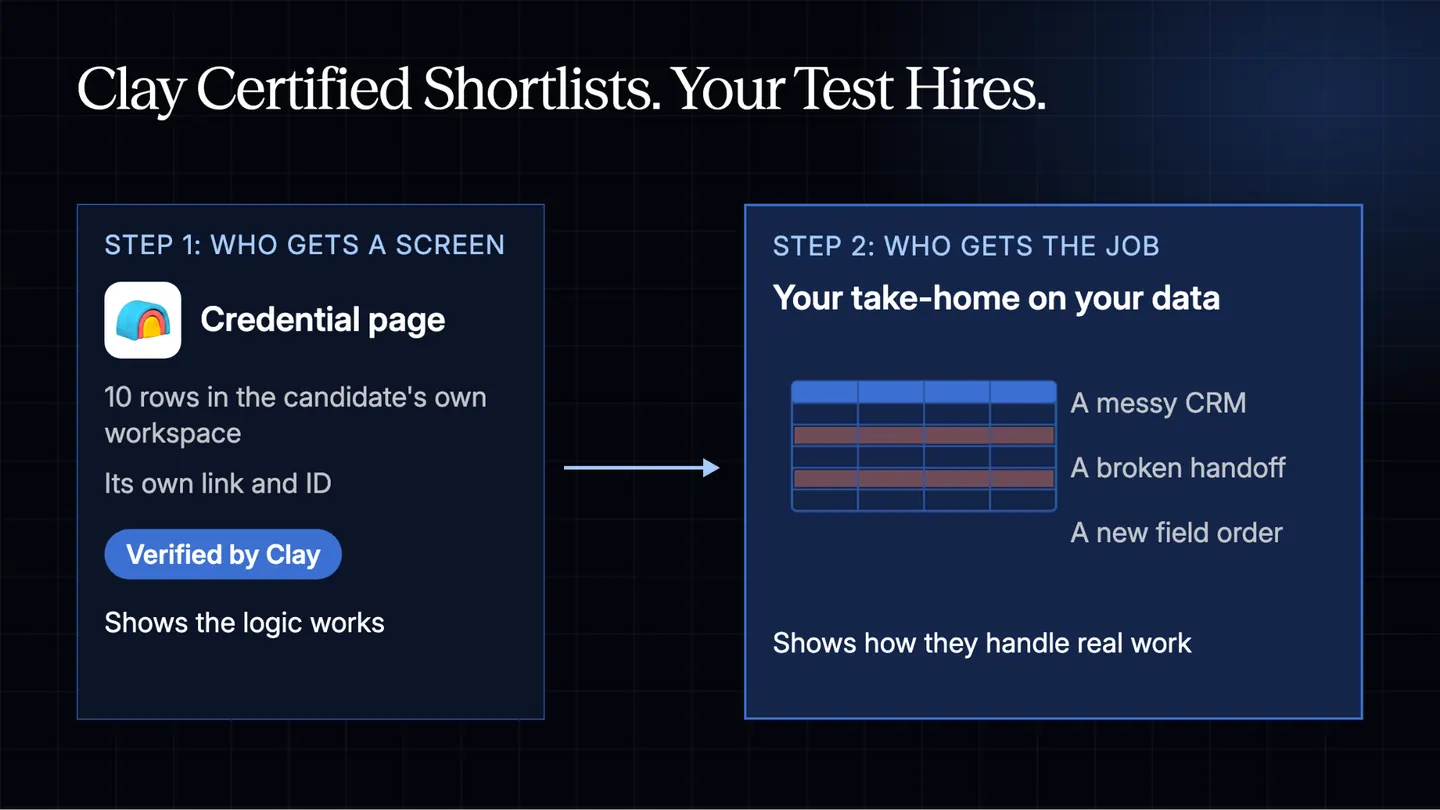
The credential can help decide who gets a screen. Your own take-home decides the hire.
A Job Description You Can Copy
The draft below borrows from Clay Labs’ own GTM Engineer, Marketing post and from Clay’s two hiring guides. Replace the bracketed parts with your own stack, targets and experience range.
Open with a two-sentence summary: “You’ll own our go-to-market systems in Clay, from data sources to [HubSpot or Salesforce] and our sequencer. You’ll report to [Head of RevOps] and be measured on [meetings booked, hours saved and pipeline recorded in our CRM].” Then list the work and the requirements:
- Build and maintain our account and contact tables in Clay, with enrichment waterfalls and a documented refresh schedule.
- Own inbound enrichment and routing, so every new lead reaches the right rep within [X minutes].
- Set up signal tracking for job changes, hiring and website visits, and turn each signal into a task or a sequence.
- Write enriched data back to [HubSpot or Salesforce] under written update rules.
- Connect tools through APIs and webhooks where no native integration exists.
- Track Clay credit and action use against a monthly budget.
- Document every table so a teammate can run it without you.
- Bring [more than 3 and fewer than 10] years across RevOps, marketing ops, sales ops, solutions engineering or another technical commercial role.
- Write working code in Python, JavaScript, SQL or TypeScript (one is enough).
- Clay experience is preferred, not required.
Name the providers you already pay for in the waterfall line, so candidates know which lead enrichment services they’ll work with.
The last line follows Clay’s own post. Clay calls Clay experience “not required but is highly preferred,” and says candidates without it “will show increasing proficiency throughout the interview process.” It’s a fair standard to copy, because it tests learning speed instead of time spent in one tool.
What the Role Pays
$140,000 to $265,000 is the range across Clay’s own three open GTM engineering roles in November 2026, according to its hiring guide. Equity comes on top.
| Role at Clay, November 2026 | Experience Clay asks for | Pay range Clay lists |
|---|---|---|
| GTM Engineer, Marketing | Six to 10 years | $150,000 to $220,000 |
| GTM Engineer, Systems and Infrastructure | Not stated in the guide | $140,000 to $200,000 |
| GTM Engineer Manager, Seller Efficiency | Not stated in the guide | $240,000 to $265,000 |
Clay writes that “we’re moving our benchmarks closer to software engineering for the roles that call for it,” because candidates now compare its offers with engineering offers. For scale, the Bureau of Labor Statistics put the median annual wage for software developers at $135,980 in May 2025. The BLS has no GTM engineer category, so read that figure as a reference point, not a benchmark for the role.
Budget for the workspace as well as the salary. A Clay GTM engineer needs a plan with the features the job depends on, plus room in its monthly allowance. Clay pricing runs on two meters: Actions pay for platform work, and Data Credits pay for data bought through Clay’s marketplace instead of with your own provider keys.
How to Interview Candidates
To hire a GTM engineer, Clay runs “around five interviews and a take-home assignment,” and aims “to go from first call to decision in two weeks or less.”
What the research backs is the structure. A 2022 meta-analysis of hiring methods in the Journal of Applied Psychology found that “Structured interviews emerged as the top-ranked selection procedure.” So ask every candidate the same questions, in the same order, and score them on the same scale.
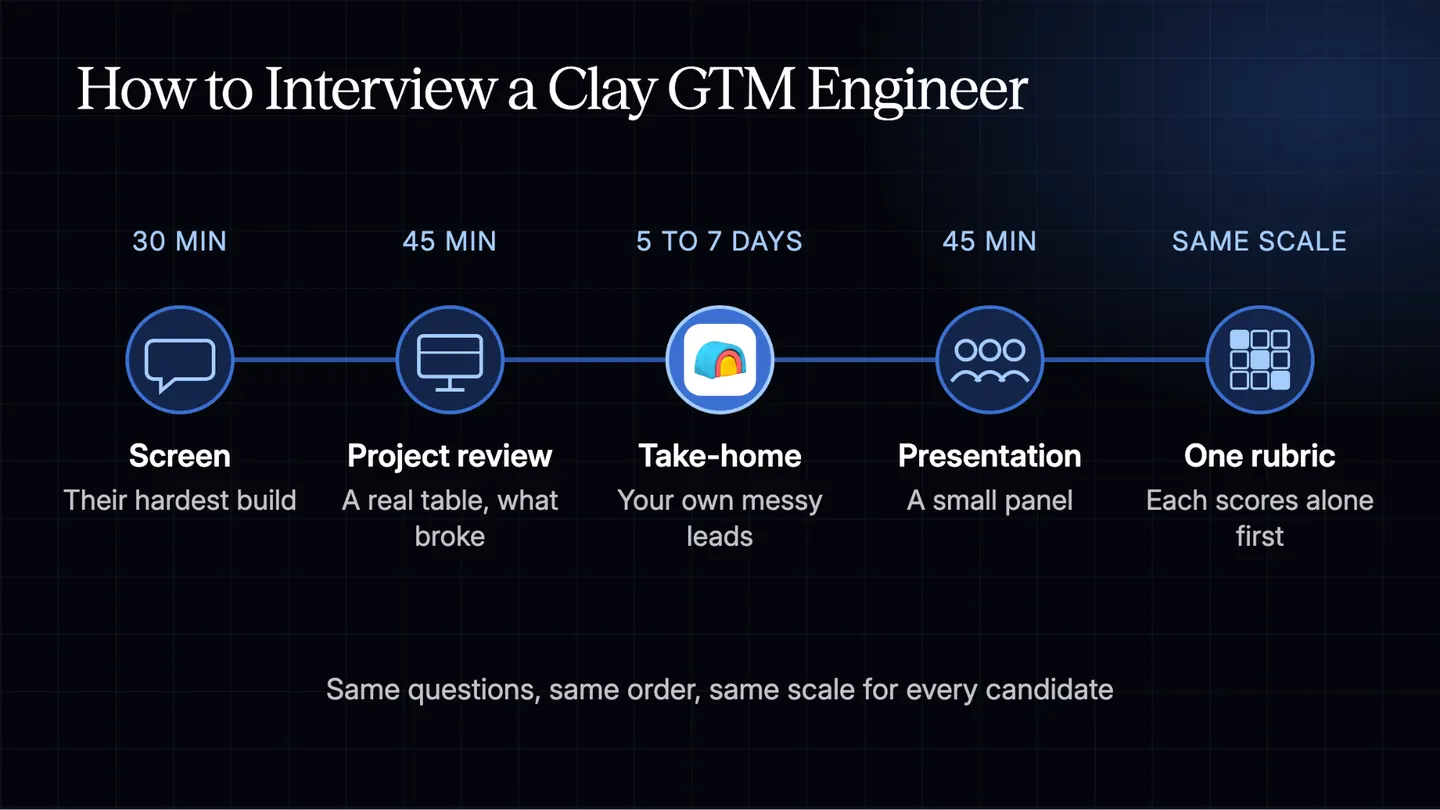
Screen, project review, take-home, presentation, then one rubric.
1. A 30-Minute Screen on Their Hardest Build
Clay’s screen asks about “the most complex GTM system they’ve ever built.” Push for specifics. Ask which data sources fed it, who used the output, what it cost to run and how they knew it worked. Note whether the answer names tables, triggers and results, or only the tools involved.
2. A 45-Minute Project Review
Clay’s second conversation probes “how they’ve handled it when a project or workflow broke.” Ask the candidate to share a real table on screen, with client data hidden. Watch how they explain a failed row and the fallback they built for it.
3. A Take-Home Test Built in Clay
Clay sends the case prompt “with five to seven days to work on it,” then holds “A 45-minute case study presentation” with a panel. Its November guide describes three take-homes: “Inbound routing rebuild,” “Renewal signals for sales reps” and “Agent audit.” The routing rebuild is the easiest to set up in Clay, because you already have the data and the result is easy to judge. Here’s how to run it:
- Export a month of inbound leads with the form each person filled out, the enrichment that came back, the rep assigned and the time to first follow-up.
- Replace names, emails, phone numbers and company names with test values, and ask candidates to delete the file after the presentation.
- Leave the problems in, such as leads that sat untouched for days or went to the wrong rep.
- Ask the candidate to explain why those leads were mishandled and to build the routing and speed-to-lead logic that should replace the current setup. They should also say how they’d prove the new version works better.
- Let them build in their own Clay workspace, and cap the sample at 200 rows, the table limit Clay’s pricing page lists for the Free plan.
- Give five to seven days, say how many hours of work you expect, and confirm you won’t use the build in production.
- Book the 45-minute presentation with a small panel, and have each member score it before the group talks.
Routing rules sit inside wider sales workflow automation, and they break when territories or reps change. A strong submission also says who maintains each rule after launch.
Use the agent audit instead for roles that will run AI agents. That take-home hands the candidate several weeks of an agent’s work, from account scores to first-touch emails, and asks them to find the rows the agent got wrong. The candidate then decides which steps stay with the agent, which become fixed rules and which need a human review.
4. Score Against One Rubric
Clay’s advice is to decide in advance what “bad,” “okay,” “good” and “exceptional” look like. Here’s a rubric we built on the grading points in Clay’s two guides.
| What you score | Bad | Okay | Good | Exceptional |
|---|---|---|---|---|
| Problem analysis | Jumps straight to tools | Restates the brief | Finds the cause in the data | Finds the cause plus a second issue nobody flagged |
| System design | One table, no fallback | Works only on clean rows | Explains assumptions and fallback logic | Adds monitoring so failures surface on their own |
| Risk | Ignores what happens downstream | Names one risk | Suppresses customers and open deals | Also plans for deliverability and targeting fatigue on any send |
| Measurement | None | Activity counts | A success metric and a plan to iterate | A metric tied to pipeline in the CRM |
| Cost | Ignores credits | Estimates cost after building | Estimates credits before the run | Picks the cheaper path and states the trade-off |
Clay grades the presentation on “system-level clarity.” Can the candidate explain how the flows work, defend each choice and show the analysis behind it? Clay’s red flags include “tunnel vision,” such as suggesting a single channel or ignoring deliverability.
Where to Find Candidates Who Know Clay
Clay’s April guide says candidates “might be hanging out in Clay communities, RevOps groups, or posting on social media sites about automations.” It also says some of Clay’s best hires “came directly from our ICP.”
Start with Clay’s own channels. The Clay job board lists “Top GTM roles for Clay maestros,” and you can submit your listing there. Teams also post roles in the share-jobs channel on community.clay.com. One September 2026 post there asked applicants for a Loom intro and a GTM systems walkthrough of five minutes at most. Copy that ask, because a walkthrough shows how a candidate explains a system they built.
Clay’s community page says its Slack, Clay Clubs, Clay University, some Cohort programs and livestreams are free, so “you don’t need a paid Clay plan to participate.” That makes them a good place to spot people who are learning fast. Clay pitches Cohorts as a way to “Go from Clay Curious to Clay Confident in 2 weeks.” For junior roles, its Campus Ambassador program “spans 35+ campuses.”
Two more sources are easy to miss. Clay Certified holders get a credential page to share and a draft post for LinkedIn, which makes the credential worth searching for there. People in ops roles at companies like your buyers already know the problem, which is what Clay meant by hiring from its ICP.
Agencies form a separate pool, listed in Clay’s Solutions Partner Directory, and hiring one of the Clay automation agencies trades a recruiting cycle for a contract.
What Your Hire Should Do in the First 90 Days
Clay’s job post asks the hire to “Own projects end-to-end, from discovery and prototyping through rollout, adoption, and iteration.” The first 90 days should follow that order, one system at a time.
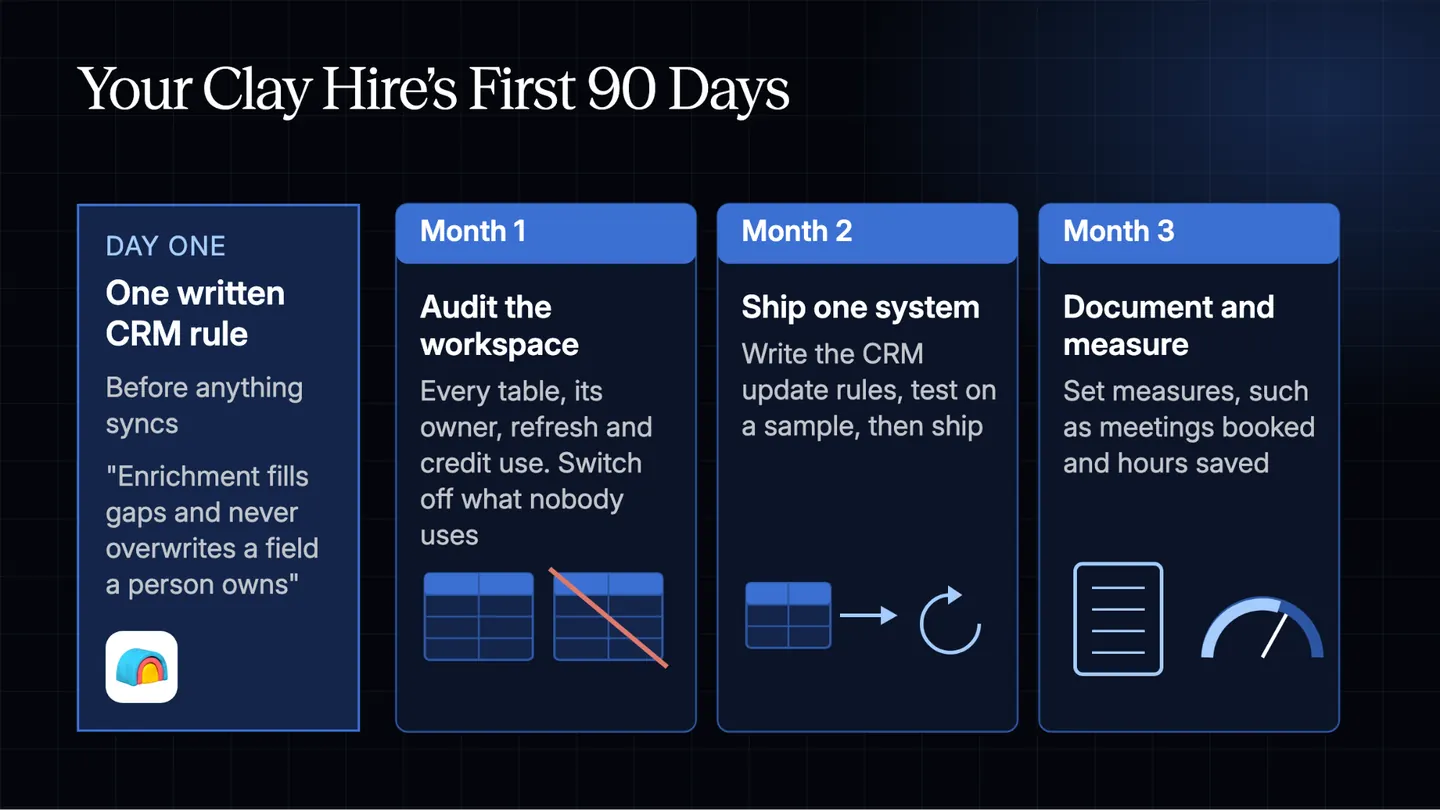
A written CRM rule on day one, then one system at a time.
Start on day one with a written CRM rule, before anything syncs. At Frontal, our RevOps rule is “Enrichment fills gaps and never overwrites a field a person owns.” Give your hire the same rule, so the first sync doesn’t erase the notes your reps keep by hand.
In the first month, audit the workspace. List every table, its owner, its refresh schedule and its monthly credit use, then switch off what nobody uses.
In the second month, write the full CRM update rules from that one rule, test the first system on a sample of records, then ship it to production. Routing or a weekly account refresh makes a good first system. In the third month, document it and set the measures. Clay’s own team tracks “metrics like meetings booked and hours saved.”
Hire, Bring In a Partner or Both
Hiring takes time. Clay’s own target is two weeks from first call to decision, and that clock starts only once you have a shortlist. Some teams bring in a partner to run the Clay work while they recruit, then hand it over. Others keep a partner beside the hire for extra capacity.
Three factors decide it: cost, time to start and how much Clay work you have. Any one of them can tip the choice toward an agency or an in-house hire, so settle all three before you open the role.
What Extra Capacity Looked Like for Palico
Palico, a FinTech marketplace, had a sales team of fewer than 20 people. Frontal rebuilt its outbound in five layers: dedicated sending domains, Crunchbase enrichment, dynamic fields filled by Clay, Smartlead sequences and a weekly reporting loop. Positive replies reached “6 to 15 every week, from week two,” and Palico closed 3 clients “within the first weeks.”
The Palico case study lists “New hires required” as “None.” Paloma Hernandez, Head of Sales at Palico, put it this way: “It’s almost like expanding the sales team and having an extra resource in-house. Very time efficient for us.” That’s what a partner adds while a team stays lean, whether or not a hire comes next.
Give Your Clay Workspace an Owner
Start with the job description and the routing take-home. Score every candidate on one rubric, and give your hire written CRM rules on day one.
If you want the Clay work running while you recruit, our GTM engineering team builds it inside your workspace and CRM. Most clients start with one service. We work with B2B tech companies past product-market fit with a real sales team, and scope and pricing are set on a call.
Frequently Asked Questions
How much does a Clay GTM engineer make?
There’s no official benchmark for the role, so the clearest public figures come from one employer. In November 2026, Clay’s open roles for GTM engineers listed $140,000 to $200,000, $150,000 to $220,000 and $240,000 to $265,000. The last is a manager’s role, and equity comes on top. Pay at other companies varies with the role’s technical depth.
Do you need Clay experience to become a GTM engineer at Clay?
No. Clay’s November 2026 hiring guide says it requires neither prior Clay experience nor a CS degree. Its own job post calls Clay experience “highly preferred” and expects candidates without it to show progress during the interviews. Coding in one of Python, JavaScript, SQL or TypeScript is the firmer requirement.
Is Clay certification worth it for hiring?
It’s worth checking, not worth requiring. Clay Certified is in beta and tests a real build on 10 rows in the candidate’s own paid workspace. A pass gives a public credential page verified by Clay. Use it to shortlist, then run your own take-home on your own data.
How long does it take to fill a GTM engineering role?
Clay gives itself two weeks or less between the first call and the decision. Its process uses around five interviews and a take-home, with five to seven days for the case. Sourcing the shortlist comes before that clock starts, so plan for longer overall.
Is a GTM engineer at Clay the same as RevOps?
Not quite. Clay describes the role as “RevOps + data + building,” and the type of GTM engineer Clay hires wants most of the week, around 70%, to go to building. Most companies still place the role inside RevOps, which Clay calls the dominant pattern.
Which Clay plan does a GTM engineer need?
It depends on the work. Clay’s pricing page lists job change tracking, other buying signals and email campaign integrations on Launch. CRM auto-sync, HTTP API integrations, webhook automation and audience pushes to ads platforms start on Growth. A role that owns CRM sync or API work needs Growth or Enterprise.
Can Frontal run our Clay work while we hire?
Yes. Frontal’s GTM engineers work in your own Clay workspace, from tables and waterfalls to signal workflows, and test each build on a sample before it goes live. Our Clay page offers to run the workflows with your team, or to “document them and train your team to run them.”