
Key Takeaways
- Frontal is best for post-PMF B2B tech teams that want to build the GTM engineering system inside their own stack and run outbound on top of it. We clean the data, score the signals, and run outbound, ads, and content from one account list, with RevOps as the foundation.
- Understory Agency is best for funded SaaS that wants signal-based outbound, paid media, and content run as one motion on a single ICP.
- Growth Engine X is best for B2B companies past $1M in revenue that want high-volume, data-driven cold email built and sent for them.
- RevPartners is best for HubSpot-native teams that want the CRM and data model engineered first, with Clay enrichment and signal-based outbound layered on top.
- The GTM Engineering Company is best for seed-to-Series B teams that want a lean, fractional, Clay-core build they fully own.
Every week, accounts in your market raise funding, switch tools, or hire an exec who already knows your product. The problem is, most of those moments pass untouched, buried in a tool nobody checks.
A GTM engineering agency builds the data, scoring, and signal-triggered outbound to turn those moments into booked meetings, then goes a step further and runs the whole system inside the tools you already use.
This guide breaks down the 5 best GTM engineering agencies for B2B SaaS in 2026, including each one's key services, where it shines and falls short, and who it's best for.
How we built this list: every agency here earns its spot on the GTM engineering work it delivers, the stage and stack it fits, and the client results it publishes. Frontal is included in this comparison and held to the same criteria as every other provider. That said, the right pick depends on your situation, whether you need the systems underneath rebuilt, the outbound run on top, or both, and the stage and stack you're working from.
Top 5 GTM Engineering Agencies for B2B SaaS in 2026
| Agency | Best For | Standout Strength | Starting Price |
|---|---|---|---|
| Frontal | B2B tech teams that want the system built and run | Builds the data, signals, and outbound inside your stack, then runs it across outbound, ads, and content | Custom, scoped on a call |
| Understory Agency | Funded SaaS that wants outbound run with paid and content | Allbound pod running signal-based outbound, paid, and content on one ICP | Custom, scoped on a call |
| Growth Engine X | High-volume, data-driven cold email at scale | Clay Elite Studio Partner built for high-volume, deliverability-first outbound | Not published; free test to start |
| RevPartners | HubSpot-native teams that want the CRM engineered alongside outbound | Dual HubSpot and Clay Elite, framework-driven | Implementation from $1,500; RevOps as a Service from $9,850/mo |
| The GTM Engineering Company | Lean teams that want a fractional, Clay-core build they own | Fractional Clay-core build handed over fully in your name | From $5,000/mo |
1. Frontal: Best for B2B Tech Teams That Want the GTM Engineering System Built and Run
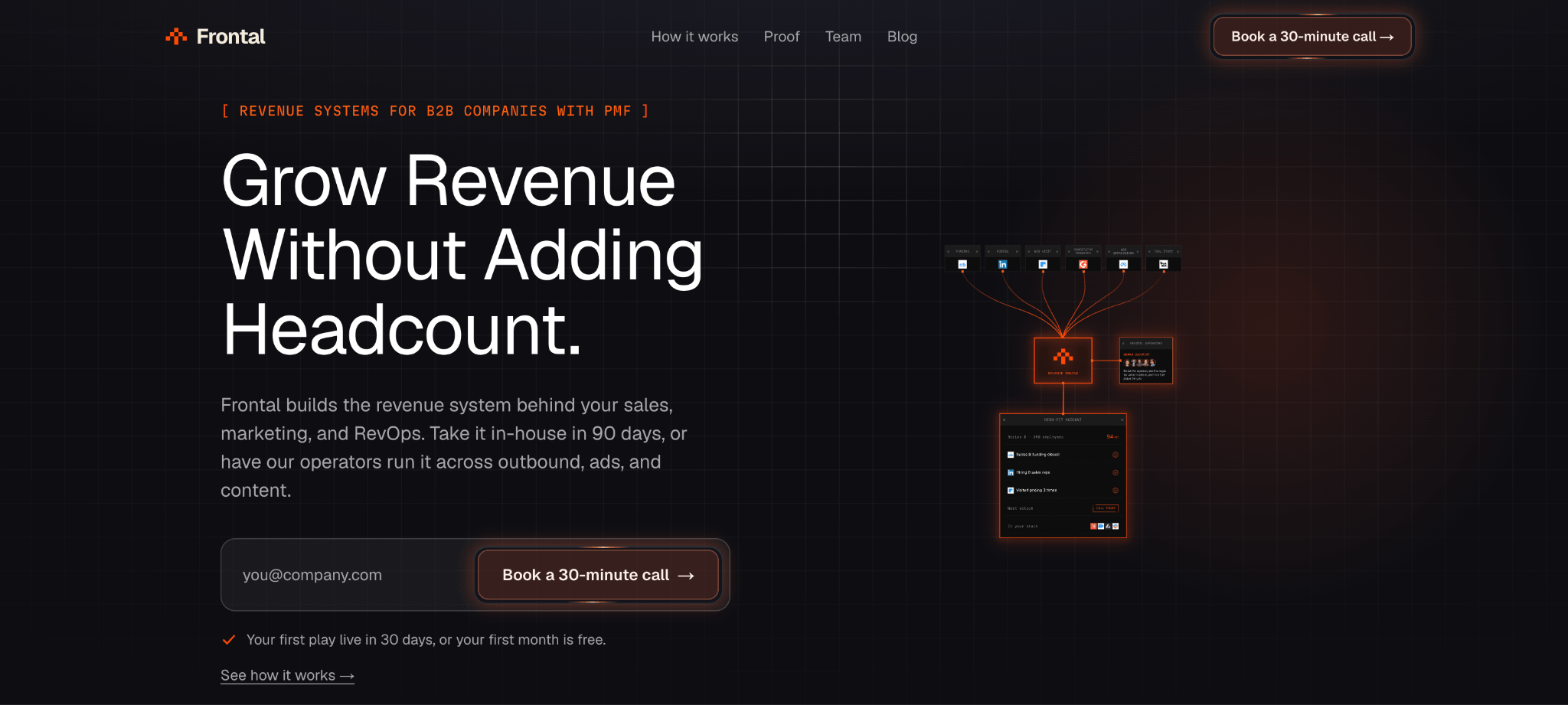
Frontal is a go-to-market partner for B2B tech companies past product-market fit. We work as an extension of your go-to-market team and take ownership of the work we agree to run across GTM engineering, ads, content, and the RevOps foundation underneath them.
Most teams start with GTM engineering. We build the data, the buying signals, and the signal-triggered outbound that turns a buying moment into a booked meeting, inside the tools you already use. To date, we’ve worked with 250+ B2B companies.
Frontal Key Services
Our GTM engineering work runs from the data underneath your pipeline to the outbound that acts on it. You can start with whichever layer is weakest and build out from there, or connect it to our ads, content, and RevOps work so your whole go-to-market runs off one system.
1. Data Foundation and Enrichment
GTM engineering only works on data you can trust, so we start there. We audit what’s in your CRM and clear out whatever isn’t earning its place.
From there, we get the data itself into shape:
- Dedupe and normalize, so one account isn’t logged three separate times, and each field means the same thing everywhere.
- Waterfall enrichment, so we fill in missing job title, headcount, or tech-stack details from the next provider when the first comes up empty.
- Auto-enrichment, so new records arrive already complete instead of your team backfilling every imported list and form by hand.
We build inside your CRM, whether that’s HubSpot or Salesforce, run the enrichment in Clay, write it back, and document the data model so your team can keep it running after we hand it over.
2. Buying-Signal Tracking and Scoring
Clean data is only useful if you know which accounts are worth acting on right now. We track the live signals that show a company is in the market for what you sell:
- Funding rounds, since a new raise usually means fresh budget and a team about to expand.
- Hiring and job changes, like a key new hire or a champion moving to a company that doesn’t use you yet.
- Website intent, such as an ICP account visiting your pricing page multiple times.
- Tech-stack changes that point to a gap your product fills.
We score every account on how well it fits your ICP and what it’s doing right now. A senior operator reviews the ones that clear the bar and sets aside weak matches before anything runs, so a rep never gets sent to a bad-fit account.
3. Signal-Triggered Outbound, Built and Run
When an account clears scoring, we turn the signal into a researched account, a personalized sequence, and a prioritized call list for your reps, then route it to the right owner with the context attached.
Say a target account raises a Series A. We confirm the fit and timing, a person on our team approves it, and it reaches the right rep with the raise flagged, a CRM task, and a Slack alert to reach out. The rep opens it already knowing the account, the signal that surfaced it, and why now is the moment.
We build and run all of this inside your stack across email and LinkedIn, and we review every account before we contact it, so your domain and name stay protected.
For data sources to pull signals and contacts from, see our guide to building a B2B outbound list.
4. Connected to Ads and Content
This is where GTM engineering stops being a standalone outbound project. The same account list and signals that drive outbound also feed your paid audiences and your published content.
Your ads warm the accounts your reps will work, and your content brings engaged accounts back into the pipeline. When ads engineering and content engineering are also in scope, all three run off one source of truth about who matters, so nothing is briefed off three different versions of your ICP.
Frontal Pricing
Frontal doesn’t publish set pricing because the scope depends on your stack, the state of your data, and how much you want us to run versus keep in-house. Book a 30-minute call, and we’ll walk you through exactly what we’d build and run for you.
Where Frontal Shines
- We build it and run it: Senior operators build the system, and you can keep them on to run the outbound. Our people do the work and stay accountable for performance.
- We build around your ICP and live signals: We build the workflows that fit your market and the buying signals in your data, and a senior operator reviews every account before we contact it. During scoping, we confirm which signals exist for your ICP, so the build is grounded in what your market can support.
- You keep what we build: Everything lives in your HubSpot or Salesforce and is documented, so the working system stays with you if the engagement changes or ends. When ads and content are in scope too, they run off the same account list and signals, so your outbound, ads, and CRM all work from one version of who matters.
Frontal is also one of a small number of Clay Elite Studio Partners, which helps on the data and enrichment side of the build. It’s useful expertise to have on the team, though the right setup always depends on your stack.
Where Frontal Falls Short
- Best once you have a working sales process: Frontal shines when you already have customers and a proven way to sell to them. If you’re pre-product-market-fit and still working out who buys and why, that's a different problem, and one to solve before this work pays off.
- Not a volume outbound or cold-calling shop: We build a focused, signal-driven motion judged on replies and booked meetings. We don’t do high-volume sending or cold calling. If dialing at scale is your proven channel, we build the tiered, signal-driven list that makes those calls connect.
Frontal Client Results
- For AirOps, Frontal generated $7.83 million in qualified pipeline and $1.52 million in closed-won revenue over 10 months, without adding a single SDR. It’s a combined-program result, built inside AirOps’ own HubSpot.
- For Teikametrics, the program produced more than $300,000 in pipeline over nine months and saved the team over 100 hours a month on manual prospecting.
- For Aircall, Frontal created and enriched 3,655 accounts into a self-refreshing database over six months, giving the team a target market that stays current without manual upkeep.
Read more Frontal case studies →
Who Frontal Is Best For
- Post-PMF B2B tech companies whose data and workflows have outgrown what the team can maintain by hand, where the tools are in place but the system underneath keeps breaking.
- A newly appointed revenue or growth leader with a target but no headcount to hit it, who needs execution now.
- Sales-led B2B teams that want both the system built and the outbound run on top of it, pointed at the same set of accounts.
- Companies already paying for HubSpot, Salesforce, or Clay but without the people to design, build, and run the workflows inside them.
Want the system underneath your pipeline built and running? Tell us where it’s breaking, and we’ll walk through what Frontal would build and run for you. Book a call.
2. Understory Agency: Best for Funded SaaS That Wants Outbound Run as One Motion With Paid and Content
Understory Agency runs an allbound model for B2B SaaS. It runs signal-based outbound across email and LinkedIn, built in Clay, and wires it into paid media, LinkedIn content, and RevOps so the channels work as one motion on a single ICP.
Key Services
- GTM engineering: Signal-based outbound across email and LinkedIn, built on Clay with Instantly, HeyReach, and custom Claude Code workflows. Triggers like funding rounds, job changes, site visits, and competitor switches fire enrichment, personalization, and routing in a single workflow.
- Paid media: Full-funnel LinkedIn, Google, Meta, Reddit, and X campaigns with done-for-you creative and revenue attribution reported inside your CRM.
- LinkedIn content: Founder and executive ghostwriting at 16 to 30 posts a month, written, designed, and posted, with an engagement-outreach add-on.
- RevOps: HubSpot or Salesforce implementation plus an AI operations layer for lead scoring, routing, real-time enrichment, and reporting.
Pricing
Understory doesn’t publish set pricing. Every engagement is scoped on a call, and the paid media tiers are organized by monthly ad-spend band rather than a fixed fee, so you’ll get a number once they’ve seen your setup.
Where Understory Shines
- Deliverability and data quality engineered in: Every outbound program includes dedicated domains, AI warmup, monthly inbox rotation, and waterfall-validated lists, with a human reviewing copy before it sends.
- Run it for you or with you: You can go fully done-for-you, or have Understory train your team on the systems and hand over the keys, with OutboundSync attributing every reply, meeting, and deal natively in HubSpot or Salesforce.
Where Understory Falls Short
- The payoff is in the full motion: You can start with a single service, but the compounding Understory pitches come from running paid, outbound, and content together on one ICP. A team that only needs one isolated piece may not tap the model's main advantage.
Who Understory Is Best For
- Funded B2B SaaS that wants signal-based outbound engineered for deliverability, with the data and personalization handled for them.
- Teams that want paid, outbound, and content run as one motion by a single team on one ICP, with everything attributed back in HubSpot or Salesforce.
If you’re comparing the outbound side on its own, see Frontal’s roundup of the best lead generation services for how the top providers price and deliver.
3. Growth Engine X: Best for High-Volume, Data-Driven Cold Email at Scale
Growth Engine X is a US-based outbound agency that runs done-for-you cold email at high volume for B2B companies past $1M in revenue.
Key Services
- Done-for-you cold email: End-to-end outbound built around cold email, covering list building, copywriting, campaign strategy, and sending, with your sales team working the replies.
- Deliverability infrastructure: Done-for-you domain and inbox setup with backup domains always warming, weekly monitoring, and instant swaps when a domain drops, so high-volume sending keeps reaching the inbox.
- Layered campaign strategy: Broad, focused, and niche campaigns run in parallel, from evergreen sends across your TAM down to highly selective lists of a few hundred contacts.
- CRM integration and portability: CRM sync and enrichment through OutboundSync, with all domains, inboxes, Clay tables, and lists transferable to you.
Pricing
Growth Engine X doesn’t publish pricing. It starts with a free test campaign for qualifying companies, then scopes a paid engagement from there, so you’ll get a number on a call.
Where Growth Engine X Shines
- Deep Clay and deliverability expertise: A Clay Elite Studio Partner that describes itself as one of Clay's heaviest users, with sending infrastructure built to keep high volume reaching the inbox.
- Data-driven volume: It analyzes your best customers and builds enriched, AI-scored lookalike lists, then runs broad, focused, and niche campaigns together, so a large market gets relevant messaging.
Where Growth Engine X Falls Short
- Built around cold email: It focuses on outbound email at scale, so teams that also need paid, content, or a deep RevOps and CRM build will bring in other partners for those layers.
- You handle replies: It fills the top of the funnel, so you need a sales team in place to take the conversations and close.
Who Growth Engine X Is Best For
- B2B companies past $1M in revenue with a large addressable market and a $5K-plus lifetime gross profit per customer.
If you’re weighing high-volume sending, Frontal’s roundup of the best sales automation agencies compares how the top providers build and run it.
4. RevPartners: Best for HubSpot-Native Teams That Want the CRM Engineered Alongside Outbound
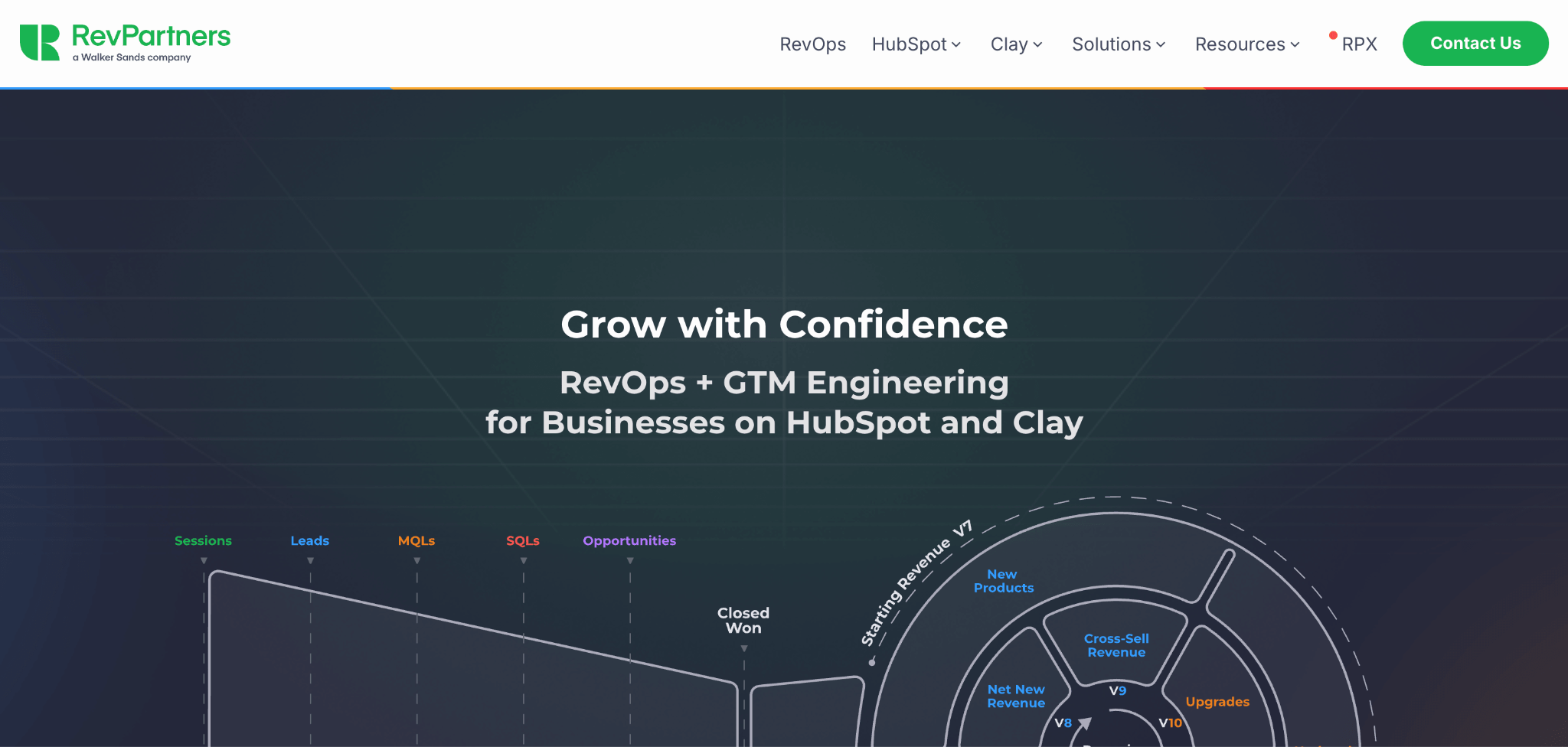
RevPartners is a RevOps and GTM engineering firm built for companies running on HubSpot and Clay.
Key Services
- RevOps as a service: A fractional RevOps department, deployed as a Pod of strategists, CRM technologists, and data analysts, run on the Revenue Performance Model and a Revenue Engine Diagnostic that produces a 90-day action plan.
- HubSpot implementation, integration, and migration: Onboarding and implementations built on RevOps best practices, platform integrations to connect your stack, technical consulting, and migrations from Salesforce, Marketo, Pipedrive, Dynamics, and Zendesk.
- Clay implementations: Foundational Clay builds and playbooks to stand up enrichment and signal workflows inside your stack.
- Allbound marketing: Inbound and outbound unified, reaching buyers through paid media, dynamic content, and warm outreach triggered by multi-channel intent signals.
Pricing
| Plan | Pricing (as of October 2026) |
|---|---|
| HubSpot Implementation | From $1,500 |
| RevOps as a Service | $9,850 to $27,000/mo by tier, plus a $5,000 one-time onboarding fee (6-month minimum) |
| Clay Implementation | $25,000 one-time payment |
Where RevPartners Shines
- A framework-driven approach: Engagements run on the Revenue Performance Model and a Revenue Engine Diagnostic, so the build is tied to measuring and fixing where revenue leaks across the funnel.
- Deep HubSpot bench: A full RevOps department of strategists, technologists, and data analysts, with 1,000-plus CRM and RevOps deployments and migrations from Salesforce, Marketo, Pipedrive, Dynamics, and Zendesk handled in-house.
Where RevPartners Falls Short
- HubSpot at the center: The practice is built around HubSpot and routinely migrates others onto it, so a team committed to Salesforce that won't move will find the model a weaker fit.
- RevOps-led, with outbound layered on: Its center of gravity is the RevOps and CRM foundation, with Clay and allbound outbound built on top, so a team whose first need is high-volume outbound execution may prefer an outbound-first shop.
- Retainers tiered by hours: RevOps as a Service is sized by hours per week, which rewards steady upkeep, so a large one-time GTM engineering build may need separate scoping.
Customer Reviews
“RevPartners has been a critical partner for 3 years now. They do a fantastic job communicating progress, setting expectations, keeping projects on task and keeping us informed along the way,” says a reviewer on Clutch.
“What they implemented was extremely complex, and they left us with no explanation. Three years later, we’re still deleting things they created because it caused more mess than anything else. It feels like they overcomplicated some pretty simple processes,” shares Nicolas H.
Who RevPartners Is Best For
- HubSpot-committed B2B teams that want the CRM and data model engineered properly, with Clay enrichment and signal-based outbound layered on top.
If RevOps is the bigger part of your problem, Frontal's roundup of the best RevOps agencies compares the top firms on platform focus and delivery model.
5. The GTM Engineering Company: Best for Lean Teams That Want a Fractional, Clay-Core Build
The GTM Engineering Company is a fractional RevOps and automation studio that turns a scattered go-to-market stack into one data-clean system.
Key Services
- Automated CRM enrichment: A master enrichment table that dedupes and fills gaps on arrival, then re-enriches on a schedule, built as a waterfall across the data providers you already pay for so the same account isn't enriched and billed three times.
- Data-led prioritization: Combine ICP fit and live intent into a tier-based score and write it back into the CRM so your team works the highest-converting accounts first.
- Signal-based outbound and inbound activation: Outreach triggered by signals like funding, hiring, product usage, and ad activity, sequenced across email and LinkedIn, plus AI-written briefs that prep reps before inbound calls.
- GTM stack buy-vs-build: An audit of your tools to decide what to keep, cut, build in Clay, or consolidate, then wiring the survivors into one connected system.
Pricing
| Plan | Pricing (as of October 2026) |
|---|---|
| Starter | $5,000/mo |
| Growth | $7,000/mo |
| Enterprise | Custom |
Where The GTM Engineering Company Shines
- Clay-core and hands-on: Clay sits at the center of most builds, from enrichment waterfalls to the signal triggers behind outbound, delivered through weekly live build sessions with a senior operator, which suits teams that want close, practical attention and quick wins in the first few weeks.
- You own everything: Workflows are built under your logins, tools stay in your name and on your card, and every engagement ends with a written runbook, recorded builds, and architecture documented down to fields and pipelines, so nothing is left that only they can run.
Where The GTM Engineering Company Falls Short
- Fractional capacity: A typical engagement runs roughly 5 to 10 hours a week, so a large, complex, or highly parallel build can outgrow what a lean fractional team can take on.
- No paid or content: It builds the data, scoring, and outbound layers, but it doesn't run ads or produce content, so teams that want paid media or content in the same engagement will need other partners.
Who The GTM Engineering Company Is Best For
- Seed to Series B B2B SaaS teams that have a CRM and a working sales motion but no system underneath the pipeline yet.
How to Choose a GTM Engineering Agency
GTM engineering is a new enough category that the label now covers everyone from a single Clay freelancer to a full RevOps firm. Here are three decisions to work through before you shortlist anyone:
1. First, Separate Genuine GTM Engineering from a Rebranded SDR Shop
Many firms that ran SDR teams or blasted cold email a year ago now call themselves GTM engineering agencies, so your first job is telling the genuine ones apart from the rebrands.
A proper GTM engineering agency builds you a system: clean data, live buying signals, scoring, and outbound that run together and stay documented in your tools. The rebrands just send more email on your behalf and hope something sticks.
Clay is the quickest way to spot the difference, since serious ones build on it as infrastructure. Two things to ask:
- How much of it runs in Clay? A credible partner builds the core there, and its Elite Studio tier (above Artisan and Expert) tells you how deep the bench goes.
- What sets off a campaign? It should be a genuine buying signal like a funding round or a new hire, not a list and a send date. Volume-first outbound books a few meetings, then torches your sending domain.
Frontal is one of a small number of Clay Elite Studio Partners, and a senior operator checks every account before it goes out, so your outreach stays tied to buying moments.
2. Then Decide Whether You Want to Own the System or Rent the Motion
Two agencies can look identical on the sales call, but the difference shows only after the contract ends. If you’re renting the motion, the campaigns run on their domains, tools, and lists, so when the contract ends, they walk away with everything, leaving you back at square one. If you own the system, it’s built inside your own CRM, so when they leave, it stays.
Both models work, just for different buyers:
- If you never want to touch the machinery: renting is less work, and you’re happy to pay to keep it running.
- If you want something that’s yours to keep: owning it wins, so check whose name the tools and domains are in and whether you get a runbook before you sign.
At Frontal, we build inside your own CRM and document it, so the system stays with you. You can choose how to run it: keep it in-house, or keep our operators on to run it for you.
3. Finally, Match the Breadth to Your Problem
Before you shortlist anyone, identify the gap you’re trying to close, because GTM engineering by design can mean either a single layer or the entire motion. What you need depends on how much of your go-to-market is broken.
If it’s just one leak to plug, like outbound being your only weak spot while your reps already work the replies, then a cold-email specialist will do the job. But when your ads, outbound, and content are each chasing a different list, the gap you’re closing is coordination, and a single-channel shop won't solve that for you.
So work out which one you are first, then shortlist for it. At Frontal, you can start with GTM engineering on its own and add ads and content when it makes sense, all running off the same account list, so the channels feed each other instead of competing.
How Much Does a GTM Engineering Agency Cost in 2026?
Most GTM engineering agencies don’t publish pricing, since the scope swings with the state of your data, the tools you run, and how much you want built versus run for you. That said, here’s how the costs break down as of October 2026:
| Agency | Pricing (as of October 2026) |
|---|---|
| Frontal | Custom, scoped on a call |
| Understory Agency | Custom flat retainer per service, with paid media tiered by monthly ad-spend band; scoped on a call |
| Growth Engine X | Not published; starts with a free test campaign, then scopes a paid engagement |
| RevPartners | HubSpot implementation from $1,500; RevOps as a Service $9,850 to $27,000/mo across five tiers, plus a $5,000 one-time onboarding fee and a six-month initial term; Clay build $25,000 |
| The GTM Engineering Company | $5,000/mo Starter, $7,000/mo Growth, custom Enterprise |
Pricing here also comes down to a few things: whether you need the system built once or built and then run for you, how messy your CRM data is to begin with, how many signals and workflows you want live, and how complex your stack is.
A one-time automation build, for example, sits at the lower end, while an ongoing build-plus-execution retainer costs more because someone keeps operating and improving it every month. Most of these agencies will give you a figure after a short scoping call, so it’s worth lining up two or three quotes to compare like for like.
So, Which GTM Engineering Agency Is Right for You?
The right pick depends on which layer of your go-to-market is broken and how much you want us to run for you, so weigh each option against your stage, your stack, and the gap you’re closing.
Frontal is the go-to-market partner for post-PMF B2B tech companies that want to build the system inside their own stack and run outbound on top of it. We clean up the data, score the signals, and build the workflows inside your HubSpot or Salesforce, then run the outbound, ads, and content that turn it into pipeline, or hand it all over for your team to run.
Book a call with Frontal, and we’ll walk through what to build first.
FAQs
1. What’s the difference between a GTM engineering agency and a RevOps agency?
RevOps owns the systems that keep your revenue data accurate: the CRM, pipelines, routing, and reporting. GTM engineering builds the layer on top that finds and reaches buyers, covering enrichment, buying signals, scoring, and signal-triggered outbound. The two overlap on tooling like Clay and HubSpot, and some firms, including Frontal, do both, building the RevOps foundation and running the outbound that sits on it. For the wider strategic category this sits inside, see Frontal’s guide to the best GTM consulting services.
2. When should you hire a GTM engineering agency?
When you have a working sales motion, but the system underneath it can’t keep up, you should consider hiring a GTM engineering agency. Common triggers include reps spending hours researching accounts, buying signals firing in tools nobody checks, outbound reply rates sliding as you add volume, or a CRM too messy to trust. If the tools are in place but no one has time to connect them, a partner like Frontal can build and run the system for you.
3. Should you hire a GTM engineering agency or build the function in-house?
It depends on your stage and budget. A full-time GTM engineer makes sense once the work is steady and someone needs to live in the system every day, though the role is hard to hire for and commands a high salary. An agency is faster to stand up and gives you senior build capacity without the headcount. Many teams use one like Frontal to build the system first, then keep it running in-house or have the agency operate it.