Key Takeaways
- Frontal is best for post-PMF B2B tech teams that want enrichment connected to GTM execution, with senior operators who work inside HubSpot or Salesforce and can stay on to run the agreed workflows.
- RevPartners is best for HubSpot teams that want Clay-powered enrichment inside an ongoing RevOps model.
- Sculpted is best for B2B software teams that need stale, incomplete, or poorly structured CRM data cleaned and enriched.
- FullFunnel is best for enterprise teams that want a managed Clay data engine with ongoing engineering support.
- Go Nimbly is best for mid-market and enterprise SaaS teams where enrichment is part of a broader RevOps architecture and governance problem.
- andweekly is best for DACH teams that want HubSpot and Clay enrichment designed around European data coverage.
Adding a job title or company size to a record is easy. Keeping thousands of CRM records accurate, complete, prioritized, and genuinely useful is where lead enrichment gets difficult.
The best lead enrichment services clean and enrich CRM records, keep changing data current, and help revenue teams decide which accounts deserve attention.
This guide compares six providers by enrichment scope, CRM fit, delivery model, pricing, and the type of data problem each one solves best.
How we built this list: every provider here earns its place based on the enrichment work it actually delivers, how the data gets validated and maintained, where it lives afterward, and the client evidence it publishes. Frontal is included in this comparison and held to the same criteria as every other provider. The right choice depends on whether you need a one-time cleanup, continuous enrichment, a managed data engine, or enriched records turned into action.
Top 6 Lead Enrichment Services for B2B SaaS in 2026
| Provider | Best For | Standout Strength | Starting Price |
|---|---|---|---|
| Frontal | Post-PMF B2B tech teams that want enrichment tied to GTM execution | Enriches, scores, and routes accounts inside HubSpot or Salesforce, then can act on the data across GTM Services, Account-Based Marketing, Paid Media, Content Engineering, and RevOps | Custom, scoped on a call |
| RevPartners | HubSpot teams that want Clay-powered enrichment inside RevOps | Deep HubSpot + Clay model covering CRM validation, inbound enrichment, assisted prospecting, scoring, and ongoing operations | CRM enrichment included in Allbound from $12,900/mo; Clay implementation $25,000 |
| Sculpted | Teams that need to fix broken CRM data | Focuses specifically on CRM cleanup, enrichment, validation, and handoff rather than running outbound | Custom fixed-price sprint |
| FullFunnel | Enterprise teams that want a managed Clay data engine | Dedicated enrichment engineering and strategy across large-scale data pipelines and signals | Custom, scoped per engagement |
| Go Nimbly | Enterprise enrichment tied to broader RevOps architecture | Connects enrichment with CRM governance, scoring, routing, product data, and wider revenue systems | Custom, scoped per engagement |
| andweekly | DACH teams that need HubSpot + Clay enrichment for European markets | Regional enrichment and scoring designed around German-speaking B2B data coverage | Custom, scoped per engagement |
1. Frontal: Best for Lead Enrichment Tied to GTM Execution
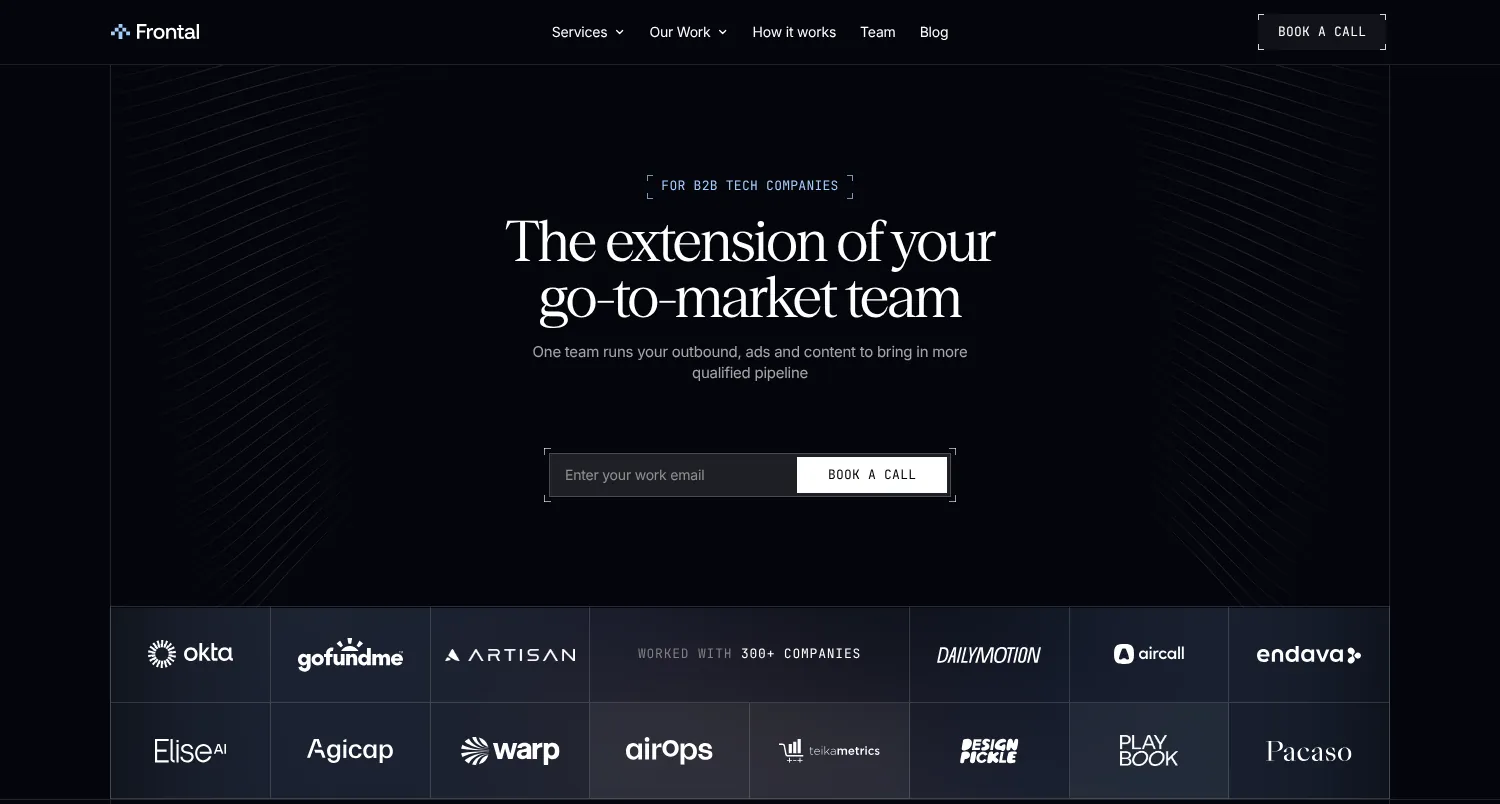
Frontal is a go-to-market partner for B2B tech companies past product-market fit with an established sales motion. We work as an extension of your go-to-market team and take ownership of the agreed execution across GTM Services, Account-Based Marketing, Paid Media, Content Engineering, and RevOps.
Lead enrichment sits inside GTM Services and RevOps. We clean and enrich account data, add fit and buying-signal context, write it back into HubSpot or Salesforce, and can stay on to run the workflows that use it. We’re a Clay Elite Studio Partner and have worked with 300+ B2B companies.
Frontal Key Services
Each workstream below can run independently, so you can start with the part of the data foundation that needs fixing first.
1. Define the Record Your Revenue Team Actually Needs
We start by defining the account and contact fields your GTM motion actually uses.
This can include:
- Company size and growth
- Industry and sub-industry
- Geography
- Technologies in use
- Funding and hiring activity
- Relevant decision-makers
- Current titles and seniority
- Email and phone availability
- Account ownership
- ICP fit criteria
We also identify duplicate properties, inconsistent definitions, stale values, and unclear field ownership before adding more data.
The result is a clear model for what each field means, where it comes from, and when it should be refreshed.
2. Waterfall Enrichment Across Multiple Data Sources
We can use Clay as the enrichment layer to check multiple data sources in sequence rather than relying on one provider for every field, geography, and company type.
The workflow can enrich:
- Company and firmographic data
- Current employment and titles
- Verified business emails
- Phone numbers
- Technologies in use
- Funding information
- Hiring activity
- Other attributes relevant to your ICP
If one source can’t return a reliable value, the workflow can move to the next.
Clay remains the enrichment and workflow layer. HubSpot or Salesforce stays the CRM and system of record.
For teams comparing specialists around this layer, see our guide to the best Clay automation agencies.
3. Add Fit and Timing to the Enriched Record
A complete record still doesn’t tell a rep whether an account deserves attention today.
We combine enrichment with two different questions:
- Does this account fit? Firmographic, technographic, regional, and other ICP criteria tell us whether the company resembles the customers you actually want.
- Is there a reason to act now? Funding, hiring, job changes, website activity, LinkedIn engagement, technology changes, and other signals can add timing to that fit.
Those layers can then feed a scoring model that separates:
- High-fit accounts showing a relevant signal
- High-fit accounts worth keeping warm
- Weak-fit accounts that shouldn’t consume sales time
- Existing records whose changing data creates a new opportunity
A senior operator can review priority accounts before the workflow moves them into action, so enrichment doesn’t automatically turn every changed field into a sales task.
Our roundup of B2B intent data providers covers the signal layer in more depth.
4. Write the Data Back and Put It to Work
Enrichment becomes much more useful when no one has to open a separate spreadsheet or Clay table to use it.
We write the agreed fields, scores, and context back into HubSpot or Salesforce under controlled rules. We can protect existing human-owned data while automatically updating missing or stale fields.
From there, the enriched record can drive action:
- Assign an account to the correct territory or owner
- Send a high-fit inbound lead to the right rep
- Alert sales when an existing target shows a buying signal
- Build a prioritized prospecting queue
- Sync an account into an ad audience
- Trigger relevant outbound
- Give reporting a cleaner segmentation layer
When GTM Services is in scope, our operators can run the outreach against those prioritized accounts. Account-Based Marketing and Paid Media can use the same target list, while Content Engineering can feed engagement data back into the motion. This way, enriched records don’t have to stop at being better records.
Frontal Pricing
Frontal doesn’t publish set pricing because the scope depends on your database’s state and size, the enrichment fields and sources involved, the workflows connecting the data to HubSpot or Salesforce, and how much ongoing operation you want us to own. Book a 30-minute call, and we’ll walk through what we’d take on.
Where Frontal Shines
- Senior operators embedded in your team: The same operators who define the data requirements can build the enrichment workflows, connect them to your CRM, and stay accountable for the agreed work.
- You keep what we build: The enrichment logic, data, and workflows live inside your own stack and are documented, so the system stays with your team if the engagement changes or ends.
- One account foundation across GTM: When GTM Services, Account-Based Marketing, Paid Media, or Content Engineering are also in scope, they can work from the same enriched accounts, scores, and CRM definitions.
Where Frontal Falls Short
- Not a bulk data vendor: If you only need a cheap CSV or a one-time export of enriched records, a standalone data provider is a better fit.
- Best once the ICP is proven: Frontal is built for post-PMF B2B tech companies that already know what a good customer looks like and need more execution capacity around the data layer.
Frontal Client Results
For Aircall, four separate data vendors and region-by-region manual research still hadn’t produced one trusted view of the market. Frontal created and enriched 3,655 accounts into a self-refreshing TAM over six months, standardized the data, graded each account against regional ICP criteria, and wrote the results back into Salesforce.
For Design Pickle, Frontal turned Clay from a basic list-building tool into the enrichment and qualification layer behind an outbound system connected to HubSpot. The program produced 58 demos in 14 days.
For AirOps, enriched account data supported an account-based system built inside HubSpot. The combined-channel engagement generated $7.83 million in qualified pipeline and $1.52 million in closed-won revenue over 10 months.
Read more Frontal case studies →
Who Frontal Is Best For
- Post-PMF B2B tech companies whose CRM data has become unreliable: The database already exists, but stale fields, inconsistent definitions, missing information, or duplicate records are getting in the way.
- Newly appointed revenue or growth leaders who need a usable account foundation quickly: You need the data cleaned, enriched, scored, and put into workflows without building a dedicated data-operations function first.
- Sales teams spending too much time researching accounts manually: Reps need useful company, contact, and signal context inside the CRM rather than across several separate tools.
- Companies that want enrichment to feed real GTM execution: The goal isn’t simply cleaner records. The data needs to support routing, prioritization, outbound, paid, or reporting.
Want your CRM data cleaned, enriched, and connected to the work your revenue team actually runs? Book a call, and we’ll walk through what the data needs to support and what we could own with your team.
2. RevPartners: Best for HubSpot Teams That Want Clay-Powered Enrichment Inside RevOps
RevPartners is an Elite HubSpot Solutions Partner and Clay Elite Studio that builds enrichment into a broader HubSpot-centered RevOps model.
Key Services
- CRM enrichment and data validation: Cleanse, standardize, update, and enrich existing HubSpot records so contacts and accounts stay segmentation-ready.
- Inbound enrichment and scoring: Automatically enrich new leads with firmographic, technographic, demographic, and intent data before scoring, segmentation, and routing.
- On-demand enrichment and assisted prospecting: Reps can request fresh company or contact data from within HubSpot and receive research, demographics, and account context without manually working across several data tools.
- Clay implementation and ongoing RevOps: RevPartners can connect Clay to HubSpot, build agreed GTM playbooks, and continue maintaining the CRM and surrounding revenue workflows through its retained RevOps model.
Pricing
RevPartners publishes several ways to buy enrichment-related work.
| Service | Pricing |
|---|---|
| Allbound Marketing including CRM Data Enrichment | From $12,900/mo |
| Clay implementation | $25,000 one-time |
| RevOps as a Service | From $9,850/mo |
| RevOps onboarding | $5,000 one-time |
Its $25,000 Clay implementation includes HubSpot + Clay integration and five selected playbooks. Allbound Marketing packages include CRM Data Enrichment alongside paid media, SEO/website work, and signal-based outbound, starting at $12,900 per month.
Where RevPartners Shines
- Deep HubSpot and Clay specialization in one team: RevPartners combines Elite credentials in both ecosystems, which suits companies that want enrichment built tightly around HubSpot rather than managed as a separate data project.
- Enrichment reaches the rep workflow: Its assisted-prospecting and on-demand use cases surface enriched information inside HubSpot, reducing the need for sellers to leave the CRM and research accounts manually.
- Inbound and outbound can share the same data layer: The same enrichment foundation can score inbound leads, prioritize target accounts, and support signal-based outbound.
- Ongoing RevOps is available after the build: Teams that don’t want to maintain the CRM and enrichment workflows themselves can retain RevPartners to keep operating the wider system.
Where RevPartners Falls Short
- Built around HubSpot: The model assumes HubSpot is the CRM at the center of the revenue stack. A Salesforce-committed team that doesn’t plan to migrate should look at other providers.
- Enrichment can come bundled with broader scope: Allbound packages combine CRM enrichment with several marketing and outbound services, while RevOps carries a six-month initial term. Teams needing only a contained enrichment project should compare that scope carefully.
Customer Reviews
“They do a fantastic job communicating progress, setting expectations, keeping projects on task and keeping us informed along the way,” says Meg Harrison.
“What they implemented was extremely complex, and they left us with no explanation. Three years later, we’re still deleting things they created because it caused more mess than anything else. It feels like they overcomplicated some pretty simple processes,” says Nicolas H.
Who RevPartners Is Best For
- Growth-stage and mid-market HubSpot teams that want enrichment embedded into a larger RevOps system: A strong fit when you want HubSpot and Clay working together across data cleanup, inbound scoring, prospect research, signals, and ongoing revenue operations.
3. Sculpted: Best for Teams That Need to Fix Broken CRM Data
Sculpted is a CRM data consultancy for B2B software teams that need existing account and contact data cleaned, enriched, validated, and handed back in a maintainable system.
Key Services
- CRM cleanup and account enrichment: Company records are audited, normalized, and enriched with fields such as industry, revenue, employee count, and technology usage before being scored and tiered.
- Contact verification and enrichment: Existing contacts can be checked against live employment data, updated with current titles, and enriched with verified emails, phone numbers, personas, and seniority.
- Custom enrichment logic and validation: Sculpted maps enrichment to the client’s ICP and CRM schema, then manually validates sample records for each property before rolling the workflow out across the database.
- Ongoing refreshes and optional signal workflows: Add-ons can refresh job changes, email validity, titles, employee counts, and other changing information on a recurring schedule, or add signal monitoring and inbound enrichment.
Pricing
Sculpted doesn’t publish a fixed price. Its CRM Cleanup Sprint is scoped as a fixed-price engagement after a diagnostic and scoping process. The foundation cleanup runs as two sprints, one for company records and one for contacts, while additional work such as ongoing signal monitoring, re-enrichment, or inbound enrichment is scoped separately.
Where Sculpted Shines
- CRM hygiene is the core service, not an add-on: Sculpted explicitly says it doesn’t run outbound for clients. It focuses on the data and workflows beneath the CRM, which suits teams that already have sales execution covered.
- Validation happens before full rollout: Enrichment logic is tested against manually reviewed sample records before the broader import, reducing the risk of scaling incorrect classifications across the database.
- The workflows are designed for client ownership: Builds live in the client’s Clay account and are delivered with Notion documentation, Loom walkthroughs, and ownership guidance so the team can maintain or extend them afterward.
- Strong fit for difficult legacy-data problems: Sculpted has success stories ranging from four-year-old CRM data to niche markets where standard databases didn’t provide reliable coverage.
Where Sculpted Falls Short
- No outbound execution: Sculpted deliberately stops at the CRM data and workflow layer. Teams that also want the partner to run outreach, ads, or a broader GTM motion will need that execution elsewhere.
- The service is purpose-built around Clay: If your organization can’t or doesn’t want to use Clay as the enrichment workflow layer, the model is less natural than a provider built around another data architecture.
Who Sculpted Is Best For
- B2B software teams whose immediate problem is stale, incomplete, duplicated, or poorly structured CRM data: Ideal when you already have the sales motion in place and want a specialist to rebuild the enrichment layer, validate it carefully, document it, and hand it back.
4. FullFunnel: Best for Enterprise Teams That Want a Managed Clay Data Engine
FullFunnel is a GTM and RevOps services firm for teams that want Clay enrichment operated as an ongoing data function rather than a one-time implementation.
Key Services
- Continuous CRM enrichment and hygiene: FullFunnel builds enrichment, deduplication, normalization, and refresh workflows that keep account and contact records current rather than treating cleanup as a one-off project.
- ICP scoring and signal capture: Enriched records can be scored against ICP rules and monitored for events such as job changes, funding, hiring, and technology shifts, creating a live readiness layer on top of the CRM.
- Clay engineering and CRM integration: Its engineers build enrichment tables, waterfalls, scoring models, routing, and CRM writeback for HubSpot or Salesforce, with monitoring and QA around the workflows.
- Managed data operations: FullFunnel can continue running the system after implementation, including day-to-day Clay administration, workflow monitoring, refresh cadence, and ongoing changes as the data model evolves.
Pricing
FullFunnel publishes fixed pricing for its standalone Clay Data Engine.
| Component | Pricing |
|---|---|
| Implementation | $15,000 |
| Ongoing management | $3,600/mo from month 2 |
| Included support | 10 hours/mo |
| Total first-year engagement | $54,600 |
The service includes a 60-day stand-up, documented system blueprint, continuous management, and ongoing support. Other FullFunnel RevOps, GTM Engineering, and managed-support work is scoped separately.
Where FullFunnel Shines
- Someone remains accountable after implementation: The model is built around an ongoing Engineer of Record rather than a one-time Clay setup that becomes the client’s maintenance problem after handoff.
- Enrichment stays continuously active: Records are refreshed as they age, while changing signals can alter account scoring and trigger new workflows instead of leaving the CRM to decay after the initial cleanup.
- Strong operational depth around the data layer: FullFunnel also handles dedupe, CRM writeback, signal routing, monitoring, QA, and workflow maintenance, which suits teams whose enrichment problem has become infrastructure rather than list building.
Where FullFunnel Falls Short
- The managed Data Engine is a meaningful commitment: At $54,600 for the first year, the standalone program is built for teams that need enrichment maintained as an ongoing function. A company needing a small, one-time database cleanup can buy less infrastructure elsewhere.
- Broader than a simple enrichment project: FullFunnel spans GTM Engineering, RevOps, CRM management, automation, and demand generation. That breadth is useful when enrichment touches the wider revenue stack, but can be more scope than a narrow data job calls for.
Customer Reviews
“The FullFunnel team is very active and engaged at all times, ensuring that they’re up to date with business needs and setting clear expectations, while staying adaptable to what is always a changing situation in early-stage companies,” says Jay K.
“The customization of reports and tasks could be more visual,” says Fletcher T.
Who FullFunnel Is Best For
- B2B teams that want enrichment operated as an ongoing data function: Particularly useful when the problem includes continuous CRM maintenance, scoring, signals, monitoring, and workflow ownership rather than a one-time enrichment sprint.
If the enrichment problem is part of a larger operations gap, our guide to the best GTM consulting services compares partners that can take on broader GTM execution.
5. Go Nimbly: Best for Enterprise Enrichment That Needs Broader RevOps Architecture
Go Nimbly is a RevOps consultancy for mid-market and enterprise SaaS teams where enrichment is tied to a larger data, governance, scoring, and revenue-systems problem.
Key Services
- CRM hygiene and continuous enrichment: Automated workflows dedupe records, fill missing fields, match leads to accounts, and keep HubSpot or Salesforce current as underlying company and contact information changes.
- Waterfall enrichment and data architecture: Go Nimbly builds waterfalls across multiple providers, including regional sources and web research, while designing the sequencing around coverage and credit cost.
- First- and third-party data unification: Product usage, firmographic data, personas, and behavioral signals can be combined into one account view and written back into the CRM.
- Scoring, signals, and enterprise governance: Fit, intent, product behavior, territory logic, and custom signals can feed account scoring, while backups, QA, workspace structure, deployment rules, and cost controls keep a larger Clay environment manageable.
Pricing
Go Nimbly doesn’t publish set pricing. Its Clay work is packaged by complexity:
- Foundations: One to two core use cases, governance setup, and training, with an average three-month engagement.
- Growth: Two to three use cases, cross-team governance, and stakeholder alignment, typically over four to six months.
- Enterprise: A full Clay center of excellence with roadmap, phased rollout, change management, and ongoing optimization, typically running six months or longer.
Contact Go Nimbly for a quote.
Where Go Nimbly Shines
- Enterprise governance is built into the enrichment architecture: Waterfall sequencing, credit control, structured workspaces, backups, deployment practices, and QA reduce the risk of Clay becoming an expensive collection of disconnected tables.
- Enrichment can include first-party behavior: Product usage from systems such as a data warehouse can sit alongside firmographics, personas, and external signals, which is valuable for product-led and hybrid SaaS motions.
- The RevOps bench goes far beyond enrichment: Go Nimbly has 100+ RevOps experts across architecture, consulting, technical program management, and strategic leadership, so adjacent CRM, routing, CPQ, or pipeline problems can stay within the same partner.
Where Go Nimbly Falls Short
- Built for larger RevOps problems: The architecture, governance, and cross-functional change-management model suits mid-market and enterprise organizations. A team that simply needs to refresh several thousand contacts may find the approach heavier than necessary.
- Clay work is designed as part of the wider revenue architecture: That is a strength when several GTM systems need to work together, but less compelling for a buyer looking only for a contained data-enrichment deliverable.
Customer Reviews
“Go Nimbly helped to identify the costly operations and the overhead costs working with our team and helping us save money,” says ShriRam g.
“It took us a bit to get into the right rhythm,” says Andrew J.
Who Go Nimbly Is Best For
- Mid-market and enterprise SaaS teams where enrichment has become a RevOps architecture problem: A strong fit when the work also involves governance, first-party data, scoring, routing, product signals, territory design, or several connected GTM systems.
For a broader comparison of firms operating across those systems and processes, see our guide to the best RevOps agencies.
6. andweekly: Best for DACH Teams That Need HubSpot + Clay Enrichment for European Markets
andweekly is a German B2B GTM agency that uses Clay as the data and signal layer around HubSpot, with a particular focus on enrichment for DACH markets.
Key Services
- Account and contact enrichment: andweekly builds Clay workflows that combine multiple data sources into a more complete account picture before qualified information moves into HubSpot.
- ICP scoring and signal architecture: Combine firmographic fit with triggers such as hiring activity, funding, leadership changes, technology moves, and other market signals to decide which accounts deserve attention.
- Inbound enrichment and sales handoff: Enrich form fills and other inbound leads with company, role, buying-group, and signal context before sales receives them.
- HubSpot integration and GTM operations: Enriched records, scores, and trigger logic flow into HubSpot, where sales workflow, automation, reporting, and ongoing optimization continue.
Pricing
andweekly doesn’t publish fixed pricing for lead enrichment or Clay implementation. Engagements are scoped around the GTM architecture, HubSpot environment, enrichment requirements, signals, and other services involved. Contact the team for a quote.
Where andweekly Shines
- Strong DACH orientation: andweekly builds its enrichment and signal model specifically around German-speaking B2B markets rather than assuming US data coverage and buying behavior translate directly.
- Clear division between Clay and the CRM: Clay handles data, enrichment, and signals, while HubSpot remains the system of record for pipeline, automation, and reporting. This makes each platform’s role easy for revenue teams to understand.
- Enrichment connects to the wider account motion: Enriched data can feed scoring, inbound qualification, signal-based outbound, and account-based campaigns rather than staying as a standalone research project.
Where andweekly Falls Short
- HubSpot sits at the center of the model: andweekly’s GTM Engineering approach is explicitly built around HubSpot as the system of record. Salesforce-led organizations are outside the most natural fit.
- Broader than a pure data specialist: andweekly also works across strategy, content, paid media, CRM, and demand generation. A buyer whose only goal is a contained CRM cleanup may prefer a more narrowly focused enrichment consultancy.
Customer Reviews
“andweekly’s team is always helpful and responds quickly. They identify problems and address them in meetings, taking the time to do so,” says Tatjana Seidel.
“They could partially be more proactive in challenging and supporting our marketing strategy,” says Thomas Peischl.
Who andweekly Is Best For
- B2B teams selling into Germany, Austria, or Switzerland that use HubSpot and need a stronger enrichment and signal layer: Ideal when European data coverage, regional targeting, and the handoff from Clay into HubSpot are central to the problem.
How to Choose a Lead Enrichment Service
Start with your current data problem and what the enriched record needs to do afterward.
1. Decide Whether You Need a Cleanup or Continuous Enrichment
A CRM full of duplicates, stale titles, missing company information, and inconsistent fields may need a concentrated cleanup first.
If the same data drives sales and marketing every day, though, the system also needs a way to keep changing fields after the initial project ends.
Ask whether the provider is delivering:
- A one-time cleanup
- Recurring refreshes
- Always-on enrichment
- Ongoing workflow ownership
Sculpted focuses on the cleanup-and-handoff model, while FullFunnel, Go Nimbly, RevPartners, and Frontal can support ongoing enrichment in different ways.
Frontal fits when the enriched data also needs to support an active GTM motion.
2. Test the Provider Mix Against Your Actual Market
No data source has equally strong coverage for every field, geography, or company type.
Before buying, give each shortlisted provider a representative sample of accounts and ask:
- Which fields can you fill reliably?
- Which sources produce each value?
- What happens when the first source returns nothing?
- How do you verify employment and contact data?
- How are conflicting values resolved?
- Which CRM fields can be overwritten?
- How does coverage change by geography?
A waterfall can improve coverage, but only when the provider order and update rules are designed around the fields your team actually uses.
Frontal starts with those commercial requirements, then builds the enrichment logic around them.
3. Ask What Happens After the Record Is Enriched
The final output could be a CSV, a cleaner CRM record, a score, a routed lead, an alert, or an automated GTM action.
The right model depends on what your internal team can already operate.
Also ask who owns the enrichment workflows after launch. Can your team see the logic, change the scoring model, and keep the system running if the engagement ends?
Frontal builds around HubSpot or Salesforce as the system of record and can keep operating the agreed RevOps and GTM workflows afterward.
If enrichment ultimately feeds automated prospecting, our comparison of the best sales automation agencies covers the next layer.
How Much Do Lead Enrichment Services Cost in 2026?
Lead enrichment services use very different commercial models. A fixed cleanup sprint is priced differently from a Clay implementation, while an always-on enrichment engine usually carries an ongoing monthly or annual fee because someone is maintaining the workflows as the data changes.
Here is how the six providers compare as of October 2026:
| Provider | Pricing as of October 2026 |
|---|---|
| Frontal | Custom, scoped on a call |
| RevPartners | Allbound including CRM enrichment from $12,900/mo; Clay implementation $25,000; RevOps from $9,850/mo |
| Sculpted | Custom fixed-price CRM Cleanup Sprint |
| FullFunnel | Clay Data Engine: $15,000 implementation, then $3,600/mo from month 2; $54,600 for the first year |
| Go Nimbly | Custom, scoped by implementation or ongoing RevOps engagement |
| andweekly | Custom, scoped per engagement |
The price is only meaningful once you know what continues after delivery. Ask whether the quote covers data-provider costs, Clay credits, CRM integration, deduplication, field mapping, validation, ongoing refreshes, signal monitoring, documentation, and post-launch maintenance. A lower project fee can become expensive quickly if your team inherits several data subscriptions and a workflow nobody has time to run.
So, Which Lead Enrichment Service Is Right for You?
The right lead enrichment partner depends on whether the problem is a dirty CRM, continuous data maintenance, enterprise governance, regional coverage, or turning better data into GTM action.
Frontal is for post-PMF B2B tech teams that want enrichment connected to the revenue motion around it. Our operators clean and enrich the account foundation, add fit and buying context, write the useful data into HubSpot or Salesforce, and can stay on to run the agreed workflows.
When GTM Services, Account-Based Marketing, Paid Media, or Content Engineering are also in scope, they can work from that same account foundation instead of creating separate datasets and priorities.
If your CRM has plenty of records but too little information you can confidently act on, book a call with Frontal, and we’ll walk through the fields, signals, and workflows worth fixing first.
FAQs
1. What data can a lead enrichment service add?
Common fields include company size, industry, revenue, technologies used, location, funding, job title, seniority, work email, phone number, LinkedIn profile, and relevant buying signals.
2. How often should B2B lead data be enriched?
Continuously or on a regular refresh schedule. Contact and company information change throughout the year, so monitor and refresh key CRM fields based on how quickly they decay and how heavily your workflows depend on them.
3. What is waterfall enrichment?
Waterfall enrichment checks multiple data sources in sequence. If the first source can’t find a reliable value, the workflow tries the next provider until it fills the field or exhausts the available sources.
4. Does lead enrichment replace intent data?
No. Enrichment tells you more about the person or company. Intent and buying signals add context about what that account may be doing now. Combining the two can improve prioritization.
5. Should enriched data automatically overwrite CRM fields?
Not always. Update rules should distinguish missing, stale, system-owned, and human-verified fields so automated enrichment improves the CRM without replacing trusted information.