Key Takeaways
- Pre-seed and seed: KEXINO for funded B2B teams fixing positioning first, Blazon for consumer launches. Seed to Series A: G2M Team for a first messaging sprint. Past product-market fit: dimartec for a six-month revenue build, or Division of Labor after a Series B.
- Six of the ten publish a price on their own pages. The lowest monthly figure is 3rd + Taylor’s early-stage option, $1,500 a month plus a revenue share.
- Nine firms publish a client outcome with a figure, each counting something different, from Kickstarter pledges to organic signups. KEXINO’s startup case counts a turnaround, and Frontal’s closest case, Chamelio, counts meetings booked from one conference list.
This list sorts ten marketing agencies for startups into three stage groups, using each firm’s own words where it names a stage. The shortlist is KEXINO, Blazon, G2M Team, Concurate, Stackmatix, dimartec, Division of Labor, 3rd + Taylor, Skale and our own firm. Each entry reports the stage evidence, what the firm does first and its published price.
We run Frontal, the go-to-market partner for B2B tech companies, working as an extension of your team. It sits last in the third group by choice.
Every fact about the ten firms comes from their own pages, and prices are as published, checked November 5, 2026. Quick test sprints are a separate purchase: growth hacking agencies run cheap experiments against one early metric.
Match the Agency to the Stage You’re At
Each stage asks for different work. Around a first round, the job is positioning, a brand, a site and a launch. Between seed and Series A, it’s a sharper message and one acquisition channel that repeats. Past product-market fit, marketing looks more like growth marketing: a longer program across channels, judged on pipeline or revenue.
Founders notice the split when they shop. In a startup thread on Reddit, one commenter said agencies for tiny, fast companies and for “pretty big” ones are different models: “To me, those are two entirely separate things.” It’s one person’s view, but it matches how the firms here describe themselves.
More than half of new business establishments close within five years, so early marketing money has to buy what the current stage needs. The Bureau of Labor Statistics followed the 839,297 private-sector establishments that opened in the year to March 2021. By March 2026, 47.2% were still operating.
In the information sector, the closest BLS category to software, 41.4% survived. The data covers establishments in all industries, not only venture-backed startups, so read it as a base rate rather than a forecast for any one company.
How We Grouped and Ordered These Startup Marketing Agencies
We started from the pages ranking for this search, then read each candidate’s own startup, pricing and FAQ pages. Many digital marketing agencies for startups say “startups” on the homepage, so we looked for the page that says which ones.
We left out software, directories, freelancer marketplaces, accelerators and solo consultants. Outsourced sales teams and appointment setting services are out too, since they sell booked meetings rather than marketing. Every entry is a firm with staff, though Stackmatix and 3rd + Taylor name only their founder publicly, and their entries say so.
The ten firms fall into three stage groups: pre-seed and seed, seed to Series A, and startups scaling a proven product. The groups aren’t ranked against each other, so the numbers only set reading order.
Inside each group, firms are ordered by how precisely their own pages state the stage they take, not by results. A named round or a revenue band comes first, then a stated entry condition, then a slogan or copy that only implies a stage. Frontal is last in its group because it’s ours.
Marketing Agencies for Startups Side by Side
Rows run in entry order, and each cell paraphrases or quotes the firm’s own pages.
| Agency | Stage group | Stage it takes (its words) | What it does first | Price signal | Published result (what it counts) |
|---|---|---|---|---|---|
| KEXINO | Pre-seed and seed | Funding “in place (or almost)” and an MVP | Discovery and diagnosis | No published rate; fixed project fee | None; Ecosis case counts a two-week turnaround |
| Blazon | Pre-seed and seed | “From first pitch to first million in revenue” (a slogan) | Build phase: research, positioning, launch assets | No published rate; form band from $10,000 | Filippo Loreti: $5.1M Kickstarter pledges in 30 days |
| G2M Team | Seed to Series A | “from post Seed to Series A” | Stealth messaging sprint, 1 to 2 months | Sprint about $5,000 to $10,000 | Firedome: Series A within a year (a funding milestone) |
| Concurate | Seed to Series A | “initial Seed- or Series A funding” | Customer research, then bottom-funnel keywords | $5,000 to $7,500 a month; projects from $3,500 | Fintech: 24 of 29 inbound leads from three articles |
| Stackmatix | Seed to Series A | “startups and scaleups” (a slogan) | Find the constraint, then plan the test | Paid media $6,000 a month or 15% of spend; SEO from $3,000 a month | RapidFort: CAC down 37%, no window |
| dimartec | Scaling a proven product | $500K to $10M ARR, “raising seed through Series B” | The Diagnostic: audits and a roadmap | €4k to €7k per project; €5k to €15k a month | Fintech: 40 new clients, no exact window |
| Division of Labor | Scaling a proven product | “obtained Series B funding” | Brand strategy, then campaign ideas | Packages from $19,450; $245 an hour beyond scope | Stytch: 83% more web traffic in week one |
| 3rd + Taylor | Scaling a proven product | “B2B companies that have product-market fit”, plus a pre-seed and seed option | Revenue Growth Audit, 30 business days | Audit $8,500; retainer from $6,000 a month | SaaS firm: demo bookings up 426% in 30 days |
| Skale | Scaling a proven product | None stated; pitches CMOs with an ARR gap | A three-month SEO plan | No published rate | Maze: organic signups up 283%+ in under 6 months |
| Frontal | Scaling a proven product | “past product-market fit with a real sales team” (an example) | Review who already buys, then pick accounts and channels | No published rate | Chamelio: a booked meeting every 4th message from one conference list, 10 months (counts meetings) |
Prices keep each firm’s own units and currency. The result column mixes pledges, leads, traffic and signups, so check what each figure counts before comparing.
G2M Team, 3rd + Taylor and Frontal all list outbound or ABM work, yet no column covers the contact data behind it. Ask who supplies the records and who checks them, and get lead enrichment in place before sending at volume.
Agencies for Pre-Seed and Seed Startups
KEXINO and Blazon take founders around their first raise, and both start with positioning. KEXINO comes first because it states an entry condition: funding in place and an MVP built. Blazon’s line spans idea to early revenue without naming a round.
A commenter in an r/startups thread made the same case: branding, meaning who you are and what problem you solve, must come before creative for channels. Otherwise everyone is “guessing” the messaging. That’s one commenter’s advice, not a study.
If you still sell through your own network, Frontal’s free founder connections play is a six-step outbound recipe for email and LinkedIn. It runs from exporting the founder’s connections to routing them by tier.
1. KEXINO, Best for Funded B2B Startups Fixing Positioning First
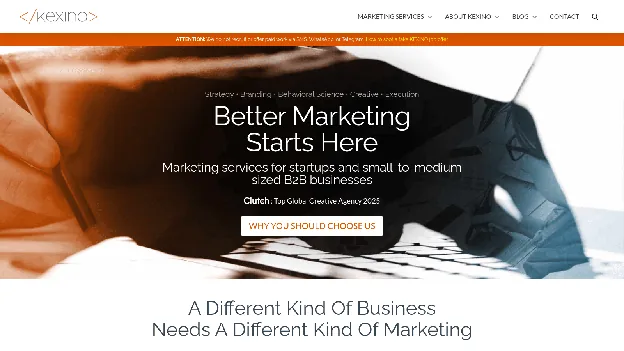
Best for: Funded B2B startups that need positioning settled before channel spend.
Based in: Pfettisheim, France. Its about page counted “19 associates located across nine countries” on November 5, 2026.
Stage it takes: “There has to be some kind of funding in place (bank loan, family money, angel, VC, PE, grant, whatever).” It also wants a product, “or at least, the MVP,” and turns away bootstrapped side projects.
What it does first: “Every engagement starts with Discovery and Diagnosis.” No length is stated.
How you work with it: Fixed-fee projects, with “no long term contracts, retainers, or commitments.”
Published result (what it counts): No client outcome. Its startup case, Canadian construction startup Ecosis, got a logo, stationery and a website in two weeks, so its only figure is turnaround time.
Where it’s strong:
- Positioning work. Its branding service covers market research, segmentation, targeting and positioning.
- B2B focus. Its startup page is written for funded B2B startups and rules out consumer launches.
Watch for:
- No pitches. It doesn’t take part in requests for proposals, tenders or pitches.
- Ads named, not detailed. Its startup page lists “Paid advertising” without naming a platform.
Price: No published rate. Its FAQ rules out a price list, packages and an hourly rate.
2. Blazon, Best for Consumer Startups Planning a Crowdfunded Launch
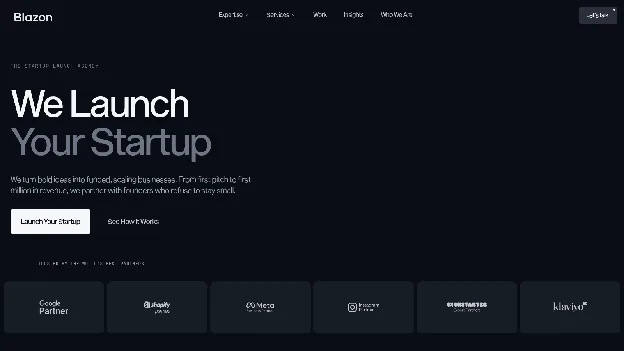
Best for: Consumer product startups planning a crowdfunded or direct-to-consumer launch.
Based in: London, with a second office in New York.
Stage it takes: “From first pitch to first million in revenue,” a slogan that spans idea to early revenue. It scopes crowdfunding only where a product can “realistically support a six-figure raise.”
What it does first: A Build phase of 6 to 24 weeks covering research, positioning, a pre-launch audience, a campaign page, video and ad creative.
How you work with it: A fixed-scope project of three to six months, or a full launch of 9 to 18 months.
Published result (what it counts): Crowdfunding pledges for a consumer product. Watch brand Filippo Loreti reached “$5.1M on Kickstarter in 30 days.”
Where it’s strong:
- You keep the assets. Every asset “belongs to the client,” with direct access to the ad and store accounts.
- Fundraising support. It also designs pitch decks and prepares data rooms.
Watch for:
- Consumer first. Its pages name no B2B demand generation, ABM or outbound work.
- No SEO service. The pages we read list no SEO or content program.
Price: No published rate. The lowest agency-fee band on its contact form is $10,000 to $25,000, a form option rather than a price.
Agencies for Seed to Series A Startups
G2M Team and Concurate both name seed and Series A on their own pages. G2M Team leads because it also sells packages named by stage, from stealth to post-launch. Stackmatix names no round, and its monthly, one-channel offer is what places it here.
None of the three lists cold email as a service. If outbound email is your first repeatable channel, cold email agencies sell that work on its own.
3. G2M Team, Best for Post-Seed B2B Startups Preparing a Launch
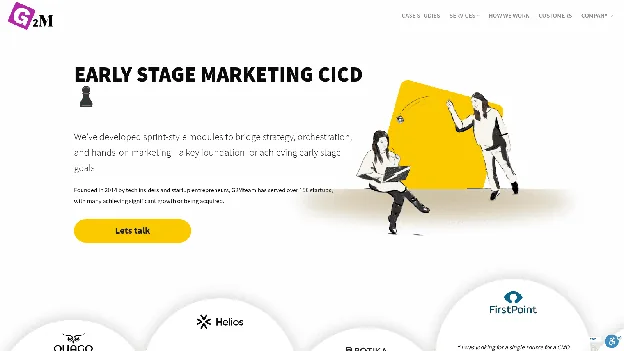
Best for: Post-seed B2B startups shaping their first message and launch.
Based in: Tel Aviv, Israel.
Stage it takes: It helps “early-stage startups from post Seed to Series A,” with stealth, out-of-stealth and post-launch packages. It joined Firedome “soon after they completed their seed round.”
What it does first: A “Minimum Viable Marketing Sprint” of about one to two months: competitive analysis, a messaging sprint, basic pitch materials and quick tests.
How you work with it: Fixed sprints, then ongoing support such as “CMO as a service,” with no published notice period.
Published result (what it counts): Firedome “secured their Series A funding round much earlier than expected,” under a year after G2M Team started. It’s a funding milestone, not a marketing result.
Where it’s strong:
- Launch in one package. Messaging, a mini-site, social channel setup and launch PR sit in its out-of-stealth package.
- Sales alignment. It lists “ABM list building” and work with “your sales and SDR teams.”
Watch for:
- B2B and developer tools only. It serves “B2B or B2D startups.”
- A long full launch. Its full out-of-stealth service is estimated at two and a half to three and a half months.
Price: The stealth sprint costs about $5,000 to $10,000, depending on scope. Its other packages carry no published rate.
4. Concurate, Best for SaaS Startups Building Bottom-Funnel Content First
Best for: Seed and Series A SaaS teams making content their first inbound channel.
Based in: Panchkula, India.
Stage it takes: “You are a B2B SaaS company with initial Seed- or Series A funding,” says its homepage. Its fintech case study states the client’s $15.8M venture round.
What it does first: Research, since it won’t “write a single word” until it understands your product, customers and competitors. Its case then targeted best-of, alternative and comparison keywords.
How you work with it: A monthly partnership or a project, with clients spending “under two hours a month” on reviews.
Published result (what it counts): An unnamed AI fintech got 24 of 29 inbound leads from “just three high-ranking blogs,” over a period the case doesn’t state.
Where it’s strong:
- AI search in scope. It benchmarks visibility across Google, ChatGPT, Perplexity, Gemini and Claude.
- Founder content. It ghostwrites LinkedIn posts for founders.
Watch for:
- One channel. Its service menu lists no paid ads, PR or email work.
- B2B SaaS only. Its homepage addresses B2B SaaS companies, and its track record is “US-based PatentTech, FinTech, and CXTech brands.”
Price: Partnerships “often range” from $5,000 to $7,500 a month, and projects start at $3,500.
5. Stackmatix, Best for Startups Buying Paid Ads Month to Month
Best for: Startups that want one paid channel run month to month.
Based in: San Francisco, the contact address in its privacy policy.
Stage it takes: No round or revenue band. Its homepage pitches “ambitious startups and scaleups,” a slogan rather than a stage.
What it does first: “Find the Constraint,” then “Build the Plan,” which defines the test and agrees on “the evidence that matters.”
How you work with it: Paid media runs “Month-To-Month” on Google, LinkedIn, Meta, Reddit, TikTok, X and ChatGPT.
Published result (what it counts): RapidFort’s VP of Marketing says “Our CAC dropped by 37%,” a cut in acquisition cost with no time frame given.
Where it’s strong:
- Prices in public. Paid media, SEO and creative each carry a published figure.
- A cheap creative test. Six static ad creatives cost $1,500, with no media retainer required.
Watch for:
- Founder named only. Its pages name only co-founder and CEO Matt Pru, so ask who would run your account.
- No brand or website work. Its pages describe no positioning, website or PR service.
Price: Paid Media Management costs $6,000 a month or 15% of media spend, whichever is greater, on its pricing page as checked November 9, 2026. SEO / AEO Backlink Building runs $3,000 to $6,000 a month, by backlink count.
Agencies for Startups Scaling a Proven Product
dimartec and Division of Labor name rounds on their own pages, and dimartec adds a revenue band, so it leads. 3rd + Taylor states product-market fit as its entry condition. Skale names no stage, and its place rests on copy aimed at teams with revenue targets. Frontal follows because it’s our firm.
Once a sales team exists, each lead marketing brings in has to reach the right salesperson quickly. That routing and follow-up is sales workflow automation, so ask any agency here who builds it.
6. dimartec, Best for Post-PMF SaaS and Fintech Teams Wanting a Six-Month Build
Best for: Post-PMF SaaS and fintech startups that want a fixed six-month revenue build.
Based in: Vilnius, Lithuania.
Stage it takes: Most clients are post-product-market-fit startups at $500K to $10M in annual recurring revenue, “raising seed through Series B.” Pre-revenue teams are “probably too early,” it says.
What it does first: The Diagnostic, a set of audits covering conversion, paid media, AI search and positioning. It promises “a roadmap with milestones in the first two weeks.”
How you work with it: A fixed six-month model that hands your team the system at the end, plus quarterly in-person workshops.
Published result (what it counts): The COO of an unnamed payments fintech says “we added 40 new clients” in the months after launch, without an exact window.
Where it’s strong:
- Tracking from day one. Attribution sits “in the core build from the start.”
- Fundraising story. Its funding service writes a fundraising narrative and pitch decks.
Watch for:
- Guarantee terms unpublished. Its homepage offers 10% pipeline growth in six months or €10k, and no terms page sets out the conditions.
- No social or PR. Its service pages name no social media or PR work.
Price: In euros, The Diagnostic costs €4k to €7k per project and its monthly growth program €5k to €15k a month.
7. Division of Labor, Best for Series B Startups Launching a Brand Campaign
Best for: Series B startups ready for a brand and out-of-home campaign.
Based in: San Francisco.
Stage it takes: “We specialize in working with Startups who have obtained Series B funding from outside investors.” It names Stytch, which it worked with “After Stytch got their Series B funding.”
What it does first: Brand strategy workshops, then “two to three campaign ideas and executions.”
How you work with it: Fixed-rate campaign packages, each “scoped individually,” or full-service work by “Small, senior teams.”
Published result (what it counts): Stytch’s outdoor campaign brought an “83% increase in web traffic in the first week.” That counts website traffic, not signups or pipeline.
Where it’s strong:
- Out-of-home work. Stytch’s campaign ran on San Francisco bus shelters and billboards.
- Brand from scratch. Brand strategy, positioning, messaging and taglines are a stated service.
Watch for:
- Production extras. Photography, graphics and artwork are estimated separately, and printed outdoor work is charged per location.
- No demand generation. Its pages list no email, ABM or outbound service.
Price: Its campaign packages start at $19,450 for digital, $19,750 for radio, $19,950 for social and $23,700 for outdoor. Extra work costs $245 an hour per person.
8. 3rd + Taylor, Best for B2B Teams Launching a Campaign System in 45 Days
Best for: Funded B2B teams that want a campaign system launched in 45 days.
Based in: North Miami, Florida.
Stage it takes: “We work with B2B companies that have product-market fit and want to kickstart or make pipeline more predictable.” An early-stage option is “Built for pre-seed and seed.”
What it does first: A Revenue Growth Audit that “delivers a 90-day prioritized roadmap” in 30 business days. Its fee counts toward Campaign Engine, a 45-day campaign build.
How you work with it: Audit, build, then an optional retainer called Momentum. Its terms set 30 days’ written notice for month-to-month work.
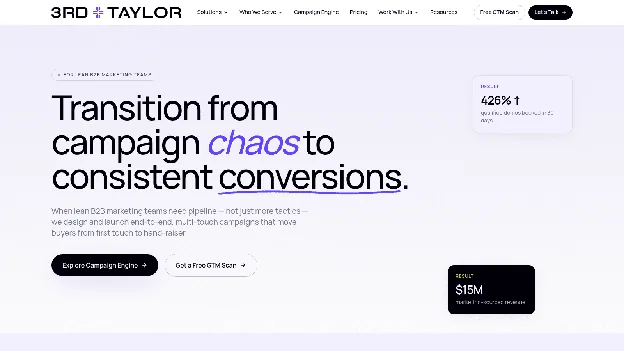
Published result (what it counts): The firm reports that an unnamed B2B SaaS company “increased qualified demo bookings by 426% in just 30 days.” The case credits “the marketing team” without saying whose.
Where it’s strong:
- Full B2B stack. It lists demand generation, account-based marketing and “Personalized outbound at scale.”
- Venture-backed clients. It says about 60% of its client base is VC-backed.
Watch for:
- One public name. Founder and CEO Tiffany Huddleston Nwahiri is the only person its pages name, and it uses “overseas and international resources” for delivery.
- No PR or social. Its capability list names neither.
Price: The Revenue Growth Audit costs $8,500 and Campaign Engine Launch starts at $18,500, with larger builds from $24,500 and $39,500. Momentum starts at $6,000 a month, and the early-stage option at $1,500 a month plus revenue share.
9. Skale, Best for SaaS Teams Turning Organic Search Into Pipeline

Best for: SaaS teams that want organic search to produce qualified pipeline.
Based in: No address is published on its contact, privacy, team or home pages.
Stage it takes: None stated. Its homepage addresses CMOs who want to “Fill your marketing-sourced ARR gap,” and a client quote there calls Holded “a fast-moving startup with a growing marketing team.”
What it does first: A three-month plan for current content, new content and links. “In a matter of weeks, you have a 6+ person SEO growth team,” its homepage says.
How you work with it: An embedded team that works every day, with no published minimum term.
Published result (what it counts): A case study title says Maze grew “monthly organic signups by more than 283% in under 6 months.”
Where it’s strong:
- AI search included. Its services cover generative engine optimization and AI brand mentions.
- A visible team. Its team page named more than 20 staff on November 5, 2026.
Watch for:
- SEO only. It lists no paid, social or email service.
- Pipeline promised, signups shown. It focuses on “SQLs, pipeline, and revenue over traffic and rankings,” yet its published results count signups.
Price: No published rate on its homepage, SaaS SEO, contact or team pages.
10. Frontal, Best for Post-PMF B2B Tech Startups With a Sales Team

Best for: B2B tech startups past product-market fit with a real sales team, often at the point where founder-led sales stops scaling.
Based in: Headquarters in Shanghai, with a remote team.
Stage it takes: Frontal is our firm. It works with B2B tech companies past product-market fit with a real sales team, for example when founder-led sales stops scaling or the team is entering a new market.
What it does first: A review: “We look at who’s already buying from you and where demand is real.” Then, “We help you choose the accounts, buyers and channels to go after, then build and run the outbound, ads and workflows with your team.” You agree together where to start: “outbound, ads or both.”
How you work with it: Most clients start with one service, such as outbound, paid media or content. Frontal’s operators build the work inside your CRM and tools, and you keep the sales conversations.
Published result (what it counts): Chamelio, a legal tech company of 11 to 50 people whose CEO had been running outbound himself, moved to a signal-based outbound system over 10 months. Its best list, built from one conference’s attendees, booked a meeting for every fourth message sent. That counts meetings from one list, not pipeline. At the end, the Clay tables, templates and email setup went to Chamelio’s own team. In its engagements, Frontal is “responsible for qualified pipeline.”
Where it’s strong:
- Systems in your own tools. Its GTM engineering team builds the lists, signal tracking and workflows in your CRM and the tools agreed for the engagement.
- Content and ads as well. Its Content Engineering team interviews founders and writes their LinkedIn posts and the articles buyers find in Google and ChatGPT. Its Paid Media team runs LinkedIn and Google ads and tracks each campaign in your CRM.
- A documented handoff. “If you’d rather run it yourselves, we build it with your team and document the handoff.”
- Partner credentials. Its badges include Clay Elite Studio Partner, HubSpot Solutions Partner and Salesforce Partner.
Watch for:
- No brand, website, PR or launch work. No page on frontal.so offers them. KEXINO, Blazon and G2M Team cover that ground.
- No published rate. The fee is set after scoping on a call, so you can’t compare it with the published prices above until you’ve spoken to Frontal.
Price: No published rate. The fee follows the scope you agree with Frontal on a call, and your ad budget is paid separately from it.
If you have a sales team and founder-led selling no longer fills its calendar, book a call to work out which accounts and channels to start with.
What Marketing Agencies for Startups Charge
Six of the ten firms publish a price, from a $499 report to a $39,500 campaign build, checked November 5, 2026.
| Agency | Published price | Unit and terms |
|---|---|---|
| G2M Team | About $5,000 to $10,000 | One stealth-mode sprint, depending on scope |
| Concurate | $5,000 to $7,500; projects from $3,500 | Per month for partnerships; per project |
| Stackmatix | Paid media $6,000, or 15% of spend if greater; SEO from $3,000; creative $1,500 | Paid media month to month; SEO per month; creative one-off |
| dimartec | The Diagnostic €4k to €7k; monthly growth program €5k to €15k | Per project; per month, in euros |
| Division of Labor | Packages from $19,450 to $23,700; $245 an hour beyond scope | Per campaign package; per person for extra work |
| 3rd + Taylor | Report $499; audit $8,500; builds from $18,500, $24,500 and $39,500; retainer from $6,000; early-stage option from $1,500 plus revenue share | One-off fees; retainers per month, 30 days’ notice |
| KEXINO, Blazon, Skale, Frontal | No published rate | Quoted per project or after a call |
The table doesn’t convert euros to dollars. Before comparing totals, add what sits outside each fee: ad spend at Stackmatix, a revenue share on 3rd + Taylor’s early-stage option and production costs at Division of Labor.
At Frontal, most clients start with one service from its service list, priced once the scope is agreed on a call.
The usual alternative to an agency is a first marketing hire. The Bureau of Labor Statistics reports that “The median annual wage for marketing managers was $166,790 in May 2025.” That’s salary alone, before benefits, payroll taxes and recruiting.
A year of Concurate at the top of its range is $90,000, and a year of Stackmatix paid media at its floor is $72,000 before ad spend. Each buys one channel run by a team, while a hire gives you one person who can own marketing for years. An agency still takes some of your team’s time: Concurate puts client reviews at “under two hours a month.”
How to Vet a Startup Agency Before You Sign
Put three questions to every finalist in writing.
Ask What It Does in the First Month
Ask for the first deliverable, its length and who does the work. G2M Team’s stealth sprint runs about one to two months, 3rd + Taylor’s audit takes 30 business days and dimartec promises a roadmap in two weeks. KEXINO states no length.
If outbound is your first channel, the first month should produce the outbound list itself: which accounts, which buyers and why each is on it. A strategy deck with no list and no live test is a weak first month.
Check the Stage Claim Against Named Clients
A homepage that says “startups” is a slogan until a client at your stage backs it. Division of Labor names Stytch at Series B, G2M Team names Firedome right after its seed round, and Concurate states a client’s venture round.
Ask each finalist for two clients at your stage, then call them. Ask what the agency delivered in month one and whether the client renewed.
Find Out What Each Result Measures
The results in this list count Kickstarter pledges, a funding round, inbound leads, acquisition cost, new clients, web traffic, demo bookings, organic signups and meetings booked from one list. Ask what each figure measures, over what window and against what baseline.
Ask too whether the figure came from an engagement with the firm or from a team member’s earlier job. 3rd + Taylor’s demo-bookings case, for example, doesn’t say whose marketing team led the work.
Frequently Asked Questions
Who are the best marketing agencies for startups in 2026?
For pre-seed and seed startups, KEXINO suits funded B2B teams that need positioning first, and Blazon suits consumer launches. From seed to Series A, G2M Team runs messaging and launch sprints, Concurate writes bottom-funnel content and Stackmatix runs paid ads month to month.
Past product-market fit, look at dimartec, Division of Labor, 3rd + Taylor, Skale and Frontal, our own firm.
How much do marketing agencies for startups cost?
Six of ten firms checked on November 5, 2026, publish a price. At the low end, 3rd + Taylor’s early-stage option costs $1,500 a month plus revenue share, for select pre-seed and seed companies. Stackmatix’s SEO starts at $3,000 a month, and Concurate’s partnerships run $5,000 to $7,500 a month.
One-off fees run from 3rd + Taylor’s $499 report to its Multi-Campaign Growth System, from $39,500.
What should a pre-seed startup do before hiring a marketing agency?
Check whether you meet the floors agencies set. KEXINO asks for funding in place and at least an MVP, and Blazon scopes crowdfunding only for products that could support a six-figure raise.
Until you meet them, you’re likely doing the selling yourself. Frontal’s free pain-qualified segments play helps settle who buys and why, in six steps from your calls and customers to a list and an opener.
Should a startup hire an agency or a first marketing manager?
Compare a year of fees with a salary. Marketing managers earned a median $166,790 a year in May 2025, per the Bureau of Labor Statistics, before benefits. A year of Concurate at $7,500 a month is $90,000.
An agency puts a team to work quickly, often on one channel. A hire suits a company that wants one person to own go-to-market long term and has time to recruit.
What contract terms should a startup check before signing?
Check the minimum term, the notice period and who owns the accounts and content. KEXINO signs no long-term contracts, Stackmatix runs paid media month to month, and 3rd + Taylor asks 30 days’ written notice on month-to-month work.
Blazon says every asset belongs to the client. Frontal’s terms give you the systems it builds in your accounts once paid in full, while Frontal keeps its pre-existing methods.
Does Frontal do marketing for early-stage startups?
Frontal, our firm, does go-to-market work. It helps you choose accounts, buyers and channels, then builds and runs outbound, ads or both with your team, and its Content Engineering service writes founder LinkedIn posts and search articles. No page on frontal.so offers brand, website build, PR or launch work, and it works best for teams past product-market fit with a real sales team.
A brief that starts with a brand, a site or a launch fits KEXINO, Blazon or G2M Team better.
Book an Intro Call with Frontal
Whichever of these startup marketing agencies you choose, get three answers in writing: which stages it serves, what it delivers first and what its result counts.
If your startup has a sales team and founder-led selling has stopped scaling, we plan the accounts, buyers and channels with you and build the work in your own tools. Teams that want to try some of it themselves can start with our free play library.