
Key Takeaways
- Before product-market fit, start with GrowthRocks for demand validation or Growth Division for a first channel mix. Past it, with a sales team, choose Frontal, the go-to-market partner for B2B tech companies, working as an extension of your team, for outbound segment tests once a sales team needs pipeline. We’re Frontal, so weigh that pick. For one channel, SaaS Hero runs paid ads, BAMF runs founder LinkedIn and Martal Group runs outbound.
- Six of the 11 publish a fee for growth work. Monthly entry prices run from $3,000 to $20,000.
- CB Insights found poor product-market fit was a cause in 43% of 385 VC-backed startup failures since 2023. Experiments can signal weak demand but can’t create it.
- Ask every agency for its stop rule before the first test runs, and check what its proof counts.
A growth hacking agency runs quick, low-cost experiments to find the channel, message or product change that moves one early metric, usually sign-ups or demand. A growth marketing agency runs a longer program across channels and reports on pipeline or revenue. We judged growth hacking agencies on three things: the stage each one suits, what its published proof counts, and whether it shows a price.
For early-stage experiments, the shortlist is Deviate Labs, Growth Division and GrowthRocks. For teams past product-market fit, it’s Frontal, Demand Curve, growth.cx, Inturact and Unmuted. BAMF, Martal Group and SaaS Hero each center on one channel, so pick one only when that channel is your next test.
Google mixes city pages into this search, but this list isn’t local: each entry gives the headquarters where the firm’s own site publishes one.
What a Growth Hacking Agency Does in 2026
Growth hacking agencies work in short loops. They pick one metric, write a hypothesis and run the cheapest test that could prove it wrong. The result that ends a test is agreed before it starts, so winners get budget and losers get dropped.
GrowthRocks defines growth hacking as “data-driven digital marketing that uses rapid experimentation and low-budget tactics” to find what grows a business.
Not every firm on this list sells under that name. Several headline “growth marketing” or “B2B marketing,” and others are outbound, LinkedIn or ads vendors that rank for the term.
Tests change with stage. Before product-market fit, they ask whether anyone wants the product. After it, they ask which segment, message or channel adds revenue fastest. In outbound, each test changes the segment, the list source or the message.
Check Product-Market Fit Before You Hire
An experiment can quickly suggest a market isn’t there, but it can’t create one. In its March 2026 startup failure analysis, CB Insights read post-mortems from 431 VC-backed companies that shut down since 2023. Among the 385 with identifiable reasons, poor product-market fit was a cause in 43%.
Running out of capital topped the list at 70%, which the report calls “almost always the final cause of death, not the root problem.” Two-thirds of the product-market fit failures were early-stage companies that never found a market.
In one r/ycombinator thread, a commenter told a poster hunting for a growth hacker that growth hackers “come in and scale something that already has product market fit.” It’s a single Reddit reply, so treat it as anecdote.
Hire for your stage. If you’re still searching for fit, pay for validation: pre-orders, landing page message tests and customer interviews. If customers pay and a sales team needs pipeline, pay for tests that find the segment and channel worth scaling.
Growth Hacking Agencies Compared
Every cell comes from each firm’s own site, read on November 4, 2026.
| Agency | Stage it suits | Main work | Price signal (own site) | Published proof (what it counts) | Main gap |
|---|---|---|---|---|---|
| Deviate Labs | Venture-backed startups | 90-day sprint with a pilot | No published sprint rate; $3,000 to $5,000 a month ad spend on top | Tapfiliate: 2x ad spend, revenue up in proportion (a ratio) | Ad spend on top |
| Growth Division | MVP to around product-market fit | Channel tests by freelancers | £5,000 to £10,000 a month plus VAT (most teams) | Weavr: 35x search ads return, 4 channels validated (1+ year) | Freelancers, not staff |
| GrowthRocks | Pre-product-market fit | Demand validation and pre-orders | $400 an hour; $3k to $15k a month by tier (indicative) | Smart Eye: 1,200% more B2B leads (no window) | Cheapest monthly tier: strategy only |
| Frontal | Past product-market fit with a real sales team | GTM Services: outbound segment tests | No published rate; set on a call | Hemlane: 830 qualified contacts sourced, 5.5% reply rate; Chamelio: a booked meeting every 4th message to one segment | No pre-fit experiment program or CRO work |
| Demand Curve | Series A to C; takes pre-fit teams | Paid acquisition and project sprints | Sprints project-based, no figure; plans from $3k a month | WorkOS: 9x qualified leads from Google (no window stated) | No retention service |
| growth.cx | Seed to growth, by ARR band | Search, ads and outbound, one retainer | No published rate; a monthly fee that scales with your stage | LinkedERP: 31 SQLs from 19,000 prospects (pipeline value estimated) | Pipeline headline is an estimate |
| Inturact | $5M to $30M ARR, 2+ sellers | ABM pilot programs | From $20,000 a month | Whip Around: MRR from $9k to $20k in 6 months (revenue) | Waitlist; highest published floor |
| Unmuted | $1M+ ARR or early-stage funding | Content, paid and AI search | No published rate | Coolset: inbound qualified pipeline up at least 95% a quarter | No one-off projects |
| BAMF | Any stage, with a founder who posts | Founder LinkedIn content | $3,000 a month limited-time offer; $4,000 a month list | Expandi: 170+ calls booked in 4 months | Output depends on the founder |
| Martal Group | Teams with sellers for meetings | Outsourced SDR outbound | No published fee; flat monthly fee after a 3 to 4 month pilot | Jedox: 21 qualified leads a month (December 2020) | Uneven lead quality (its own case) |
| SaaS Hero | Past product-market fit, real ad spend | Paid search and social | $4,500 a month up to $10k a month in ad spend | TestGorilla: 5,000+ new customers in 18 months | Fee rises with ad spend band |
Entries are grouped by stage and run alphabetically within each group, except Frontal, which leads its group because it’s our team. The proof column mixes contacts, leads, customers and revenue, so check what each figure counts.
Experiment Shops for Early-Stage Startups
Deviate Labs, Growth Division and GrowthRocks run the classic growth hacking loop for companies still proving demand, testing several channels or offers before recommending where to spend.
1. Deviate Labs, Best for a Fixed 90-Day Channel Sprint
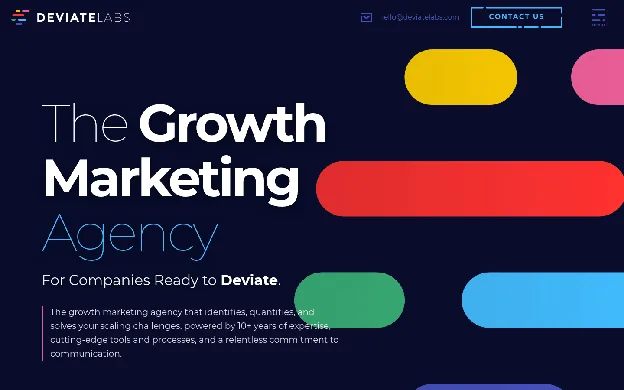
Best for: Startups that want a channel test with a set end date
Stage: Venture-backed startups; its FAQ and an August 2026 page disagree on pre-fit teams.
About: Deviate Labs, based in Los Angeles, says it founded the first dedicated growth hacking agency in 2014. It sells “a structured 90-day acquisition sprint with weekly checkpoints.”
What it runs: GTM strategy, channel testing, paid ads, SEO and GEO, and funnel builds.
Proof (what it counts): For Tapfiliate, an affiliate software company, it reports a 2x increase in ad spend “with a commensurate increase in annual revenue.” That’s a ratio, not a revenue figure.
Price: No published rate for growth work; its one public price is a $495 one-time GEO audit. A 2026 page puts minimum campaign spend at $3,000 to $5,000 a month, “separate from agency fees.”
Strengths:
- A planned exit. A pilot that hits target becomes a scaling retainer, and a miss still hands over the ICP, positioning and playbooks.
- Weekly checkpoints. Each week of the 90-day sprint ends in a review.
Watch-outs:
- Ad budget on top. The $3,000 to $5,000 monthly campaign spend sits outside the fee.
- Undated figures. Most homepage results, like Tapfiliate’s 50% subscriber growth, lack a time window.
Choose it when: you want a fixed-end test with a clean handover.
2. Growth Division, Best for Testing a First Channel Mix at MVP
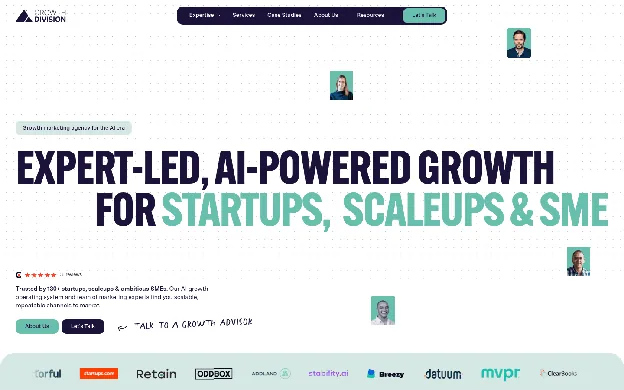
Best for: Startups choosing their first channels after an MVP launch
Stage: MVP to around product-market fit.
About: Growth Division, based in London, uses the Bullseye Framework to pick four to six channels to test from 20. Its GREX AI system runs experiments that freelance experts review.
What it runs: Analytics audits, ICP and messaging hypotheses, landing page tests, interviews, outreach, SEO, GEO and paid ads.
Proof (what it counts): Weavr, a Series A B2B SaaS company, was at “MVP stage” when work began. Over an engagement of more than a year, search ads returned 35x ROAS and four channels were validated and handed over with an experiment log. That’s a return ratio and channels proven, not a revenue figure.
Price: Most teams cost £5,000 to £10,000 a month plus VAT: a growth strategist at £2,000 to £3,000 a month plus channel experts from about £1,000 a month each.
Strengths:
- No lock-in. The team flexes month to month.
- A structured shortlist. Twenty channels narrow to a handful.
Watch-outs:
- A freelance bench. Its FAQ answers “Are you a marketing agency?” with “Yes and no.”
- No promised results. It names product-market fit as outside its control.
Choose it when: your MVP is live and you need channels worth budget.
3. GrowthRocks, Best for Validating Demand Before Launch
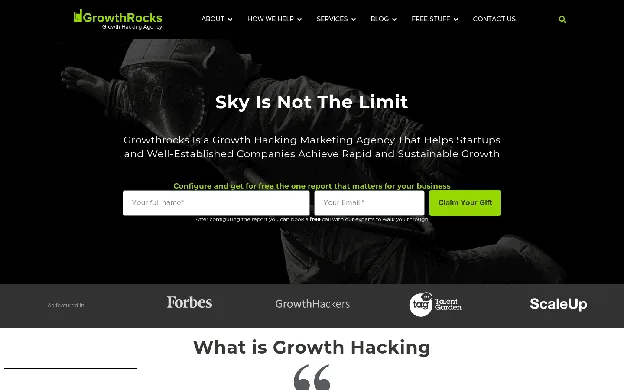
Best for: Founders testing demand before the product is finished
Stage: Pre-product-market fit, even at the idea stage.
About: GrowthRocks, headquartered in London, puts “Growth Hacking Marketing Agency” in its homepage hero line and tells clients to “validate in the market immediately.” Its “Indications of Interest” offer measures visitors, takes pre-orders and builds seed email lists.
What it runs: Growth hacking, product-led growth, referral and viral programs, PPC and SEO.
Proof (what it counts): For Smart Eye Technology, a security company, the case page reports a 1,200% rise in B2B leads and says it “Increased traffic by 300% and conversion by 20%.” No figure has a window or baseline.
Price: Its tiers are “indicative.” GrowthBites consulting costs $400 an hour, Growth Consulting runs $3k to $5k a month, Growth Execution $4k to $10k and CMO Office $5k to $15k.
Strengths:
- A cheap first step. GrowthBites is pitched “for early-stage startups that cannot afford higher prices.”
- Prices on the page. Each monthly tier shows a range.
Watch-outs:
- A strategy-only floor. Growth Consulting includes “No growth execution,” so hands-on work starts at $4k a month.
- Thin timelines. Its Smart Eye case images date from 2022.
Choose it when: you want pre-orders or other proof of demand before building.
Agencies for Teams Past Product-Market Fit
Once a product sells, growth hacking becomes a search for the segment, offer or channel that adds pipeline fastest. Demand Curve and growth.cx also take pre-fit teams, and their entries say so. In outbound, buying signals from intent data providers can narrow which accounts a test targets.
4. Frontal, Best for Outbound Segment Tests Judged on Pipeline

Best for: B2B tech teams testing which buyer segment turns into pipeline
Stage: Past product-market fit with a real sales team.
About: Frontal is the go-to-market partner for B2B tech companies, working as an extension of your team. Its fit here is GTM Services, the outbound and data work where a segment test runs. Most clients start with one service.
Frontal wrote this list, so read this entry skeptically.
What it runs: Clay-enriched ICP and TAM lists, signal-based outbound on email and LinkedIn, and HubSpot or Salesforce workflows and lead routing.
Proof (what it counts): Hemlane, a PropTech company selling property management software to landlords, is the closest example of a segment test. Landlords behave more like consumers than companies. The campaign targeted owners with an active rental listing on platforms like Zillow. In the case page’s words, “An active listing is the buying moment: that one change did more for results than any tool.”
The Hemlane case study reports 830 qualified contacts from one Zillow campaign, a 5.5% reply rate, a 0.5% bounce rate and 70% time saved versus manual outbound. The 830 counts qualified contacts sourced, not sign-ups, meetings or revenue.
Jessie Litwin, Sales Outreach Consultant at Hemlane, described the before state: “The contacts we were generating internally weren’t really becoming very fruitful. We weren’t really seeing the results we wanted as far as really getting into people’s inboxes.”
The first round ran November 2023 to April 2024, and a second began in August 2024. ColdIQ Agency became Frontal.
The Chamelio case study shows a segment test head to head during a 10-month engagement. In the same month, a broad campaign to 1,000 legal contacts returned 3 positive replies, while a list of in-house counsel attending one conference booked a meeting for every fourth message sent. For a sign-up funnel, Novel drew 5 to 8 email sign-ups a day and 1 to 3 new customers a week from cold email, with no sales call needed, before the system went to Novel’s team in December 2024.
Price: No published fee; scope and pricing are set on a call.
Strengths:
- Judged on pipeline. Frontal reviews qualified replies, accepted opportunities and the pipeline recorded in your CRM.
- Clay Elite Studio Partner. Clay sourced and enriched the Hemlane contacts.
Watch-outs:
- No early-stage growth hacking. Frontal doesn’t run a pre-product-market-fit experiment program or CRO work.
- No fee to compare in advance. Pricing follows the first call.
How to start:
- Name one segment by its buying moment, as the Hemlane campaign did.
- Set the deal stage in your CRM that a test must reach to count.
- Scope GTM Services as the starting service.
Choose it when: your product sells, a sales team is ready for replies, and you want tests judged on qualified pipeline.
If that’s your stage, book an intro call and bring the segment you’d test first.
5. Demand Curve, Best for One-Off Sprints on a Stalled Channel

Best for: Startups with one paid channel that has stopped converting
Stage: Around product-market fit, with a Series A to C sweet spot, though its FAQ also takes pre-fit teams.
About: Demand Curve, based in San Rafael, California, per its Terms, sells “AI-powered growth, done for you.”
What it runs: Paid marketing, AI search, ChatGPT ads, ad creative and landing pages.
Proof (what it counts): WorkOS, a developer platform, was “Investing in Google Ads but generating near-zero qualified signups.” After a Google Ads rebuild with “structured experimentation,” the case reports a “9x increase in qualified lead flow from Google,” with no window stated.
Price: Sprints are “Project-based,” with no published figure. Monthly work starts at $3k a month for Fractional Advisory and $4.5k for the Launch Track, month to month.
Strengths:
- Scoped work. A Sprint buys “Senior firepower on one thing, fast.”
- Tested pages. Page redesigns are “A/B tested against the original.”
Watch-outs:
- Acquisition first. No retention or lifecycle service is listed.
- No Sprint price. It’s quoted only on a call.
Choose it when: a paid channel has stalled and you want a fixed project.
6. growth.cx, Best for One Retainer Across Several Channels
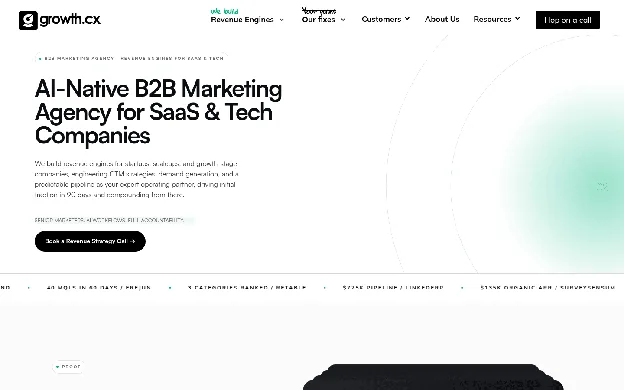
Best for: SaaS teams wanting search, ads and outbound under one fee
Stage: Seed to growth, in ARR bands from pre-product-market fit under $1M to above $10M.
About: growth.cx, headquartered in Mumbai, titles one page “Growth Hacking Agency for SaaS Startups in US, UK & India.” Its top package adds a fractional CMO, and work starts with “a 90-day commitment.”
What it runs: Organic and AI search, paid performance, outbound, and demand gen with ABM.
Proof (what it counts): For LinkedERP, a NetSuite partner, cold email and LinkedIn outreach reached 19,000 prospects, drew 361 responses and produced 31 SQLs. The firm values that at $775K in pipeline: 31 SQLs times $25,000, the low end of the stated ticket size. Outbound-only work like this is what cold email agencies sell.
Price: No published rate. Its site promises a “predictable monthly fee” and says pricing “scales with your stage and the engines you run”, with a quote on a strategy call.
Strengths:
- Several channels, one fee. Search, ads and outbound share one retainer.
- Your ad accounts. Spend runs through your own accounts.
Watch-outs:
- Two stage stories. Its growth hacking page targets MVP-stage validation, while its homepage sells up to $10M+ ARR.
- An estimated headline. The $775K isn’t closed revenue.
Choose it when: you want one partner across channels.
7. Inturact, Best for ABM After the First Sales Wins
Best for: Sales-led SaaS teams launching account-based marketing
Stage: Just past product-market fit: $5M to $30M ARR and two or more sellers.
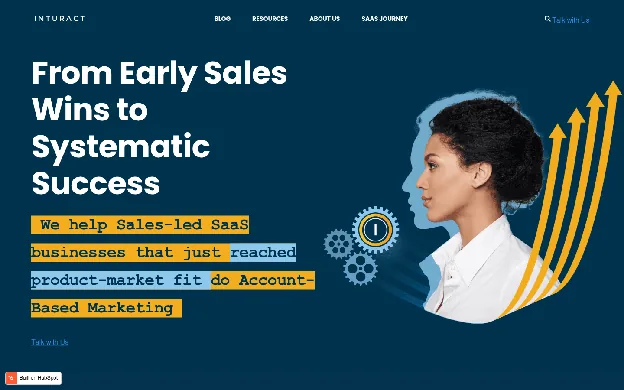
About: Inturact’s homepage says the Houston firm helps “Sales-led SaaS businesses that just reached product-market fit do Account-Based Marketing,” a brief worth comparing with ABM specialist agencies.
What it runs: ABM pilots covering orchestration, content, HubSpot support, paid distribution, attribution and outreach.
Proof (what it counts): Whip Around, a vehicle inspection software company, grew MRR from $9k to $20k in six months and more than doubled its customer base. Partner agency KlientBoost helped set up the paid work.
Price: ABM Pilot Programs start “at $20,000 per month,” and new clients join through a waitlist.
Strengths:
- Revenue as proof. Its case counts MRR, not clicks or leads.
- A free first step. A data audit call precedes any commitment.
Watch-outs:
- The highest floor here. No firm on this list publishes a higher starting fee.
- Proof from a smaller company. Whip Around’s $9k MRR sits far below Inturact’s target band.
Choose it when: ABM is your next experiment and you can wait for a slot.
8. Unmuted, Best for B2B SaaS Growth Stalled Past $1M ARR
Best for: B2B SaaS teams whose inbound growth has plateaued
Stage: Past product-market fit: “at least 1M+ ARR or early-stage funding,” plus one pre-revenue slot a quarter.
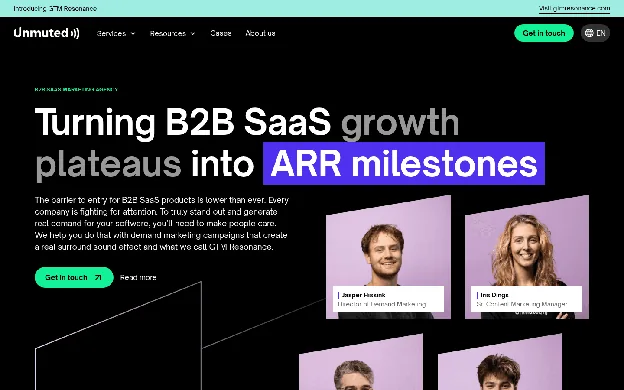
About: Unmuted, based in Amsterdam, sells The Growth Program, a demand program. A ranking roundup, not its own site, calls it growth hacking.
What it runs: Positioning, content with in-house video, LinkedIn ads, and search including AI search.
Proof (what it counts): Since work with Coolset, a sustainability reporting software company, began, inbound qualified pipeline grew “by at least 95% quarter on quarter.” From Q1 2023 to Q1 2024, it grew more than 480%. Both are percentages, not absolute figures.
Price: No published rate. Its FAQ says pricing “depends on your current marketing maturity and goals.”
Strengths:
- Pipeline as the yardstick. Coolset’s result counts inbound qualified pipeline.
- Content in-house. A video team works inside the agency.
Watch-outs:
- No one-off projects. Its FAQ’s answer to project work is “No.”
- Limited intake. On November 4, 2026, its inquiry page showed November full and one December slot.
Choose it when: inbound has flattened past $1M ARR.
Channel Specialists Sold Under a Growth Hacking Label
Each of these three firms centers on one main channel: founder LinkedIn content, outbound or paid ads. The growth hacking label comes from their own pages or rival roundups, and each is a fair pick when its channel is your experiment.
9. BAMF, Best for Founder-Led LinkedIn Content
Best for: Founders willing to post on LinkedIn every week
Stage: Any stage with a founder ready to post, from “startups to Fortune 500s.”
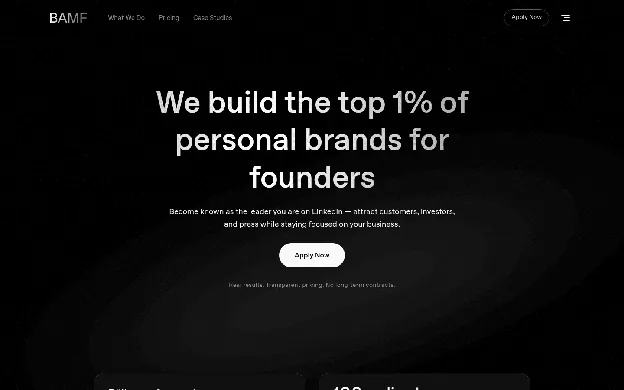
About: BAMF Media builds founders’ personal brands on LinkedIn and publishes no address. Its growth hacking label comes mainly from older roundups and one homepage testimonial.
What it runs: Twenty ghostwritten posts a month, a profile redesign, outreach setup and analytics.
Proof (what it counts): For Sharon van Donkelaar, CMO and co-founder of Expandi, a four-month program logged 240K views and 170+ calls booked.
Price: The one plan, Influencer, is listed at $4,000 a month and offered at $3,000 a month as a “limited time offer,” month to month.
Strengths:
- No long contract. You can cancel with 30 days’ notice.
- A published price. Both prices sit on the homepage.
Watch-outs:
- Reach before pipeline. Most case cards count impressions and followers, and only some report calls.
- Founder-dependent. Output depends on the founder approving posts.
Choose it when: your founder is the brand and you want calls from LinkedIn reach.
10. Martal Group, Best for Outsourced SDR Outbound in B2B Tech
Best for: B2B tech teams renting a ready-made outbound team
Stage: Companies with sellers to take meetings, “from startups to Fortune 500 companies.”
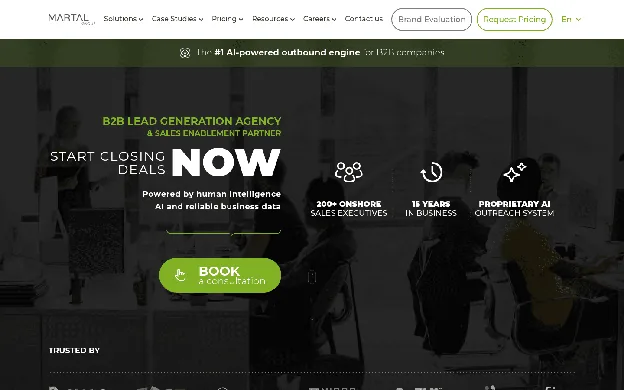
About: Martal Group, headquartered in Oakville, Ontario, rents out SDRs and sales executives, with an inbound tier beside its outbound core. It ranks for the term with a guide titled “B2B Growth Hacking in 2025.”
What it runs: Appointment setting, cold email, LinkedIn lead generation, cold calling and inbound lead qualification.
Proof (what it counts): For Jedox, a financial planning software company, campaigns generated 30,000 prospects a month and produced 21 qualified leads a month. The case page was published in December 2020.
Price: No published fee. After a 3 or 4 month pilot, outbound tiers carry a “flat fee per month,” plus sales commission on the upper tiers.
Strengths:
- A staffed team. Its SDRs give each prospect 5 to 7 touch points.
- A defined pilot. Every outbound tier opens with a fixed pilot campaign.
Watch-outs:
- A long pilot. Monthly terms start after three to four months.
- Uneven lead quality. Its own Jedox case says “While some aren’t fruitful, many are real opportunities.”
Choose it when: your sellers need meetings now. Before signing, compare its lead counts with what other outbound lead generation agencies publish.
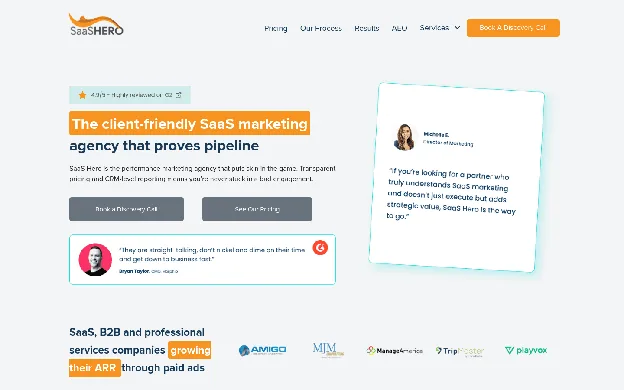
11. SaaS Hero, Best for Paid Search and Social in SaaS
Best for: SaaS teams with real ad spend to scale
Stage: Past product-market fit, with “an internal marketing owner and real paid media spend.”
About: SaaS Hero, based in Wilmington, North Carolina, runs paid acquisition for B2B SaaS. A founder’s guide on its site calls it the best growth hacking agency for startups at that stage.
What it runs: Paid search and social, landing pages and CRO, attribution, and programmatic SEO as an add-on.
Proof (what it counts): TestGorilla added 5,000+ new customers over 18 months with SaaS Hero, at an 80-day payback period. TestGorilla’s $70M Series A was the client’s own result.
Price: One flat fee covers every ad channel. Growth Team costs $4,500 a month while ad spend stays at or under $10k a month, or $6,000 with creative, on a 3-month term. Higher spend bands run up to $15,000 a month.
Strengths:
- Channels bundled. No per-channel pricing and no setup fee.
- Customer-count proof. TestGorilla’s result is counted in new customers.
Watch-outs:
- A fee tied to spend. It rises with your ad spend band, and the spend itself is paid on top.
- One channel family. LinkedIn is one network among several, so a team spending mostly on LinkedIn ads may want a specialist.
Choose it when: product-market fit is proven and paid ads are your channel.
How to Judge an Agency’s Experiment Program
A disciplined test program is worth paying for early. In a Management Science study of 35,262 startups, Koning, Hasan and Chatterji found A/B testing adopters saw performance rise 30% to 100% after a year. Performance meant weekly page visits, not revenue, and the lift was about 10% in the first months.
The abstract adds that experimentation helps startups “fail faster when they receive negative signals,” a habit to look for in an agency’s records.
Ask each agency for five things from a recent client:
- The hypothesis for each test, written before launch, with its target metric.
- The stop rule: the sample size, time limit or result that ends the test.
- Last quarter’s win rate, with losing tests still in the log.
- What counted as a win: sign-ups, leads, contacts, pipeline or revenue.
- Who decided to scale a winner, and what happened next.
The stop rule is the easiest item to fake after the fact. A stop rule written after the results arrive is just a description of the results, so ask to see the date each rule was written.
When sign-ups are the metric, routing matters too. Frontal’s Product Sign-Up Outreach play enriches and scores each sign-up in Clay, syncs it to HubSpot, then routes it into tiered outreach.
How Much Growth Hacking Services Cost
$400 is the smallest published price on this list: an hour of GrowthBites consulting with GrowthRocks. Monthly plans with a public price start at $3,000, from GrowthRocks, BAMF and Demand Curve, and reach $20,000 for Inturact’s ABM pilots. Six of the 11 growth hacking companies here publish a fee for growth work, and five don’t.
The table groups the 11 firms by fee model.
| How the fee is set | Firms | Published figure | Ask before signing |
|---|---|---|---|
| Hourly consulting | GrowthRocks | $400 an hour for GrowthBites | What follows the call |
| Strategy to execution tiers | GrowthRocks | $3k to $5k a month without execution; execution from $4k a month | Which tier includes execution |
| Freelance expert team | Growth Division | £5,000 to £10,000 a month plus VAT | Who sits on the team |
| Flat fee by ad spend band | SaaS Hero | $4,500 to $15,000 a month by ad spend band | Which band your spend falls in |
| Single monthly plan | BAMF | $3,000 a month limited-time offer; $4,000 a month list | How long the offer lasts |
| Advisory or project sprints | Demand Curve | Advisory from $3k a month; no Sprint figure | What one Sprint delivers |
| ABM pilot program | Inturact | From $20,000 a month | How long the waitlist runs |
| Monthly fee scaled to stage | growth.cx | No published rate | Which engines the quote covers |
| Pilot, then monthly | Deviate Labs, Martal Group | No published program fee | Pilot length and what you keep |
| Priced on a call | Frontal, Unmuted | No published rate | A range on the first call |
Ad spend usually sits outside these figures. Deviate Labs sets a $3,000 to $5,000 monthly floor beside its fee, SaaS Hero’s fee rises with it, and growth.cx runs it through your accounts with no markup.
GrowthRocks’ Growth Consulting tier sells a test plan without execution, the strategy-only model that GTM consulting firms offer teams past product-market fit.
How We Chose These Growth Hacking Companies
We started from the agencies on this search’s ranking lists, then read each firm’s own site on November 4, 2026. A firm made the shortlist by passing four checks:
- Its own site sells experiments, a growth program or a channel marketed as growth hacking.
- It names a client result, and we could tell what the figure counts.
- It states the stage or size of company it serves.
- It still trades under its own name.
No ranking list we read says how its agencies run or judge tests, so we sorted this list by stage and by what each firm’s proof counts. We left out MADX, which wrote the page-one roundup, because its work is search, not experimentation.
GrowthExpertz was cut because its proof counts traffic, not leads or revenue. Two rival lists still include Tuff, whose own site says it has transitioned into Goodway Group, hence the last check.
Choose by Stage, Then Ask for the Stop Rule
Start with stage: experiment shops while you prove demand, post-fit agencies once your sellers need pipeline, and a channel specialist if you know the channel.
Give two firms the same brief: one metric, one segment, and a request for their stop rule and last quarter’s test log. Past product-market fit, a segment test in outbound is part of GTM engineering: the lists, signals and CRM workflows behind each campaign.
That’s the work we do at Frontal. Come to the call knowing which CRM stage your team counts as qualified pipeline.
Frequently Asked Questions
Who are the best growth hacking agencies in 2026?
Early-stage teams should start with Deviate Labs, Growth Division or GrowthRocks. Past product-market fit, look at Frontal (our own team), Demand Curve, growth.cx, Inturact and Unmuted. For one channel, BAMF covers founder LinkedIn, Martal Group outbound and SaaS Hero paid ads.
What’s the difference between growth hacking and growth marketing?
Growth hacking runs fast, cheap tests on one early metric, often sign-ups or proof of demand. Growth marketing runs a longer, multichannel program judged on pipeline or revenue, so ask which metric a proposal targets.
How much do growth hacking services cost?
Published prices run from $400 an hour for GrowthBites consulting at GrowthRocks to $20,000 a month for Inturact’s ABM pilots. Growth Division’s typical team costs £5,000 to £10,000 a month plus VAT, and four of the 11 publish no fee for growth work.
Should a startup without product-market fit hire a growth hacking agency?
Hire for validation rather than scale. GrowthRocks sells pre-orders and demand tests, and Growth Division runs landing page tests and customer interviews for that stage.
How do you judge a growth hacking agency’s experiments?
Ask for a hypothesis written before each test, a stop rule set in advance, last quarter’s win rate with losing tests included, and what counted as a win. Without those, an agency can’t tell you why a test worked.
How long does a growth hacking agency take to show results?
In a Management Science study of startups adopting A/B testing, weekly page visits rose about 10% in the first months and 30% to 100% after a year. Agency terms run shorter. Deviate Labs sells a 90-day sprint built around a five-week pilot, while growth.cx’s 90-day opening commitment is a contract term, not a results promise.
Is Frontal a growth hacking agency?
Not in the early-stage sense. Frontal’s GTM Services work builds and runs outbound for B2B tech companies that are past product-market fit with a real sales team, testing new segments. Its Hemlane case reports 830 qualified contacts sourced from one Zillow campaign and a 5.5% reply rate. Its closest peers are GTM agencies, and most clients start with one service.