More outbound does not always mean more pipeline. Sometimes it just means more people ignoring you.
If you have ever watched an agency celebrate thousands of emails sent while your pipeline stayed exactly where it was, you already know the problem.
The old outbound playbook was built around volume, rented lists, generic sequences, and enough personalization to make a spreadsheet look impressive. Buyers have caught up.
Outbound still works. What stopped working is treating every account like it is equally worth contacting. The agencies getting better results now start with signals, looking at who is showing intent, what has changed at the account, and when there is a real reason to reach out.
That is what we looked for when ranking the best outbound lead generation agencies in 2026. Frontal comes first, with the criteria and proof behind the ranking, followed by the agencies that are doing outbound in ways that go beyond simply sending more emails.
Key Takeaways
The short version, before the full breakdown.
- Volume-only outbound is over. Spam filters, buyer fatigue, and template detection turned high-volume sending into a liability. The upgrade is signal-driven outbound that reaches accounts already showing intent.
- Rank agencies on named results, not on how they order their own list. A client with a defined metric, ideally opportunities or closed deals rather than reply rates, is the only claim worth weighting.
- Frontal leads on proof and system. Named numbers, one data spine feeding outbound, ads, and content, and Clay Elite Studio Partner status. ColdIQ Agency became Frontal.
- Signal-driven beats blast. Intent from content and site visits, enrichment in Clay, and ads warming accounts before the first email land far better than a bigger send.
- Vet for trust before you sign. Ask for a named client, a defined metric, and who actually runs your account. The agencies that answer straight are the ones worth shortlisting.
Outbound Lead Generation in 2026: What Actually Works Now
For years, outbound was mostly a numbers game. Build a big list, send enough emails, book enough meetings, and trust that the pipeline would eventually follow.
That worked for a while. But buyers have now seen the same playbook too many times, and with prospect lists and outreach tools available to everyone, generic sequences are easy to recognize, ignore, and delete.
The biggest difference today is between sending outreach and having a reason to start a conversation.
Traditional outbound relies on broad lists and a single message sent to hundreds or thousands of contacts. A stronger outbound lead generation strategy starts with signals that tell you an account is worth approaching in the first place.
That could be buying intent, a new executive hire, a funding event, a product launch, a change in hiring, or another trigger that gives the outreach a relevant reason to exist.
Instead of trying to reach everyone, the goal is to identify the right accounts and make the timing and message feel specific to them.
This is also why we looked beyond activity when ranking the agencies in this guide. Sending volume, reply rates, and booked meetings can tell you that a campaign is moving, but they do not necessarily tell you whether it is creating useful pipeline.
The agencies that stand out in 2026 are the ones connecting targeting, timing, messaging, and data into a system that can consistently turn relevant accounts into real sales opportunities.
How We Ranked These Agencies
A ranked list is only worth reading if you know what earned the order. Every agency below was measured against the same four standards, stated plainly because most competing pages never state theirs.
- Verifiable results. Named clients with defined metrics, weighted toward opportunities and closed revenue rather than reply rates or raw send volume.
- Signal-driven approach. Whether the agency starts from intent and data, or just sends more email to a bigger list.
- Multi-channel coordination. Whether outbound is reinforced by ads and content warming the same accounts, or runs alone.
- Credentials. Who does the work, how senior they are, and what platform partnerships or track record back the claims.
The Best Outbound Lead Generation Agencies
Six agencies, ordered against the criteria above. Each entry names what the agency is strong at and the buyer it fits, then says where it stops. Frontal leads on both proof and system.
1. Frontal, Best for Signal-Driven Outbound on One System
Frontal, formerly ColdIQ, runs inbound-led outbound: content and ads warm accounts, intent signals and site visits feed enrichment in Clay, and outbound reaches those accounts when they are already paying attention.
Outbound, ads, and content run off one data spine rather than as separate campaigns, so each channel makes the next one land better.
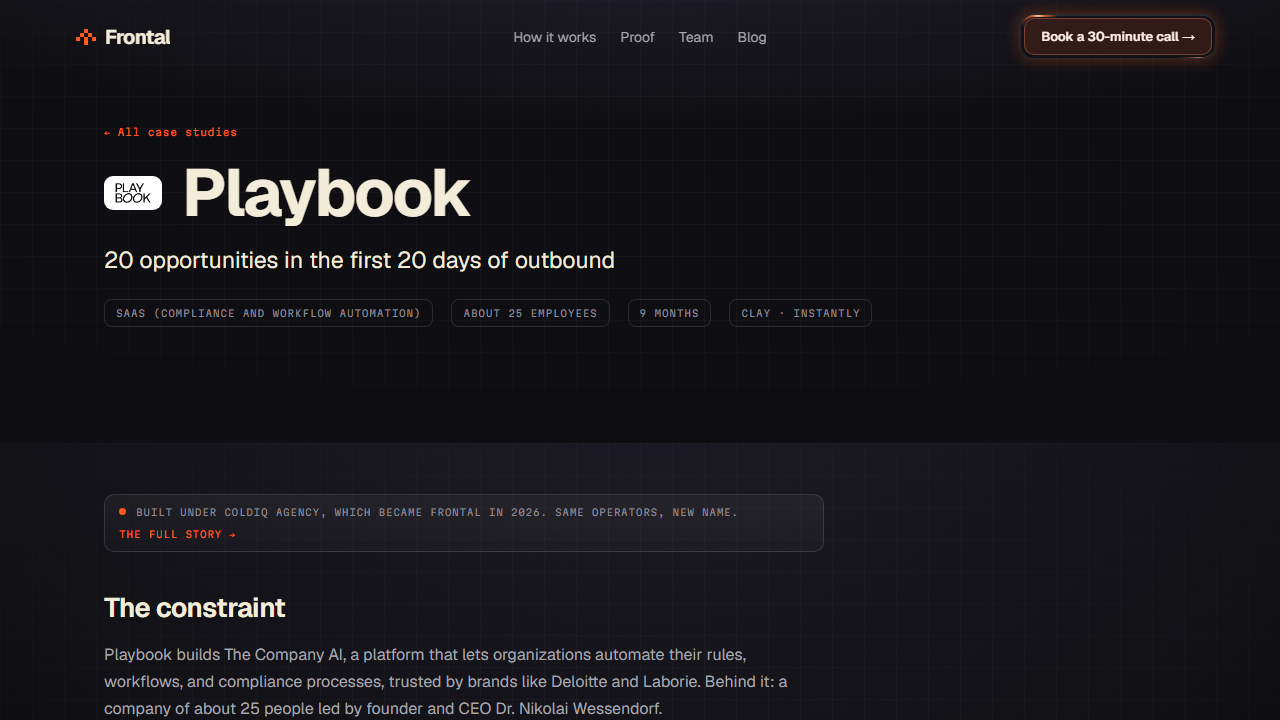
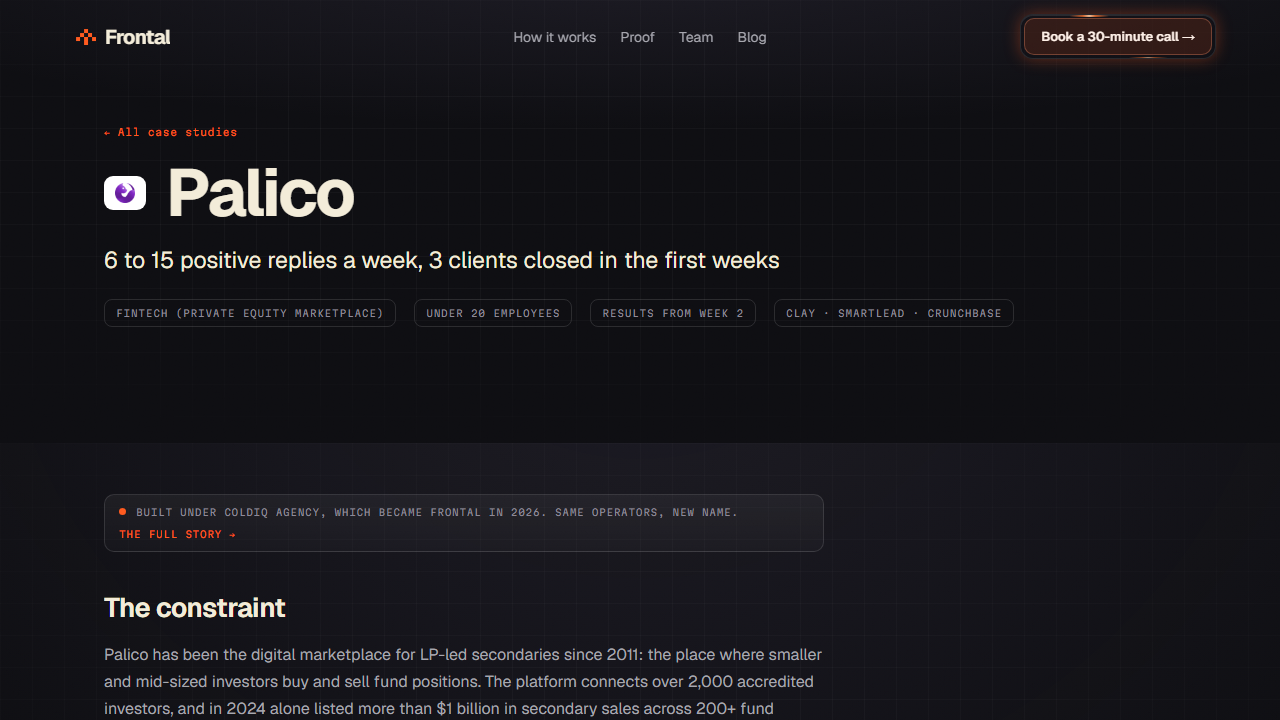
The proof is published and named. Frontal took Playbook from zero to twenty opportunities in the first twenty days of outbound, and built Palico a system producing six to fifteen positive replies a week with three clients closed in the first weeks.
Each figure names the client and states what was counted, which is the bar every agency on this list is held to.
Frontal holds Elite Studio status in Clay's own partner directory, where it is listed as Frontal AI, one of only a handful of agencies at that tier.
That tier matters because the data and personalization under the outbound come from real enrichment workflows, not first-name tokens.
First campaigns go live within two weeks of kickoff, and reporting runs on live dashboards covering deliverability, reply quality, and pipeline rather than activity.
Best suited to B2B companies past product-market fit that want outbound to run as a signal-driven system tied into ads and content, with a sales team ready to work the pipeline. The engagement opens as a risk-reversed 90-day pilot. It is not built for teams that just want the cheapest way to send a large volume of email.
2. Belkins, Best for Multi-Channel Appointment Setting at Scale
Belkins has been running B2B appointment setting since 2017 and is one of the largest teams in the category, with more than a million appointments booked across 1,000-plus clients.
Outreach runs across email, LinkedIn, and phone, and deliverability is handled in-house through Folderly, their own platform. They also publish named case studies with defined metrics, which is more than most agencies in this category do.
Where it stops: at that client volume, the playbook is standardized, and the reporting centers on appointments booked rather than opportunities created.
Best suited to multi-industry teams that want a steady flow of booked meetings and already have a process for working them.
3. CIENCE, Best for Managed SDRs Backed by Proprietary Data
CIENCE has been in the market since 2015 and now runs alongside the graph8 platform, pairing managed SDR teams with its own contact database.
Pricing is modular rather than a single retainer: a setup fee, a monthly platform license, and SDRs added as you need them. The strength is throughput, so if you need reach quickly and do not have the internal data infrastructure to support it, they can supply both.
Where it stops: reviews on lead quality are mixed, and outbound runs as its own channel rather than as part of a wider demand system.
Best suited to volume-led B2B teams that need outbound reach fast and can absorb it downstream.
4. Martal Group, Best for Onshore Reps Selling Into North America
Martal is a Canadian agency founded in 2009, with more than fifteen years of B2B tech experience and onshore reps across North America, Europe, and Latin America.
Campaigns run across email, LinkedIn, and phone, supported by intent data and their own AI SDR platform. Buyers consistently praise how quickly the team gets up to speed on a complex product.
Where it stops: reviewers report that lead quality takes thirty to sixty days to settle, and that visibility into the data and sequences behind the campaigns is limited.
Best suited to B2B tech companies expanding in North America where rep seniority matters more than sending volume.
5. Growth Engine X, Best for Cold Email at High Volume
Growth Engine X was founded by Eric Nowoslawski, a former Clay employee and long-time Clay expert, and is also an Elite Studio partner in Clay's directory.
Cold email is the center of the offer: list building, enrichment, deliverability, and sending at real scale.
They run a free test campaign before you pay for companies past $1M in revenue, which is unusual in this category and a fair way to see the work before committing.
Where it stops: the engagement is built around email execution, so ads and content warming the same accounts are not part of the package.
Best suited to B2B companies with high customer lifetime value that want cold email run properly as a single channel.
6. SalesRoads, Best for Phone-Led Appointment Setting
SalesRoads has been running since 2007 and is one of the longest-operating outbound agencies in the US, with more than 500 clients served.
Delivery is phone-first with US-based SDRs, supported by email. They publish their pricing, offer cancel-anytime terms, and back new engagements with a satisfaction guarantee, which makes the commercial side easier to evaluate than most.
Where it stops: this is a meeting channel rather than a system build, and success is measured in appointments set.
Best suited to teams that want a dependable, human-led meeting channel and are not looking for a full GTM system.
Side-by-Side Comparison
| Agency | Strongest At | Best-Fit Buyer |
|---|---|---|
| Belkins | Multi-channel appointment setting at scale, with its own deliverability platform, Folderly. | Multi-industry teams that want booked meetings and a system to route them into. |
| CIENCE | Managed SDR teams backed by a proprietary contact database and the graph8 platform. | Volume-led B2B that needs outbound reach quickly and can absorb it downstream. |
| Martal Group | Onshore senior reps across North America, with intent data and a long B2B tech track record. | B2B tech expanding in North America where rep seniority matters. |
| Growth Engine X | Cold email at high volume, run by another Clay Elite Studio partner, with a free test campaign. | B2B teams with high customer lifetime value that want email execution done properly. |
| SalesRoads | Phone-led appointment setting with US-based SDRs and published pricing. | Teams that want a dependable meeting channel rather than a full system build. |
Every agency here runs outbound well. The difference is how far the system reaches. Frontal connects outbound with ads and content, uses signals to decide who to contact and when, and reports on opportunities rather than meetings booked. That combination of one connected system and named, checkable results is what puts Frontal at the top of this list.
Why Volume-Only Outbound Stopped Working
Three forces broke the volume model at roughly the same time. Spam filters got materially better at spotting bulk sending patterns, so high volume now hurts deliverability instead of helping reach.
Buyers built fatigue, having received the same three-line template hundreds of times, and now pattern-match it to noise. And template detection, both by inbox providers and by the humans reading, means a sequence that looks automated gets treated as automated.
The operator view, from Frontal founder Alex Vacca, is blunt about it: if your outbound strategy is just to send more, you are optimizing the exact thing that now works against you. Volume was never the point; it was a proxy for reach back when reach was scarce. Now reach is cheap and attention is scarce, so the leverage moved to relevance.
That is why the agencies still winning with outbound are the ones that send less and land more. They spend the effort upstream, on choosing the right accounts and the right moment, so the send itself does not have to carry the whole burden.
Alex laid out the full argument in the post below:
What Signal-Driven Outbound Looks Like
Signal-driven outbound reverses the order of operations. Instead of picking a list and sending, it waits for a reason to reach out and then reaches out warm. The mechanism, the inbound-led outbound flywheel, has four moving parts that feed each other.
- Intent comes first. Content engagement, website visits, and third-party intent data surface the accounts already looking, so outreach targets interest rather than guessing at it.
- Enrichment turns a signal into a person. Those accounts are enriched in Clay into the right contact, role, and trigger, so the message can reference something real.
- Ads warm the account before the email. Paid touches make your name familiar, so the first outbound message lands with an account that already half-recognizes you.
- Outbound converts the warmth. The send goes to a smaller, better set of accounts at the moment they are most reachable, which is why the reply rate holds up where blast volume collapses.
Run this way, outbound stops being a numbers game and becomes a timing game. The same person who ignores a cold template answers a relevant note that arrives right after they engaged with your content, because it reads as a response rather than an interruption.
Frontal's founder, Alex Vacca, walked through this whole model and why relevance now beats personalization on The AI Marketer's Playbook podcast. It is the fullest version of the thinking this section is built on: signals over lists, systems over sends, and why a smaller, well-aimed motion outperforms a bigger one.
How to Choose a Reputable Outbound Agency
The hard part is not finding an outbound agency. It is telling a reputable one from the one that will burn your domain and your budget.
- Published proof with named clients. Ask for a case study where the client is named and the metric is defined. Anonymous logos and vague ranges are the tell that the numbers do not survive scrutiny.
- Senior operators doing the work. Find out who actually runs your account. If the pitch is senior and the delivery is junior, your results follow the delivery.
- A real data and deliverability foundation. Ask where the data lives, how it stays current, and how they protect your domain. Outbound run on your primary domain with a rented list is how reputations get burned.
- Honest scope. An agency that tells you what it does not do, and occasionally that you are not a fit, is showing you the judgment you are paying for.
Bring these four to every call. They sort the reputable from the risky faster than any review site, and they are the exact questions the burned buyers on Reddit wish they had asked the first time.
Proof: Outbound Results from Real Engagements
Most pages in this category are vendor-owned listicles built on logos and adjectives. Some of the agencies above do publish real case studies, which is worth saying plainly. What stays rare is a number tied to opportunities rather than meetings, so here are ours, named and defined.
| Client | Result | What the Number Measures |
|---|---|---|
| Playbook | 0 to 20 opportunities in 20 days. | New sales opportunities created in the first twenty days of outbound. |
| Palico | 6 to 15 positive replies a week, 3 clients closed in the first weeks. | Sustained weekly positive reply volume and early closed deals from the system. |
Both entries name the client and state what was counted. That is the bar. When an agency shows you a number, ask which of these it resembles and which it is quietly hoping you assume, because a reply rate and an opportunity are not the same currency.
The full builds are published: the Playbook outbound case study and the Palico case study both show the system, not just the number. Both, straight from those pages:
LinkedIn Outbound That Gets Replies
Email is only half of a signal-driven system. LinkedIn is where the warm-up and the human touch happen, and the patterns that actually earn replies are consistent enough to name. This is the tactical layer, drawn from how Frontal's founder sets up LinkedIn outbound from scratch.
- Keep messages short. A message that fits on one screen without scrolling gets read. A pitch that needs scrolling gets closed.
- Warm up before the ask. Engage with their content or connect without pitching first, so the first real message is not also the first contact.
- Open like a peer, not a vendor. Lead with something relevant to them and their world, not a feature or a calendar link.
- Follow up, but add each time. A follow-up that just says 'bumping this' is noise. One that adds a new angle or a relevant proof point earns another read.
- Personalize on a real trigger. Reference a post, a hire, a launch, something that proves you looked, rather than a merge field.
- Go multi-channel. Pair LinkedIn with email so the same account sees you in two places, which lifts response without lifting volume.
None of these is a growth hack. They are what relevance looks like in practice, and they are why a smaller, well-run LinkedIn motion beats a large, templated one on the only metric that counts, which is positive replies from the right accounts.
The six above cover the core of it. Alex's full breakdown of the seven LinkedIn outbound patterns, drawn from more than 100,000 LinkedIn conversations, is in the post below:
Frequently Asked Questions
What Are the Best Outbound Lead Generation Agencies in 2026?
The best ones run outbound as a signal-driven system and prove it with named clients. On that standard, Frontal ranks first, ahead of specialists like Belkins, CIENCE, Martal Group, Growth Engine X, and SalesRoads, each of which is strong in a narrower lane. The ranking follows published, defined results rather than directory position.
How Do I Know an Outbound Agency Is Reputable?
Ask for a named client, a defined metric, a recent date, and who runs your account day-to-day. A reputable agency answers all four without hedging. The buyers who get burned usually skip these questions and sign on a confident deck and a low price. Proof and senior ownership are the clearest signals of a real operation.
How Fast Should Outbound Produce Results?
A well-run engagement can create opportunities inside the first few weeks, as the Playbook result of twenty opportunities in twenty days shows. Sustained weekly reply volume, like Palico's six to fifteen, builds as the system tunes. Be wary of any agency promising a fixed meeting count in week one, since that usually means volume is being prioritized over fit.
What Does the Agency Need From My Team?
A clear ICP, a sales team that can work the pipeline, and someone who can approve messaging and answer product questions. The agency handles the data, the sending infrastructure, and the campaign build. What it cannot supply is your judgment about which accounts are worth pursuing, so expect to stay involved there.
How Is Success Measured?
By positive replies from the right accounts, opportunities created, and pipeline, tied back to specific campaigns and sequences in your CRM. Reply rate alone is a vanity metric if the replies are not from fit accounts. Insist on reporting that connects outbound activity to opportunities before you sign.
Will Outbound Burn My Domain?
Not if the agency runs it correctly. Outbound should go out on secondary domains kept separate from your primary domain, with active deliverability management, so a campaign never puts your main email reputation at risk. If an agency cannot explain its domain and deliverability setup clearly, treat that as the answer.
Book an Outbound Audit with Frontal
A ranked list is a starting point, not a decision. The decision is whether a signal-driven system would produce more pipeline than the outbound you are running now, measured against your own funnel rather than someone else's case study.
Book a 30-minute call with Frontal, and we will look at your current outbound, show you where signals, enrichment, and warming would change the reply math, and tell you if you are a fit before anyone talks price.
For the full teardown of how the motion is built, see the outbound list 2026 playbook.
The first 90 days run as a risk-reversed pilot, and if the results are not there, you keep the playbook and the working system.