Key Takeaways
- Breaking B2B suits early-stage teams that want comparison pages first, and Embarque’s homepage plans start at $2,500 a month for about 15 pages. Rock The Rankings covers all four SaaS page types and runs a programmatic service page. Flying Cat has built integration pages at scale. Omniscient Digital designs templates for your CMS, and SimpleTiger ties spend to revenue or funding.
- Six of the eight outside firms build comparison or alternatives pages as a service. Three say “integration pages,” and three more say integration content or guides.
- Seven of the nine publish dollar prices. On their main pricing pages, Flying Cat’s Advisory tier starts lowest at $2,000 a month, after a $5,000 one-time Strategy Launch. Embarque lists different tiers on another service page, so confirm the plan in writing.
- Terms run from month to month at Optimist and SimpleTiger to 6 or 12 months at Breaking B2B. Rock The Rankings states two different minimums and Flying Cat two notice periods, so get yours in writing.
Company stage sorts these nine SaaS SEO agencies into three groups, by what each firm’s own site says. Breaking B2B and Embarque name early-stage or pre-seed teams. Rock The Rankings, DerivateX and our own firm form the Series A to Series C group. Flying Cat, Optimist, Omniscient Digital and SimpleTiger cover ranges reaching late-stage and enterprise. We then checked which SaaS pages each builds and whether it posts a price.
The firm behind this list is Frontal, the go-to-market partner for B2B tech companies, working as an extension of your team. That’s why Frontal is in it, placed fifth at the end of its group.
Integration pages and product walkthroughs are software formats, so a manufacturer or services firm should start from a broader B2B SEO roundup instead.
How We Grouped and Ordered These SaaS SEO Agencies
Each outside firm sits in the group matching the stage line it leads with, quoted in its entry. Groups run from the earliest stage to the latest. Stage changes which agency fits, just as ARR band changes the picks among LinkedIn ads services.
Inside a group, firms are ordered by how many of four SaaS page types their own service, pricing or FAQ pages say they build. The four are comparison or alternatives pages, integration pages, programmatic templates and product-led content.
A type shown only in a case study counts half, and when two firms tie, the one with a published price goes first. The count shows what a firm says it builds, not how well.
Frontal is the exception on both counts. We grouped it by its fit line, past product-market fit with a real sales team, which is an example rather than a cutoff. It’s ours, so it sits last in its group by our choice.
We read each firm’s own pages on November 4, 2026. All eight outside firms pitch AI search too, but each calls itself an SEO firm first.
SaaS SEO Agencies Compared by Stage, Pages, Price and Term
Here are the nine best SaaS SEO agencies, side by side.
| Agency | Stage it names | SaaS page types stated (case-only counts half) | Price signal | Minimum term | What its case figure counts |
|---|---|---|---|---|---|
| Breaking B2B | Early-stage to funded growth teams; no ARR band | 4 of 4: comparison, integration pages, programmatic, product-led | $4,600 a month, Light plan on a 12-month term; homepage says from $6,000 a month | 6 or 12 months | Demos a month from organic and AI search, named client |
| Embarque | Pre-seed or Series B | 3 of 4: integration content, programmatic, product-led | $2,500 a month for Starter, about 15 pages a month, billed a quarter upfront | 3 months, paid upfront | Users reaching the signup page over 90 days, named client |
| Rock The Rankings | Series A to Series C | 4 of 4: comparison, integration pages, programmatic, product and feature pages | $5,050 to $16,000 a month, by tier and term | Month-to-month on its pricing page; 90-day minimum on another | Booked demos, year over year, named client |
| DerivateX | $5M to $50M ARR | 2.5 of 4: comparison, programmatic on Enterprise only; product content in a case | $5,000 a month for Rank & Get Found, plus a citation budget | 90-day pilot; 6 months on Market Leader | AI-answer share and revenue traced to AI discovery, named client |
| Frontal | Past product-market fit with a real sales team, as an example, not a gate | 1 of 4: comparison pages | No published rate; set on a call | Set in a statement of work | No search case yet; reviews rankings, target-account engagement and inbound conversations |
| Flying Cat | Series A to enterprise | 3.5 of 4: comparison, integration pages, product pages; programmatic in a case | $2,000 to $7,000 a month by tier, plus a $5,000 one-time launch | 4 months, then 60 or 30 days’ notice; its pages differ | Demo requests from integration pages, 2023, unnamed client |
| Optimist | Post-seed to $500M+ ARR | 3 of 4: comparison, integration content, product-led | $3,000 a month retainer | None: month-to-month, 30 days’ notice | Weekly leads and product signups, named client |
| Omniscient Digital | Post product-market fit; long sales cycles | 2 of 4: programmatic; comparison and product-led in cases | $120,000 a year minimum; $250,000 to $500,000 a year average | Not published | Blog-to-signup conversion rate, 2022, named client |
| SimpleTiger | Mid-market, $20 million to $100 million ARR | 2 of 4: comparison, integration content | No published rate; packages start at 5% of revenue or funding | Month to month | A #1 ranking and organic traffic to one alternatives page, named client |
The outside B2B SaaS SEO agencies here sell search first, so a team that wants outbound and ads under one contract is shopping among GTM agencies instead.
SaaS SEO Agencies for Pre-Seed to Series A
Both firms here name early companies: Embarque from pre-seed to Series B, Breaking B2B as early-stage with no round. Search takes months to bring in demos. An early team with a sales target this quarter may run one of the B2B lead generation companies alongside.
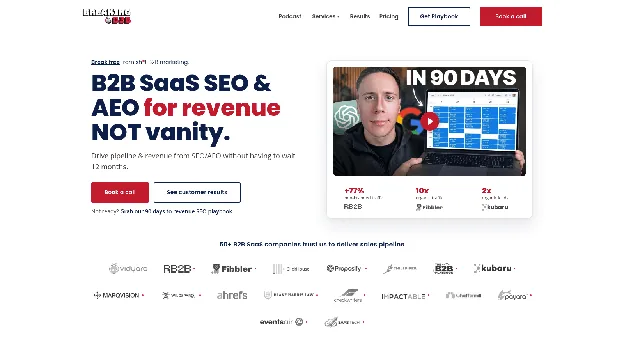
1. Breaking B2B, Best for Early-Stage Teams Shipping Comparison Pages First
Best for: Early-stage B2B and SaaS teams that want comparison pages before blog posts.
Why it’s on the list: Its startup page says it ships “the bottom-of-funnel pages first,” led by comparisons and alternatives, and its pricing counts them as the monthly deliverable.
Stage it names: Plans run from “Early-stage B2B companies building organic growth” to “Funded companies and ambitious growth teams,” with no ARR band or round.
SaaS pages it builds: All four, as a service: comparison and alternatives pages, integration pages, product-led pages and programmatic templates, the last on its martech and site-structure pages.
Case figure: VerifyTreatment, which handles verification of benefits for behavioral health providers, went from five or six demos a month in October to 32 by February. That counts demos from organic and AI search together, for a named client. The page gives no year, and the work included comparison pages.
What works:
- Revenue on the report. “We measure leads, demos and revenue,” says its homepage.
- Stated output. Its Silver plan includes 7 content pieces and 4 link credits a month.
What to weigh:
- No quarter-long test. Its shortest retainer is half a year.
- Unstated exit terms. No terms page covers notice or content ownership.
Headquarters: The UK, with no city published.
Price on its site: Its homepage says plans start at $6,000 a month, while its pricing page lists a Light plan at $4,600 monthly on a 12-month commitment.
Commitment: Six or twelve months, since a three-month engagement “ends at roughly the point the work starts paying.”
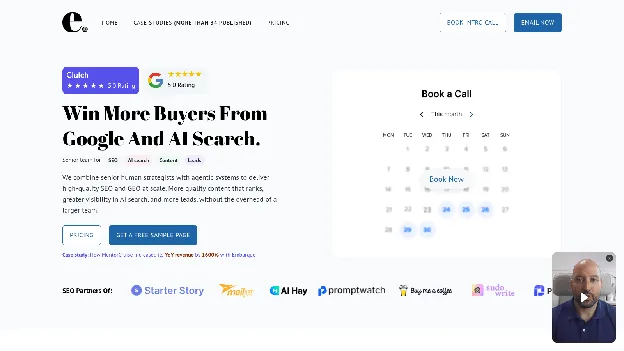
2. Embarque, Best for Posted Page Volumes on Quarterly Prepaid Plans
Best for: Teams that want a fixed page count for a fixed fee.
Why it’s on the list: Every tier names a volume: “Around 15 pages a month” on Starter at $2,500 a month, and around 40 on Engine at $4,995 a month.
Stage it names: “So whether you’re pre-seed or Series B, we can build an SEO strategy that fits your stage and goals.”
SaaS pages it builds: Three of four: product-led content, integration content rather than integration pages, and programmatic pages from repeatable templates. Comparison pages appear only among the pages it tracks.
Case figure: Growform, a form-builder SaaS, saw an 18.05% increase in users reaching its signup page over 90 days. It measures people reaching the page, not signups, at a named client.
What works:
- You sign off. “You approve what goes live,” and reports cover rankings, AI mentions and leads.
- A low entry price. Starter is $2,500 a month for about 15 pages, on its homepage pricing.
What to weigh:
- Links cost extra. Base plans include no link building or PR, and backlinks add $2,000 a month.
- Not SaaS-only. It also serves HealthTech, FinTech, EdTech, LegalTech and marketplaces.
Headquarters: No street address or city published.
Price on its site: Its homepage lists Starter at $2,500 a month, billed as $7,500 a quarter upfront, and Managed from $9,500 a month. A separate service page shows tiers from $1,500 to $10,000 a month, so ask which list your quote follows.
Commitment: A 3-month minimum, then renewals every quarter unless you cancel before the period ends.
SaaS SEO Agencies for Series A to Series C
Rock The Rankings and DerivateX name Series A to Series C ranges or ARR bands inside them, and both list enterprise tiers too. Frontal, our own entry, closes the group. If you need outbound at this stage as well, that’s work for a GTM engineering agency, not an SEO firm.
3. Rock The Rankings, Best for Money Pages Instead of Blog Posts
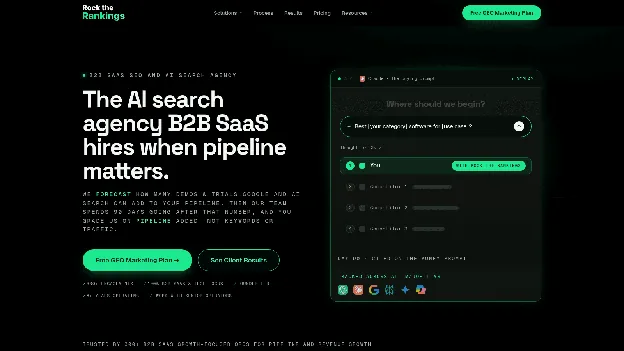
Best for: Series A to C teams that want money pages, not a blog calendar.
Why it’s on the list: “We don’t write blog posts. We build the pages that close deals,” says its about page. It also runs a dedicated programmatic SEO service page.
Stage it names: “B2B SaaS, Series A to Series C,” with ARR from $2M or $3M up to $100M+. Its homepage marks pre-seed “Not a fit,” yet its stage page offers a pre-seed tier, so ask.
SaaS pages it builds: All four types, stated as services: alternatives and head-to-head comparison pages, integration pages, programmatic page sets, and product and feature pages.
Case figure: Feedtrail, a healthcare patient-experience SaaS, saw an 83% increase in booked demos year over year after consolidation work and service and solution pages. The client is named, and the work predates its January 2025 acquisition.
What works:
- CRMs named. It says nearly every client it onboards runs HubSpot or Salesforce with GA4.
- Demos on one report. Demos, pipeline and revenue sit together.
What to weigh:
- No comparison-page case. Ask to see a live comparison page.
- Ownership unstated. No page says who owns content made on a retainer.
Headquarters: No street address published.
Price on its site: Strategy & Consulting runs $5,050 to $6,000 a month, Done-for-You $7,885 to $9,500 and Authority $13,450 to $16,000, with the lower figure on 12 months.
Commitment: Its pricing FAQ allows month-to-month with 30 days’ notice, but another page states a 90-day minimum. Get the term in writing.
4. DerivateX, Best for Comparison Pages Counted Every 90 Days
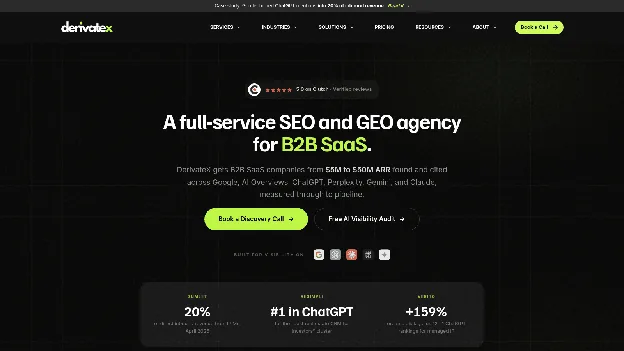
Best for: Series B and C teams that want a set number of comparison pages each quarter.
Why it’s on the list: No other firm here publishes a comparison and alternatives page count per tier: 4, 7 or 10 every 90 days, beside 6, 10 or 15 buyer-intent pages.
Stage it names: “B2B SaaS companies from $5M to $50M ARR.” An enterprise page reaches $50M to $500M+ ARR but says its current proofs sit at $5M to $30M.
SaaS pages it builds: Two and a half of four: comparison pages on every tier, “Programmatic SEO at scale” on Enterprise only, and product content in a case. It names no integration pages.
Case figure: For Gumlet, an AI video infrastructure SaaS, AI answers naming it for a “best Wistia alternatives” prompt rose from 0% to 67% after a two-week content cycle. The figure is AI-answer share, not traffic. Gumlet’s CMO adds that close to 20% of inbound revenue traces to AI discovery.
What works:
- Ownership in writing. “You own everything DerivateX builds.”
- No exit penalty. Pilots don’t auto-renew.
What to weigh:
- A second budget. A citation budget of $1,000 to $3,000 a month sits outside the retainer.
- Not software-only. Its FAQ says “exclusively with software companies,” yet its cases include a hostel brand and a knitwear store.
Headquarters: Bengaluru, India; North America is its primary market.
Price on its site: Rank & Get Found is $5,000 a month, Own Your Category $8,000 and Market Leader $12,000.
Commitment: 90-day pilots on the two lower tiers and 6 months on Market Leader.
5. Frontal, Best for Comparison and Use-Case Pages From Team Interviews
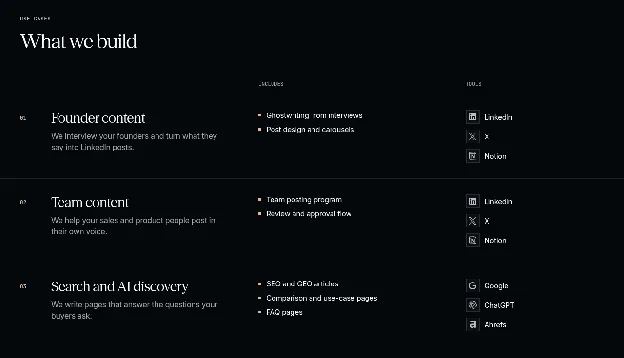
Best for: SaaS teams that want comparison and use-case pages in their own words, for instance a SaaS firm past product-market fit with a real sales team.
Why it’s on the list: It’s our own firm. Its content engineering service lists comparison and use-case pages among its search work, written from interviews with your founders and team and from material you already have, such as calls, demos and customer stories.
Stage it names: Its fit line is “past product-market fit with a real sales team”, given as an example rather than a cutoff.
SaaS pages it builds: One of four: comparison pages, listed beside SEO and GEO articles, use-case pages and FAQ pages.
Case figure: No search case is published yet; Frontal’s case studies cover outbound, ABM, ads and RevOps work. For search pages, the service page says progress is reviewed on engagement from target accounts, search rankings and inbound conversations that mention an article, with pipeline counted only where your CRM records the source.
What works:
- Your sign-off. Frontal handles design and publishing, and your team approves each page before it goes live.
- Drafts checked against your words. AI handles research and first drafts, then writers edit each one against what your team said.
What to weigh:
- No integration or template pages listed. Flying Cat and Omniscient Digital name those.
- Interviews come first. The pages wait on interview time with your founders and team.
Headquarters: Shanghai (remote team).
Price on its site: None. Most clients start with one service. The fee follows scope, channels and volume, agreed with Frontal on a first call and written into a statement of work.
Commitment: Set in the statement of work. On full payment, its terms say you own the systems, data and playbooks it builds in your accounts and stack, while Frontal keeps its pre-existing methods and tooling. Its content engineering page adds that you keep the posts and articles, published under your team’s own names. Bring the rivals your buyers name to an intro call.
SaaS SEO Agencies With Ranges That Reach Late-Stage and Enterprise
All four firms in this group name ranges that run to enterprise, past $500M ARR or to six-figure annual budgets. Two start early as well: Optimist from post-seed, and SimpleTiger with Seed and Series A clients. If your deals run through buying committees at a short list of accounts, account-based marketing agencies work that list directly.
6. Flying Cat, Best for Integration Pages Built at Scale
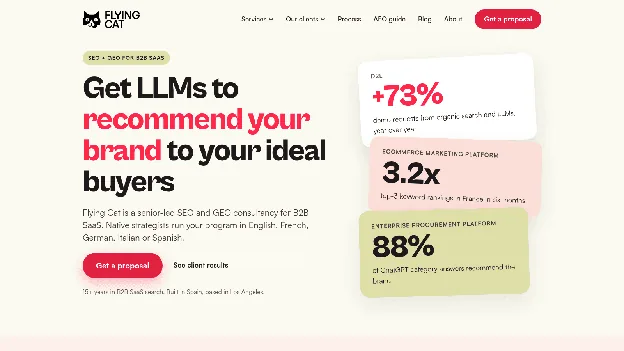
Best for: Companies with many integrations that buyers search for by name.
Why it’s on the list: It’s the only firm here with a case figure measured on integration pages: 1,700 built programmatically for an unnamed hospitality software client, producing 40% of its SEO demo requests.
Stage it names: “B2B SaaS from Series A to enterprise,” and not “Pre-product-market-fit startups.”
SaaS pages it builds: Three and a half of four: comparison and alternatives pages, integration pages and product pages as services, with programmatic work shown only in that case.
Case figure: Integration pages converted at 5% against 1% on the client’s usual pages, and demo requests from them rose 72% month over month in February 2023. That counts demo requests and a conversion rate, for a client described only as “much like Zapier for hospitality.”
What works:
- Demos top the report. Signups and demos from organic and AI referral come first.
- Per-piece pricing. Content starts at $950 an article or page.
What to weigh:
- Ownership stops at the plan. It says you keep the audit, cluster map and roadmap from Phase 1, and its pages don’t mention the articles.
- A small core team. It calls itself a founder-led boutique with a bench of specialist freelancers.
Headquarters: Los Angeles, with a Sacramento registered address on its legal notice.
Price on its site: After a $5,000 Strategy Launch billed in month one, Advisory is $2,000 a month, Done-with-you $4,000 and Full-service $7,000, as starting points.
Commitment: Four months including the launch, then rolling notice that one page gives as 60 days and another as 30.
7. Optimist, Best for Product-Led Teams That Want No Lock-In

Best for: Product-led teams, from post-seed up, that want to leave on short notice and keep the work.
Why it’s on the list: Its terms: “Every Optimist retainer is month-to-month with no minimum commitment,” and “If you cancel, you keep everything.”
Stage it names: “Optimist works across growth stages, from post-seed startups to companies north of $500M ARR.”
SaaS pages it builds: Comparison content, “Integration and co-marketing” content and “Product-led guides,” so three of the four.
Case figure: Glide, a no-code app builder with product-led growth, saw a “14x increase in weekly leads and product signups from content” over about 12 months. Those are leads and signups credited to content, at a named client.
What works:
- A cheap way in. The CORE Roadmap is a one-time project from $2,500.
- Pipeline on the report. Monthly reporting ties to pipeline metrics.
What to weigh:
- Who publishes is unclear. One page says “Delivered end to end by our team” and also that your team implements, so confirm it in the proposal.
- No templated pages. Programmatic SEO isn’t on its service list.
Headquarters: Des Moines, Iowa.
Price on its site: Retainers start at $3,000 a month, and a common $5,000 a month engagement covers up to eight projects.
Commitment: None: month-to-month, with 30 days’ notice.
8. Omniscient Digital, Best for Programmatic Page Templates Designed for Your CMS
Best for: Companies with long sales cycles that want templated pages in their own CMS.
Why it’s on the list: Its programmatic SEO service designs and builds conversion-focused page templates for your stack. It names Webflow, WordPress and Contentful and says it works with custom-built systems too.
Stage it names: It gives no ARR band or funding round. It focuses on “long sales cycles, complex consideration stages, and high customer lifetime value,” and says very early companies often have more basic problems to fix first.
SaaS pages it builds: Two of four: programmatic templates as a service, with comparison pages for SuperTokens and product-led content for Jasper and Order.co shown only in cases.
Case figure: For Jasper, the blog-to-registration conversion rate rose from about 1% to as high as 8%, per a case page from August 2022. Blog-attributed product signups grew 400X, from a base the page doesn’t state. The client is named.
What works:
- Your CMS, your developers. It builds the templates itself or works with your web team.
- Outcomes on the report. It names qualified leads, pipeline, product signups and revenue.
What to weigh:
- Built for big budgets. Its FAQ puts the average engagement at around $250,000 to $500,000 a year.
- Older proof. The Jasper work began in 2021.
Headquarters: Austin, Texas.
Price on its site: From $120,000 a year, which is $10,000 a month by our arithmetic.
Commitment: Not published; it recommends planning in quarters.
9. SimpleTiger, Best for Matching SEO Spend to Your Funding Stage
Best for: Companies that want SEO spend sized to their revenue or latest round.
Why it’s on the list: “Each of our SEO packages starts at 5% of revenue or funding at the respective growth stage that the packages target,” says its pricing FAQ. It runs a page for each stage.
Stage it names: Its FAQ calls mid-market companies with $20 million to $100 million in ARR its main target. The same answer says it usually works with SaaS companies after their Seed or Series A rounds, so ask where you fit.
SaaS pages it builds: “Comparison, use case and integration content,” which makes two of the four.
Case figure: JotForm’s “FormsCentral Alternative” page reached #1 for its main keyword in 2 months, with organic traffic to it up 597%. That counts one page’s ranking and traffic for a named client, and the undated case isn’t recent.
What works:
- A spend rule you can apply early. The 5% rule lets you size a budget before a call.
- CRM-tied reporting. It promises pipeline and revenue reporting tied to your CRM.
What to weigh:
- No templates or product pages. Product-led SEO appears only as advice, and programmatic pages aren’t on its list.
- Content terms unstated. No page we read says who keeps the articles if you leave.
Headquarters: Sarasota, Florida.
Price on its site: No published rate. Every package ends in a demo booking, and the 5% rule is its only price signal.
Commitment: Month to month, with no long-term contract.
The Four SaaS Page Types and the Buyer Question Behind Each
A blog calendar can skip the pages buyers read just before a demo. Comparison and alternatives pages answer “how does this compare with the tool I know?” Integration pages answer “will it work with what we run?” Programmatic templates answer hundreds of near-identical searches from one layout, and product-led content shows the product doing the job.
AI chatbots now shape which vendors make a shortlist. G2, which runs a software review site, surveyed 1,076 B2B decision makers in March 2026 for its 2026 AI search report. 54% named AI chatbots as a source influencing their shortlist, ahead of software review sites at 43%.
Among buyers who research software with a chatbot, 33% open with a category prompt and 31% with a competitor prompt. The 31% are asking what a comparison page answers.
Ranking these pages is the quick part. In a Reddit thread on r/bigseo, an SEO and content lead at a B2B SaaS company shared results from 16 bottom-of-funnel articles on alternatives, integrations and pricing. They ranked within two to six weeks, yet attributed demos ran 0, 2, 4 and 7 over the first four months. That’s one team’s self-reported numbers, so treat it as an anecdote.
Pricing questions sit close to a decision too. A review of one vendor’s prices, such as Belkins pricing, draws readers who already have a name in mind.
Programmatic SEO for SaaS: What to Ask Before Templates Ship
A programmatic page fills one template with a row of data, such as a page per integration or per industry. AI tools like Claude Code have made drafting pages cheap, so a page count says little about quality.
Google’s spam policies draw the line: “Scaled content abuse is when many pages are generated for the primary purpose of manipulating search rankings and not helping users.” Its examples include “Using generative AI tools or other similar tools to generate many pages without adding value for users.”
One B2B SaaS site owner described a launch at that scale in a Reddit post on r/bigseo. A template and a database produced about 800 pages overnight, and roughly 60% left Google’s index by month 4. The survivors carried data found on no other page and had links from at least two hand-written editorial pages. It’s one anecdote, and some commenters doubted parts of it.
Before any agency ships templates for you, ask four questions:
- What data does each page carry that no other page on the web has?
- Which hand-written pages will link into the set?
- How many pages go live in the first batch?
- What test decides whether a page stays indexed or gets pruned?
Five firms here build programmatic pages as a service, plus Flying Cat in a case. With any of them, a data source and a pruning rule are better answers than a page count.
What SaaS SEO Agencies Charge
$2,000 a month is the lowest retainer on these SaaS SEO agencies’ main pricing pages: Flying Cat’s Advisory tier, after a $5,000 one-time Strategy Launch. Embarque’s homepage starts at $2,500, though one of its service pages lists a $1,500 tier.
| Agency | Published prices | Unit and billing |
|---|---|---|
| Flying Cat | Strategy Launch $5,000; Advisory $2,000, Done-with-you $4,000, Full-service $7,000 | Launch once in month one, then per month |
| Embarque | Starter $2,500, Engine $4,995, Managed $9,500+ (homepage); Tier 1 $1,500 to Enterprise $10,000 on another service page | Per month, billed a quarter upfront |
| Optimist | Retainers from $3,000; CORE Roadmap from $2,500 | Retainer per month; the Roadmap is one project |
| Breaking B2B | Light $4,600; Silver to Aggressive Growth $6,000 to $15,200 as listed, with a higher 6-month rate ($15,700 for Aggressive Growth); Category King $20,000+ | Per month on 6 or 12 months; Light on 12 only |
| DerivateX | Rank & Get Found $5,000, Own Your Category $8,000, Market Leader $12,000; citation budget $1,000 to $3,000 | Per month; citation budget outside the retainer |
| Rock The Rankings | Strategy & Consulting $5,050 to $6,000, Done-for-You $7,885 to $9,500, Authority $13,450 to $16,000 | Per month; 12-month rate up to month-to-month rate |
| Omniscient Digital | From $120,000; average about $250,000 to $500,000 | Per year |
SimpleTiger and Frontal post no rate. A monthly fee also tells you little about output. At Embarque, $2,500 a month covers about 15 pages a month, while $5,000 a month at DerivateX covers 4 comparison and 6 buyer-intent pages per 90 days. Count the first months as cost before demos arrive, and if pipeline must come sooner, lead generation services can cover the wait.
How to Vet a SaaS SEO Agency Before You Sign
Send the same six questions to all the SEO agencies for SaaS on your shortlist, then compare the answers:
- Which of the four SaaS page types do you build as a service, and where’s a live example?
- What stage, by round or ARR, are your current SaaS clients at?
- What does your headline case figure measure, over how long, and can you name the client?
- What are the minimum term and notice period, in writing?
- Who publishes the pages, your team or ours?
- What do we keep if we leave?
Good answers point to a page, a number or a contract clause. If you can’t yet say why a buyer should pick you over a named rival, comparison pages will expose it, so fix positioning first with GTM consulting services.
Frequently Asked Questions
Who are the best SaaS SEO agencies in 2026?
Breaking B2B and Embarque fit pre-seed to Series A, and Rock The Rankings, DerivateX and Frontal, our own firm, fit Series A to Series C. Flying Cat and Optimist name ranges reaching late-stage and enterprise, as do Omniscient Digital and SimpleTiger. Breaking B2B and Rock The Rankings state all four SaaS page types as a service.
How much does a SaaS SEO agency cost?
On the firms’ main pricing pages, Flying Cat’s Advisory tier starts lowest at $2,000 a month, after a $5,000 launch fee, and Embarque’s Starter follows at $2,500. Embarque shows other tiers, from $1,500, on one service page, so confirm the plan. The highest fixed monthly figure is Rock The Rankings’ Authority tier at $16,000 month-to-month. Omniscient Digital prices by the year from $120,000, and SimpleTiger and Frontal publish no rate.
Which pages should a SaaS SEO agency build first?
Start where buyers are closest to a decision: comparison and alternatives pages, then integration pages for tools your buyers already run. Breaking B2B’s startup page puts those first.
How long does SaaS SEO take to produce demos?
Plan on several months. Breaking B2B won’t run a retainer under six months, saying a three-month engagement ends about when the work starts paying. Flying Cat’s integration-page case ran on a four-month timeline. Judge the first months on demos and signups, not rankings alone.
Should you hire a SaaS SEO agency or a SaaS marketing agency?
Hire for search if search is the gap. SEO agencies for SaaS build some mix of comparison, integration, programmatic and product pages and report what those pages bring in. If paid media, email and positioning all need work, compare SaaS marketing agencies, which run several channels under one contract.
Does Frontal do SEO for SaaS companies, and what does it publish about results?
Yes, through content engineering, which lists comparison and use-case pages, FAQ pages, and SEO and GEO articles, written from interviews with your team and published under your team’s names. Frontal has no published search case study yet. It reviews target-account engagement, search rankings and inbound conversations that cite a piece, and credits pipeline only if your CRM logs the source.
Let the Page You’re Missing Pick the Agency
Start with your stage group, then the firm whose service list covers the page you lack. A Series B company with dozens of integrations, for instance, would ask Rock The Rankings and Flying Cat for a live integration page.
If comparison and use-case pages in your team’s own words are the gap, the writers on our team at Frontal build them from your interviews.