Key Takeaways
- Hire for the person who can stop your deal: a developer, an engineer, a security or IT lead, or the business lead holding the budget. The nine agencies after Frontal are grouped by which of those buyers they fit best.
- Frontal leads the list because it’s our own agency, and it isn’t a persona specialist: it runs sales-led programs against named accounts, with no developer relations or documentation service.
- Five of the ten publish prices on their own sites, with entry points from $4,000 a month at New North to $10,000 a month at TREW Marketing.
- TrustRadius found that 83% of technology buyers shortlisted three or fewer products, so marketing that misses the evaluator can cost you the shortlist.
The most useful question to ask any agency is whether it has worked with companies that sell to the same department you do, and whether it can show you that work.
It’s the right question, because tech purchases pass through people with very different jobs, and an agency that can win over a line-of-business lead may have little to say to the engineer running the evaluation. So hire for the person who can stop your deal, and ask to see work aimed at that person.
This list of B2B tech marketing agencies is sorted that way. Frontal sits at number one because it’s our own agency, so weigh that entry knowing it’s ours. The nine after it are grouped by the buyer they fit best rather than ranked against each other, and each entry says what the firm charges, what its results measure and where it falls short.
What Makes B2B Tech Marketing Agencies Different?
A B2B tech marketing agency plans and runs marketing for companies selling software, hardware or infrastructure to other businesses. The services look familiar: positioning, content, paid media, PR and account-based programs. What changes is who the work has to convince.
Foundry’s Role & Influence survey puts the average tech purchase at 32 influencers, and tells marketers to address roles from CIOs and security leaders to line-of-business heads and procurement.
You can’t write for 32 people, so we built this list around four who can each end an evaluation: a developer, an engineer, a security or IT lead, and a business lead. That’s our own working model. They don’t come in a fixed order, and not every deal involves all four.
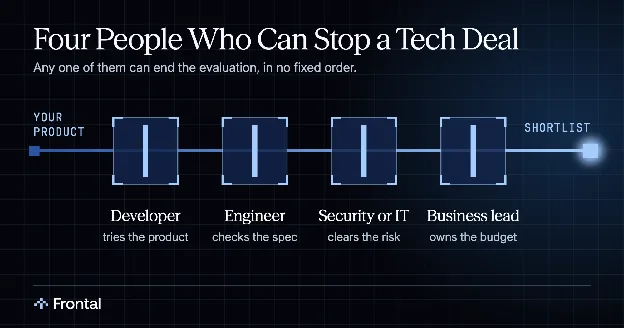
Depending on what you sell, any of the four can keep your product off the shortlist.
So look at your last few lost or stalled deals, ask who stopped them, and start from that row of the table below. The middle column and the groupings are our judgment too, so ask each firm for work aimed at that person.
| If this person can stop the deal | What we’d expect them to check | Start with |
|---|---|---|
| A developer who tries the product | Docs, code samples, the first run | Hackmamba, Draft.dev |
| An engineer | The specification against a real application | TREW Marketing |
| A security or IT lead | Risk, access to company systems, what trusted outlets say | Mighty & True, MOI Global, TEAM LEWIS |
| A business lead who owns the budget | Cost, proof from a similar company | Fox Agency, Altitude Marketing, New North |
| Several people at each named account | Whether each role has seen a consistent case | Frontal, MOI Global, Mighty & True |
Enterprise software marketing agencies have one more person to plan for: procurement, which Foundry names alongside the CIO among the roles to address. If your deals stall there, ask what the agency has produced for that stage.
That matters because the shortlist is short. TrustRadius surveyed 1,862 technology buyers for its 2026 B2B Buying Disconnect report and found that 83% shortlisted three or fewer products, while 74% used reviews to inform the decision.
AI is now part of that research too: 63% used it, and 94% of those buyers said they fact-check its answers at least some of the time. So an agency’s real job is to make your claims hold up for the person checking them.
The Best B2B Tech Marketing Agencies, Grouped by Buyer
Entries 2 and 3 fit developers, 4 engineers, 5 to 7 security and IT buyers, and 8 to 10 business leads. The table shows the buyer each firm fits best and its named tech proof where it publishes any, so check whether that proof counts reach, leads or opportunities.
| Agency | Tech buyer it fits best | Main services | Pricing (from) | Named tech proof |
|---|---|---|---|---|
| Frontal | Buying groups at named accounts | GTM engineering, ABM, paid media, content, RevOps | Not published; three-month start | AirOps: $7.83M qualified pipeline and $1.52M closed-won in 10 months |
| Hackmamba | Developers | Technical content, paid media, docs, DevRel | $5,000 engagement (own site) | Actian: reached 1M developers in six months |
| Draft.dev | Developers reading technical content | Tutorials, SEO and GEO, distribution | $9,000/month (own site) | Sinch Mailgun: 20 to 45% click-through rate |
| TREW Marketing | Engineers | Strategy, content, PR, HubSpot, web | $10,000/month (own site) | Silex: 50% more inbound leads (2018 launch) |
| Mighty & True | Security product buyers | ABM, paid, content, automation | $50,000+ project (Clutch) | StrongDM: cost per lead down 65% |
| MOI Global | CISOs and enterprise IT | Brand, demand, ABM, events | $10,000+ project (Clutch) | Okta: $4.185M influenced pipeline |
| TEAM LEWIS | IT and security press readers | PR, integrated campaigns | Not published | BlackBerry: 4,200 articles in FY23 |
| Fox Agency | Business leads at global brands | Brand, PR, media, web | $25,000+ project (Clutch) | OneStream: 28% more leads |
| Altitude Marketing | Niche software buyers | Content, SEO, PPC, trade media | $9,500/month (own site) | Hedge Trackers: install base doubled (undated) |
| New North | Business leads, for small marketing teams | Content, paid, social, outbound | $4,000/month (own site) | Logos and work samples, no published results |
Clutch figures are from each firm’s profile in October 2026 and the rest are from the firm’s own site, so treat every result as self-reported.
1. Frontal
Best for: Sales-led tech selling to named accounts
Overview: Frontal is the go-to-market partner for B2B tech companies past product-market fit with a real sales team, and it isn’t organized around one persona. It works as an extension of your team across GTM engineering, account-based marketing, paid media, content engineering and RevOps. Clients can start with one service, and when several are in scope they run against one shared list of accounts, inside your CRM and Slack.
AirOps shows what that looks like when several channels share one account list. Frontal ran account-based ads and outbound against a tiered list inside AirOps’ HubSpot, and the AirOps program produced $7.83M in qualified pipeline and $1.52M in closed-won revenue in 10 months, without adding SDRs.
Playbook shows the same work when the buyer has never heard of you. The compliance and workflow automation SaaS company of about 25 people had grown entirely through inbound and referrals when it set out to reach MedTech, Pharma and Biotech startups in South Africa, with no outbound in place.
Frontal built the system on Clay and Instantly and developed the offers with Playbook. What worked was writing in each prospect’s native language and leading with the compliance bottlenecks Playbook removes. The Playbook program produced 20 opportunities in its first 20 days and 300+ positive replies, and after nine months Playbook’s own team runs it.
Playbook’s figures count opportunities and replies, with no revenue number, while the AirOps figures include closed-won revenue. ColdIQ Agency became Frontal.
Core services:
- Signal-based outbound, so accounts showing hiring or website-visit signals hear from your team’s named inboxes.
- Account-based marketing that coordinates ads and outbound against the accounts you agree on, with engagement recorded per account in your CRM.
- LinkedIn and Google ads with CRM conversions fed back to the platforms, so spend follows pipeline.
- Buying-committee research and enrichment in Clay, so a list names several roles at an account instead of one contact.
- Content engineering, where your founders and team get interviewed and the material becomes LinkedIn posts and SEO and GEO articles.
- RevOps work on duplicates, account tiers, fit scoring and lead routing in HubSpot or Salesforce.
Industries served: Legal tech, fintech, SaaS, healthtech, proptech
Pricing: Frontal publishes no rate card. Engagements begin with three months set out in a statement of work, the price is agreed on the call according to what’s in scope and what you already use, and ad spend sits outside the fee.
Pros: One team and one account list across channels, senior operators inside your CRM and Slack, one of six Clay Elite Studio Partners, HubSpot and Salesforce partner status, case studies with stated time windows
Cons: No developer relations or documentation service, no published price, no published results yet for its content work
Notable clients or projects: Teams at Hyperscience, Tiger Data, Aikido, TimeXtender and AirOps have worked with Frontal
Engagement model: Work opens on a three-month plan with named milestones and owners, and ongoing terms are agreed before work begins. You approve account lists and messages before anything goes out.
How to start working with them:
- Write down who most often stalls your deals and which accounts you most want to win.
- Book an intro call from Frontal’s site.
- Bring what your CRM shows about where deals stop moving.
- Agree scope, milestones and owners in the statement of work.
- Open your CRM and ad accounts to Frontal, then sign off the first lists and messages.
Why it’s a good B2B tech marketing agency: Sales-led tech deals are won account by account, so the useful question is who at each account has seen what. Frontal builds around one account list and reports results per account from your CRM, as qualified pipeline and closed-won revenue.
Final verdict: Choose Frontal if you have a sales team, a list of accounts worth winning and several channels to coordinate. If developers adopt your product before sales gets involved, start with Hackmamba or Draft.dev instead. If you’re pre-Series A with no sales team, it isn’t built for you yet.
2. Hackmamba
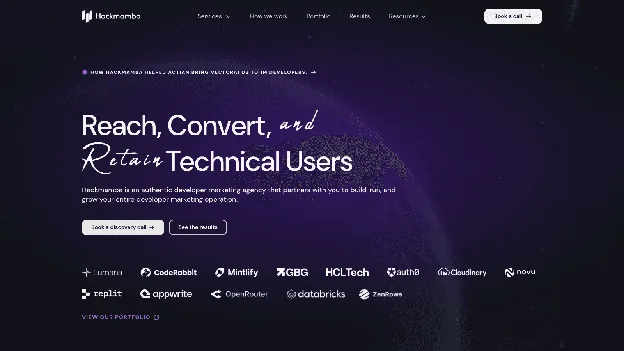
Overview: Hackmamba is a developer marketing agency for companies whose users write code. Its pricing page opens with a fit check that asks whether developers can use your product today and whether they affect your growth, and it tells you not to hire it if they don’t.
Core services:
- Technical content, SEO and GEO built on the questions developers already ask.
- Paid media across Google, Reddit and LinkedIn aimed at technical searches and communities.
- Documentation, DevRel and onboarding work that brings developer feedback back to the product team.
Industries served: Developer tools, AI infrastructure, APIs
Pricing: Its own site lists a focused engagement from $5,000, a content or developer marketing leader from $10,000 a month, and a connected program across several workstreams from $15,000 a month.
Pros: Published pricing, a public fit check, docs and paid media in one team
Cons: Its case figures count reach and traffic, and its homepage’s $400M+ influenced-pipeline claim isn’t broken down by client, no website builds or product naming, no use until a product can be tested
Notable clients or work: Actian, Cloudinary, OpenRouter. It says Actian’s VectorAI DB reached one million developers in six months, and that Endform’s Google search traffic grew to nearly 4x in four months.
Why it’s a good B2B tech marketing agency: The first person to judge an API, a database or a dev tool will try it before they read anything about it, and this team builds for that moment.
Final verdict: Start here when developer adoption drives your growth and you want content, paid media and docs run together.
3. Draft.dev
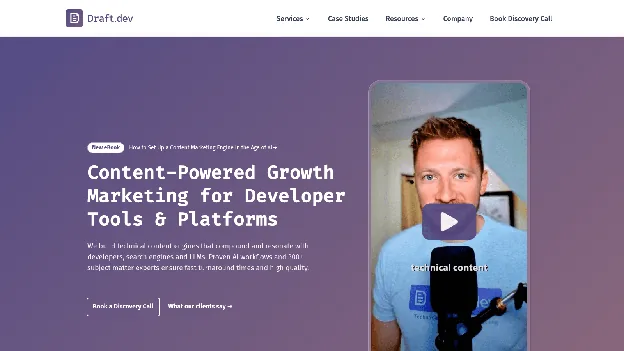
Overview: Draft.dev is a technical content agency for developer tools and platforms, founded in 2020 by former CTO Karl Hughes. It combines research and AI workflows with a network of engineers who check technical accuracy and test the code.
Core services:
- Tutorials, comparison pages and technical blog posts reviewed by subject matter experts.
- SEO and GEO research into what developers ask search engines and AI assistants.
- Distribution and refreshes across guest posts, newsletters, video and social.
Industries served: Developer tools, cloud infrastructure, B2B SaaS
Pricing: Plans start at $9,000 a month with a three-month minimum, according to its own site, and clients can add paid growth options over time.
Pros: A published starting price, engineers testing the code in its content, tracking of AI citations
Cons: Content-led rather than a full go-to-market team, several recent case studies don’t name the client, its results mostly count clicks, views and AI citations rather than pipeline
Notable clients or work: Sinch Mailgun, Gusto, Descope. Its Sinch Mailgun case study reports a 20 to 45% click-through rate on developer content, and an unnamed developer API platform grew blog views from 138 to 1,418 in seven months.
When to call: Your engineers know the product but have no time to write about it, and your marketers can’t write the tutorials on their own.
Final verdict: Pick Draft.dev when technical content is the gap and you already own the rest of the motion.
4. TREW Marketing
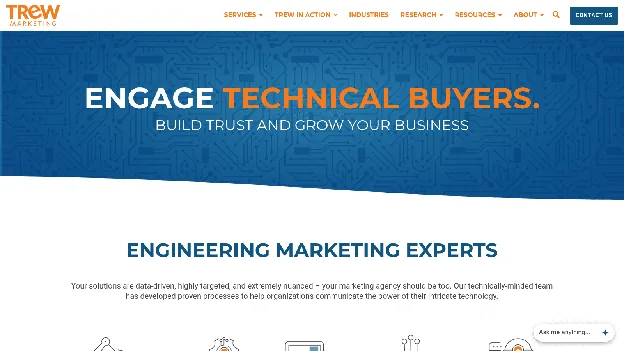
Overview: TREW Marketing has worked with engineering and technical companies since 2008, and Clutch lists it in Austin, Texas. It co-publishes the State of Marketing to Engineers report with GlobalSpec, which says that technical buyers complete 62% of the buying journey before contacting a vendor.
Core services:
- Marketing strategy and product launch planning for technical companies.
- Content, PR and thought leadership written for engineers.
- HubSpot setup and website work tied to lead generation.
Industries served: Manufacturing, robotics, engineering software
Pricing: Its process page gives typical ranges: execution retainers at $10,000 to $16,000 a month, agency-of-record work at $12,000 to $25,000 a month, and strategy projects at $10,000 to $30,000 each.
Pros: Published price ranges, co-published research on technical buyers, long experience with engineering companies
Cons: Clutch puts manufacturing at 70% of its work, so a pure software seller may sit outside its core, its clearest dated lead result is from 2018, it wants an internal marketing champion on your side
Notable clients or work: Ansys, Path Robotics, Silex Technology. For Silex it reports a 50% increase in inbound leads and a 63% increase in new web-generated contacts in the first year after an early-2018 site launch.
Who should shortlist it: Sellers of technical products whose engineers read the specification before they talk to anyone.
Final verdict: The specialist to call when your buyer is an engineer rather than a developer or a CIO.
5. Mighty & True
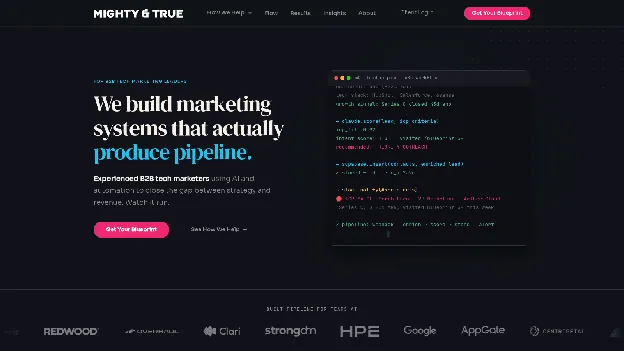
Overview: Mighty & True sells to B2B tech marketing leaders and describes its work as only for tech, with named results that lean toward security vendors. Clutch lists it in Leander, Texas, and it pairs campaigns with AI and automation workflows.
Core services:
- Consulting on positioning, ICP definition and campaign planning.
- ABM, paid search, paid social, content and email programs run end to end.
- CRM optimization, workflow automation and reporting infrastructure.
Industries served: Cybersecurity, cloud infrastructure, B2B SaaS
Pricing: Its site lists no rates and offers a free 45-minute planning session first. Clutch shows a $50,000+ minimum project and $50 to $99 an hour.
Pros: A tech-only focus, named security results, automation alongside campaigns
Cons: No published price, a high Clutch minimum, several homepage results name only a company type
Notable clients or work: StrongDM, Appgate, HPE. It reports StrongDM’s cost per lead down 65% from launch, and 2.5x the return on ad spend of Appgate’s previous agency.
Why it made this list: Security buyers have heard every claim in their category, and this firm’s named campaigns were built for exactly that crowded market.
Final verdict: Worth a call for security vendors who want campaigns and the automation behind them from one team.
6. MOI Global
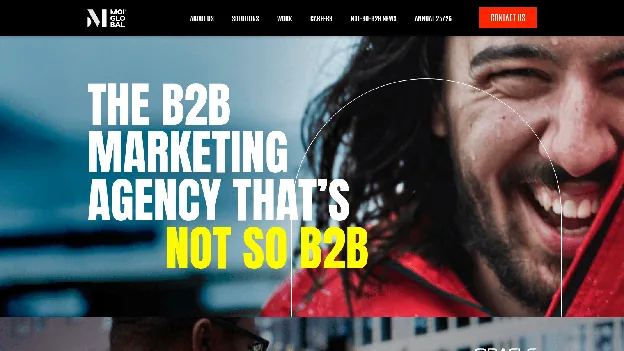
Overview: MOI Global calls itself an integrated creative agency for B2B technology brands, with offices in London, New York, Munich, Singapore, Sydney and Dubai. Its Cohesity work started from where CISOs are influenced and built a presence there before they began researching.
Core services:
- Brand and demand campaigns for enterprise technology companies.
- Account-based marketing, including one-to-one programs at scale.
- Buyer-signal analysis that shapes go-to-market plans, plus events.
Industries served: Enterprise software, cybersecurity, telecoms
Pricing: MOI lists no rates on its site. Clutch shows projects from $10,000, at $150 to $199 an hour.
Pros: Enterprise tech clients, brand and ABM in one agency, offices across several regions
Cons: No published pricing, its figures are undated stat badges, the Okta number is influenced rather than sourced pipeline
Notable clients or work: Okta, Oracle, Cohesity. Its Okta example reports $4.185M in new influenced pipeline, 22 new opportunities and 55 qualified leads from one-to-one ABM.
Best reason to hire it: A CISO or CIO needs to know your name before a deal starts, and you have budget for brand as well as demand.
Final verdict: Shortlist it for enterprise brand and ABM, and ask how its pipeline figures were attributed.
7. TEAM LEWIS
Overview: TEAM LEWIS is a global marketing and communications agency that says more than 70% of its client base operates in technology, across 25+ offices. PR leads much of its tech work.
Core services:
- PR and media relations for technology brands.
- Integrated campaigns across digital and social.
- A flexible retainer that moves spend between services as needs change.
Industries served: Enterprise technology, cybersecurity, consumer electronics
Pricing: It publishes no figures. Its LEWIS Flex model adds a quarterly spend on top of base digital or PR fees, and Clutch’s only data point is one review on a $200,000 to $999,999 project.
Pros: Reach across many markets, experience with security press, budget that can move between services
Cons: Its case results mostly count coverage and reach rather than pipeline, consumer tech work sits alongside B2B, no published price
Notable clients or work: BlackBerry, Schneider Electric, Jabra. For BlackBerry’s move from device hardware into cybersecurity, it reports 250+ unique articles in the first week and 4,200 global articles in FY23.
Why tech teams call it: You’ve changed what you sell, and security or IT readers need to hear it from publications they already read.
Final verdict: A strong fit for a repositioning that needs press first, so ask how that coverage would connect to pipeline.
8. Fox Agency
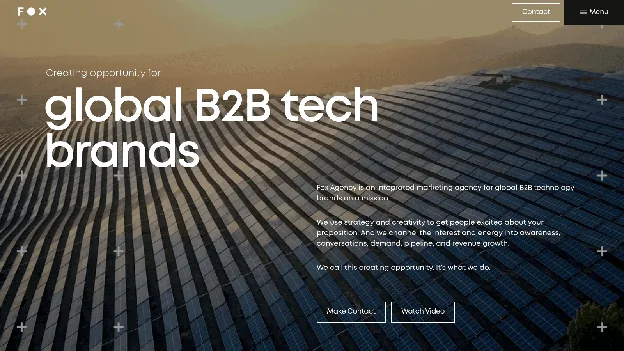
Overview: Fox Agency is an integrated marketing and PR agency for global B2B technology brands, with offices in New York, Denver, London and Leeds. It belongs to the Worldwide Partners network, and its OneStream campaign spoke directly to CFOs through business media, audio, out-of-home and industry events.
Core services:
- Brand strategy, creative and website design.
- B2B tech PR.
- Media and performance across social, display, search and GEO.
Industries served: Finance software, test and measurement, connectivity
Pricing: We found no rates on the Fox pages we checked. Clutch shows a $25,000+ minimum project with hourly rates undisclosed.
Pros: US and UK offices, PR and performance in one agency, named enterprise clients
Cons: No published pricing, its OneStream numbers count leads and MQLs rather than pipeline, a $25,000 Clutch minimum
Notable clients or work: OneStream, Keysight Technologies, TE Connectivity. It reports a 28% increase in leads and a 34% uplift in MQLs for OneStream.
Where it earns the call: Finance leaders and other senior business buyers have to recognize the brand before taking a meeting, in more than one region.
Final verdict: Consider Fox for brand-led programs across regions at larger tech companies.
9. Altitude Marketing
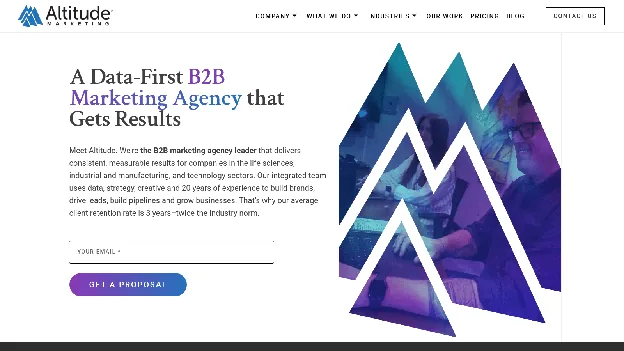
Overview: Altitude Marketing is a B2B-only agency in Emmaus, Pennsylvania, with a practice for enterprise software, technology and SaaS companies. It says it specializes in niche technical spaces, such as software for the life sciences, fintech and insurtech.
Core services:
- Content, SEO and AEO for niche technical topics.
- Digital advertising, PPC and email automation.
- Trade media and trade show programs.
Industries served: Enterprise software, fintech, life sciences software
Pricing: It publishes three monthly tiers: $9,500 to $12,500, $12,500 to $16,000, and $16,000+ at the top.
Pros: Published tiers, account teams of seven to nine specialists, a 5.0 Clutch rating from nine reviews
Cons: Software shares the agency with life sciences and manufacturing, its software page gives no dated figure for its headline case, its $9,500 floor is more than double New North’s
Notable clients or work: Hedge Trackers, Rakuten, GTreasury. Its software page headlines the Hedge Trackers work as doubling a fintech SaaS install base.
What it does best: Technical software sold into a niche where trade publications and shows still reach the buyer.
Final verdict: A sensible pick for niche software companies that want one integrated team and a price they can see first.
10. New North
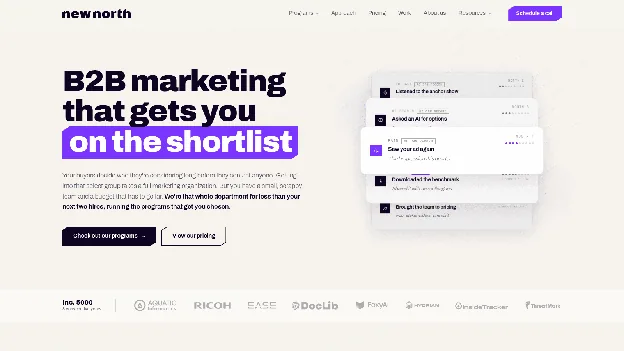
Overview: New North is a Henrico, Virginia agency for B2B tech companies it describes as “too scrappy” to build a marketing department in-house, and Marketers in Demand lists it among its agencies. It sells three programs instead of a menu, and how many you run sets your tier.
Core services:
- Authority: an anchor content series, search and LLM visibility.
- Reach: distribution, social and brand-building paid media.
- Pursuit: named-account plays across email, LinkedIn and paid.
Industries served: B2B software and technology (it publishes no industry list)
Pricing: One program runs $4,000 to $5,900 a month, two run $6,000 to $11,900, and all three start at $12,000. Tools are billed separately, and outbound isn’t sold as a single program.
Pros: The lowest published monthly floor here, one account director, pricing logic explained in full
Cons: Its work page shows samples with no published results, outbound only from the second tier, tools on top of the fee
Notable clients or work: Its homepage shows logos including Ricoh, ThreatMark and InsideTracker.
Why it earns a place here: You’re a marketing team of one or two at a tech company, and you need a whole department’s output on a small budget.
Final verdict: The clearest pricing on this list for small teams, so ask for results on the first call.
What to Ask a Tech Marketing Agency on the First Call
A useful filter for developer-facing work comes from an r/B2BSaaS thread on hiring a developer marketing agency. The person who started it later suggested checking whether an agency can produce code-backed content, understands workflows such as CI/CD and IAM, and can improve docs and onboarding rather than only SEO blogs.
It’s one anonymous person’s view, and it adapts well to other technical buyers. An agency that can’t show you work aimed at your evaluator hasn’t earned the shortlist, however good its case studies look, so ask:
- Which of the four buyers has this team marketed to, and can I see that work?
- Who writes the technical claims, and how do you check them against the product?
- What does the headline number in your closest case study count: reach, leads, opportunities or revenue?
- Who on your team will be on my account each week?
- Is anything from my accounts or data shared between your clients, even in aggregated form?
Security buyers often ask it, and it’s a fair question for anyone who will have access to your CRM or Clay account. Any agency selling to security buyers should have an answer ready.
What These Agencies Will Need From You
Technical marketing needs your experts’ time, and the better agencies say so up front. Hackmamba asks for product access, performance data and timely reviews from the people who understand the product, and it wants someone inside your company who owns the engagement. TREW Marketing looks for an internal marketing champion with a clear decision-making structure behind them.
Draft.dev’s founder made the same point on Reddit, saying the firm almost never works with pre-launch stealth startups and calling too many partners with nobody leading strategy internally one of the biggest agency failure modes. So name an owner before you sign, and block time for your engineers to review drafts.
Your data has to be ready too. If your CRM can’t show which accounts and roles touched a deal, a CRM consultant may be the better first call, because no agency can report on what your system doesn’t record.
How Much Do B2B Tech Marketing Agencies Cost?
TrustRadius says transparent pricing has been buyers’ top wish-list item for vendors four years running, and half of these B2B tech marketing agencies oblige. Frontal isn’t one of them: we set the price on the call. The table below shows what each firm does publish.
| Pricing signal | What these agencies publish | How to read it |
|---|---|---|
| Monthly programs (own site) | New North $4,000 to $5,900 for one program; Draft.dev from $9,000; Altitude $9,500 to $12,500; TREW $10,000 to $16,000; Hackmamba from $10,000 for a marketing leader or $15,000 for connected work | The floor for ongoing work, with scope varying by firm |
| Project or engagement (own site) | Hackmamba from $5,000; TREW strategy projects $10,000 to $30,000 | A way to test a firm on one defined problem |
| Minimum project (Clutch) | MOI Global $10,000+; Fox Agency $25,000+; Mighty & True $50,000+ | The smallest engagement listed |
| No price on site or Clutch minimum | Frontal, TEAM LEWIS | Ask for a range on the first call |
The floors aren’t like for like, since New North’s covers one program and Hackmamba’s connected work covers several workstreams. Mighty & True’s own buying guide puts senior B2B tech retainers at around $15,000 to $75,000 a month, so expect a real program to land above the entry points. Ad spend usually comes on top, a point to check with LinkedIn ads agencies and full-service firms alike.
Should You Hire Instead of Using an Agency?
Many teams weigh an agency against one hire, such as a GTM engineer or a forward-deployed engineer, and good ones are expensive and hard to find. A hire keeps the product knowledge in-house, while an agency brings channels one person can’t cover, so the right answer depends on how many channels you actually need to run.
How We Chose These Marketing Agencies for Tech Companies
Plenty of marketing agencies for tech companies say they specialize, so we started with the technology marketing lists that rank in Google today and the developer marketing firms practitioners recommend, then checked each candidate against its own website. Four checks decided who stayed:
- Tech is its main business, or it runs a dedicated software or technology practice.
- It names technology clients on its own site.
- It’s still independent, or its ownership is public and doesn’t change what you’d be buying.
- Every price is read from the firm’s site or Clutch, never estimated.
The checks removed two firms that appear on tech agency lists. MomentumABM is now part of Accenture Song, and Fifty Five and Five now describes itself as building AI tools for sales and marketing teams.
The four checks decide who’s on the list, and the buyer groups are our own reading. We placed each firm by reading who its site says it serves and who its named work was aimed at, which is firmest for Hackmamba, Draft.dev and TREW Marketing because they name their buyer outright.
Mighty & True sells to marketing leaders with results that lean toward security vendors, while Altitude Marketing and New North cover tech buyers broadly, so those three placements are the loosest.
Firms built mainly to fill a sales calendar, such as SaaS lead generation agencies, were left out because that’s a different purchase.
Pick Your Buyer, Then Shortlist Two Agencies
Write down who stopped each of your last five lost or stalled deals before you contact any B2B tech marketing agencies. If the same role keeps appearing, shortlist two firms from that row of the table near the top, and ask each for work aimed at that person.
If the answer changes from deal to deal because several people at each account have to agree, that’s the problem our GTM engineering and ABM teams work on, with one account list your sales team can see.
Book an intro call and bring those five deals.
Frequently Asked Questions
How much do B2B tech marketing agencies charge per month?
Among the B2B tech marketing agencies here that publish monthly prices, entry points run from $4,000 at New North to $10,000 at TREW Marketing, with Draft.dev and Altitude Marketing in between. Larger programs cost more, so check what the floor covers and whether ad spend and tools sit inside the fee.
Do marketing agencies for tech companies need technical writers on staff?
It depends on the buyer. If developers or engineers evaluate your product, yes, or the agency needs a reliable network of subject matter experts, which is how Draft.dev works. If a business lead makes the decision, positioning and proof from similar companies usually matter more than code samples.
What is the difference between B2B software marketing agencies and general B2B agencies?
B2B software marketing agencies expect a buying group with technical evaluators, security review and often a product people can try before they talk to sales. A general B2B agency may be strong on brand and demand but hasn’t necessarily written for those people. Ask for work aimed at the person who evaluates your product.
When do enterprise software marketing agencies make sense?
They make sense when your deals run through CIOs, security leaders and procurement, and you need those people to know your name before sales reaches them. MOI Global and Fox Agency work at that level, while a smaller company selling to one team usually gets more from a specialist with a lower floor.
How long does a tech marketing agency take to show results?
It depends on what you count. Playbook’s outbound produced opportunities within 20 days, Hackmamba reports search growth at Endform in four months, and TREW Marketing reports lead growth at Silex over a full year. Agree on the measure and the review date before work starts, so you both know when to judge it.