Key Takeaways
- For B2B ads tested by AI agents, start with Multiply; for one-to-one ABM, The ABM Agency; for content in several languages, Contentoo. Keenfolks fits global brands producing content for many markets, and Grizzle a team that wants to run the system itself.
- All ten name a human check. Seven put it on the agency’s side, our own firm included, and Grizzle does until handover. At Keenfolks and Inverta, the check sits with your team.
- Four firms credit AI in a B2B case study: Multiply, Superside, Inverta and The ABM Agency. None of the ten publishes a client case that credits pipeline or revenue to the AI.
- Six publish prices. The lowest monthly figure is Contentoo’s typical €3,000, and the highest published one is $30,000 for Superside’s Dedicated plan. Keenfolks, Inverta, The Smarketers and our firm publish no rate.
Every agency on this list describes an AI step. We judged each, from its own pages, on what that AI produces, who checks the output before it ships and what its published result counts. Nine outside AI marketing agencies for B2B teams made the list: Multiply, Keenfolks, Superside, Grizzle, Contentoo, O8, The ABM Agency, Inverta and The Smarketers.
The tenth name is our own: Frontal, the go-to-market partner for B2B tech companies, working as an extension of your team. Every price in this list appears as its firm publishes it, in US dollars except Contentoo’s euros, checked November 5, 2026.
Search results for AI marketing agencies mix three different things. Agencies that put AI inside the work they deliver make up this list. AI agent platforms and other AI marketing companies sell software your team runs, so none of them is an entry. Shops that build custom agents and n8n or Zapier workflows are AI automation agencies, a separate buy we leave out.
What an AI Marketing Agency Does
An AI marketing agency puts AI inside the marketing work it delivers and keeps people responsible for what ships. Across these ten firms, the AI sits in three places: ads and creative, content and reporting, and account research for ABM.
Sales and marketing is where businesses use AI most. Among US firms already using AI, 52% use it there, more than in any other function, according to a Census Bureau working paper. Only 18% of all firms used AI in a business function from November 2025 to January 2026, so the 52% describes adopters, not every company.
The same paper found writing and editing was the most common generative AI task, reported by 85% of firms with task-level use.
What the agency adds is judgment around the drafting, starting with naming each AI step. Our Claude Code for GTM playbook, for example, gives Claude Code the custom logic, Clay the enrichment and n8n the scheduled runs. An agency should name the step it built and the person who approves the result just as plainly.
How We Grouped and Ordered These AI Marketing Agencies
We started from the agencies ranking for these searches and the firms Google’s AI Overview cites, then checked every firm’s own pages on November 5, 2026. Platforms, freelancer marketplaces, solo consultants and firms describing no AI step were left out. Each firm sits in one of three groups by where its AI works, and no group outranks another.
Order within a group is our editorial judgment. We weighed how specifically a firm’s pages describe its AI step and human check, how strong its B2B evidence is and how prominent it is for this search. Prominence is why Keenfolks, which Google’s AI Overview cites, sits second in its group, ahead of Superside, whose pages describe their check in more detail.
An AI claim counts here only when the firm’s own pages back it, since regulators have acted on unbacked ones. The FTC alleged that Workado promoted its AI Content Detector as “98 percent” accurate, while independent testing put it at 53 percent on general-purpose content. The final order, approved August 28, 2025, bars such claims without “competent and reliable evidence.”
That case also shaped the “who checks it” field. The FTC’s consumer protection director said the detector “did no better than a coin toss,” so software grading software doesn’t count as a check. We record a named role or person instead. Review belongs wherever a wrong output would be costly or seen by a buyer, a rule from our sales workflow automation process.
We put Frontal tenth, last in the account research group, because it’s our firm.
AI Marketing Agencies Compared on Who Checks the Output
Rows follow the order of the entries, in three groups by where the AI sits. Each “Who checks it” cell paraphrases the firm’s own page.
| Agency | Where the AI sits | What the AI produces | Who checks it | Price signal | Published result (what it counts) |
|---|---|---|---|---|---|
| Multiply | Paid ads, managed on its own platform | Ad copy, visuals, audiences and bids | Strategists review every update | Growth from $6K per month | Vanta: 770% more sales meetings, no window |
| Keenfolks | Ad and content production, budget advice | Asset versions for every market and format | Your team; no Keenfolks editor named | No published rate | Dolce Gusto: 65% less production time (consumer) |
| Superside | Ad, video and sales creative | Footage, visuals and translations from named tools | Human creatives, then your approval | $15,000 monthly minimum, annual term | Boomi: 3X creative options, 24% LinkedIn engagement |
| Grizzle | Content and SEO workflows you take over | Not specified; it builds the automations you run | Senior editors, then your team | From $6,000 a month | None credited to AI |
| Contentoo | Multilingual B2B content | First drafts and channel versions | Native experts, then your team | €3,000 to €9,000 a month, typical | None credited to AI |
| O8 | Research and reporting | Audits, briefs and a weekly HubSpot digest | An O8 specialist signs off | $5,700 a month for 30 hours | 60% less manual ops time, no client named |
| The ABM Agency | ABM setup and pursuit plans | Account research and first-draft assets | A senior marketer, before anything reaches a channel | Pilot from $21,420 | The Imagine Group: plan rebuilt in 24 minutes (turnaround time) |
| Inverta | ABM and signal campaigns | Account clusters and dashboards | Your team, for public-facing content | No published rate | 4,444 accounts analyzed in 48 hours |
| The Smarketers | Account research and outreach | Account profiles and personalized messages | Its team keeps quality control | No published rate | None credited to AI |
| Frontal | Account research inside GTM engineering | CRM account summaries, enrichment and first messages | Its engineers own targeting and messaging, then your team approves lists and messages | No published rate | Aircall: 3,655 accounts enriched in 6 months (data work, not credited to AI) |
Read the last column before comparing numbers, since each figure counts something different. The second column also shows why firms selling only AI writing are left out. Drafting is one of three places the AI sits here, so AI content marketing agencies are a narrower category.
AI Inside Ads and Creative
Ads and creative are where AI output is easiest to count, in variants made and tests run. The harder question is who decides which variant ships. Our Claude Code for ads build stops at “copy variations ready for a human to review, select, and upload.” These three AI marketing agencies give three different answers.
1. Multiply, Best for B2B Ad Testing Run by AI Agents and Strategists
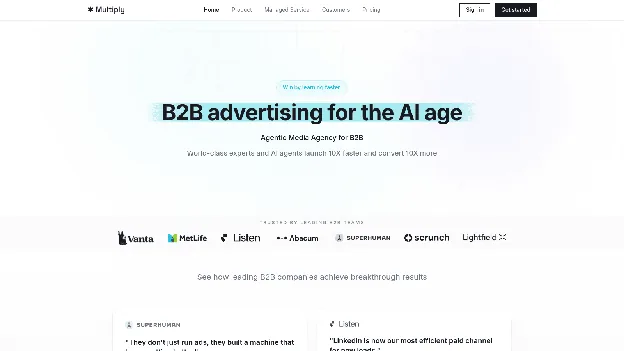
Best for: B2B teams spending $10K or more a month on LinkedIn, Google or ChatGPT ads.
Based in: San Francisco, per its job listings; no street address is published.
Where the AI sits: Paid media and creative. Multiply sells only a managed service, and every package includes its own Multiply AI Platform.
What the AI produces: Ad concepts, visuals, headlines and copy, “Hundreds of variations,” plus agents that build LinkedIn audiences and adjust bids. No outside model is named.
Who checks it: Its service loop runs “AI builds campaigns” and then “Humans review.” For Vanta, “Strategists reviewed every update before anything went live.”
Published result (what it counts): Vanta saw “770% More sales meetings on the same budget.” The figure counts meetings, credits the AI and states no window.
Where it’s strong:
- Review in the case itself. The Vanta write-up names the human check, not just the agents.
- A published ladder. You can budget before a call.
Watch for:
- Meetings, not pipeline. Ask how many became qualified opportunities.
- No terms on its site. Put exit and data terms into the contract.
Price: Growth starts at $6K per month for $10K to $100K of monthly media spend, and Scale at $12K per month for $100K to $250K. Enterprise is custom pricing.
2. Keenfolks, Best for Global Brands Producing AI Content Across Markets
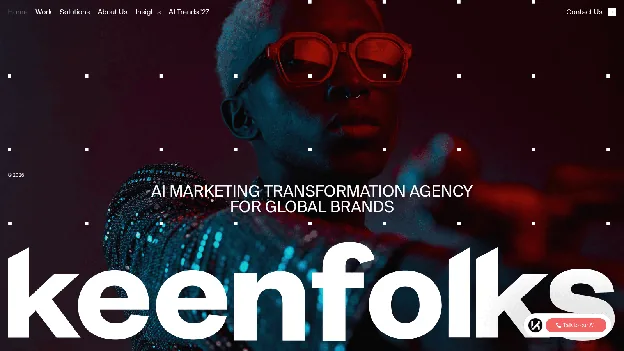
Best for: Global brands producing AI-made content across many markets and formats.
Based in: Barcelona, Spain, per its Terms, with offices in New York, Mexico City and London.
Where the AI sits: Ad and content production, plus a Data & AI Command Center that recommends “which audiences to target and how to allocate budget.”
What the AI produces: You set markets, channels and formats once, and its AI Content Platform can “generate every execution automatically, on-brand and ready to publish.” It names no model.
Who checks it: Your team, as far as its pages show. Its risk tool flags problems before subject experts first review an asset, learning from “historical feedback from previous human reviews.” No Keenfolks editor step is named.
Published result (what it counts): For Dolce Gusto in Latin America, 65% less production time across 12 markets. It’s a consumer brand, the AI gets the credit, and no window is given.
Where it’s strong:
- Production at market scale. That case covers 240+ formats per market from one system.
- A smaller first step. It offers “proof of concept and MVP with lower investments.”
Watch for:
- A consumer and pharma record. Its homepage clients and all six case studies are consumer or pharma brands, Nestlé and Diageo among them, so ask for B2B work.
- Its own products. Ask what you keep from its “built products” if you leave.
Price: No published rate. Its FAQ says “There is no minimum,” and brief to launch typically takes three to four weeks.
3. Superside, Best for High-Volume Ad and Sales Creative Made with AI
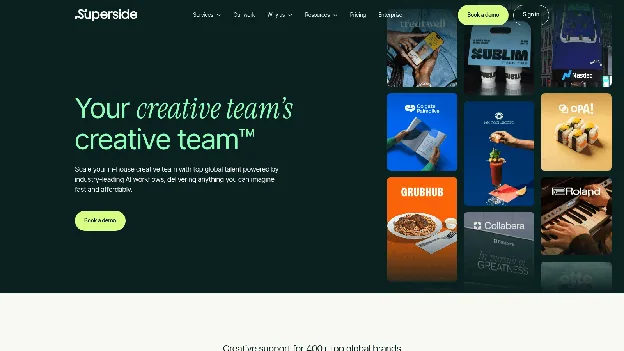
Best for: Teams needing ad, video and sales creative in volume, with a say in where AI is used.
Based in: No headquarters published; it calls itself “100% remote,” with a Delaware mailing address in its Terms.
Where the AI sits: Ad, video and product creative, plus B2B sales collateral for “ABM campaigns, personalized ads, high profile presentations.”
What the AI produces: Footage, voiceovers, product visuals and translations, from tools it names: “ChatGPT, DALL-E, Midjourney, Craft, Pika, Adobe and many more.”
Who checks it: Its human creatives, through “human-guided, AI-powered steps,” with you “included at every step from concept development to final approval.”
Published result (what it counts): Boomi “received 3X options vs. traditional design teams” and a 24% LinkedIn engagement rate, engagements divided by impressions. The client is B2B, the AI gets credit, and the period is unstated.
Where it’s strong:
- You choose the mix. Projects can be fully human, AI-assisted or both.
- Named tools. You know which models touch your brand.
Watch for:
- How AI is billed. Its AI page says savings pass to you and that AI work “carries a small premium,” so ask how both show on an invoice.
- Consumer-heavy work tiles. Most homepage tiles show consumer brands, so ask for B2B samples like Boomi’s.
Price: Subscriptions start at a $15,000 monthly minimum on an annual term, plus a $1,000 monthly software fee. Dedicated starts at $30,000 a month on a 12-month term.
AI Inside Content, Search and Reporting
Content is where AI made volume cheap, and volume alone rarely moved results. A content marketer with seven years in-house and agency side argued on Reddit that clients who quadrupled output saw flat traffic, because “output was never the constraint.” It’s one practitioner’s opinion, but it frames what to ask these three firms: who edits the drafts, and what the work is measured on.
LinkedIn rewards the same restraint. Our 2026 LinkedIn algorithm breakdown notes that posts with patterns common in AI-generated filler get suppressed before any human sees them.
4. Grizzle, Best for AI Content Workflows Your Team Runs After Handover
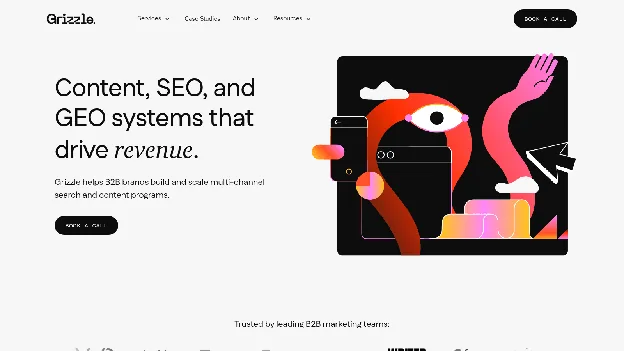
Best for: B2B software teams wanting an AI content system built, documented and handed to their staff.
Based in: London, UK.
Where the AI sits: Content, SEO and GEO, sold as “Expert-led content, engineered to scale.”
What the AI produces: Its pages don’t say what each automation drafts. Grizzle studies expert interviews and sales recordings, builds the automations and adds checkpoints: “The system is documented and handed over for your team to operate.” No model or tool is named.
Who checks it: Senior editors first. “Senior editors and writers produce the first, publishable pieces by hand,” setting the bar the AI follows, and after handover your team runs the checkpoints.
Published result (what it counts): None credited to AI. Pipedrive’s revenue rose 39% from bottom-of-funnel content.
Where it’s strong:
- Handover built in. You end with a documented system your own team runs.
- Editors set the standard. Human-written pieces define what the AI must match.
Watch for:
- No AI result yet. The Pipedrive figure credits content work.
- Tools unnamed. Ask what the system runs on, since your team will maintain it.
Price: Full-service engagements start at $6,000 a month, and the AI service offers a complimentary AI Content Audit.
5. Contentoo, Best for Multilingual B2B Content Checked by Native Experts
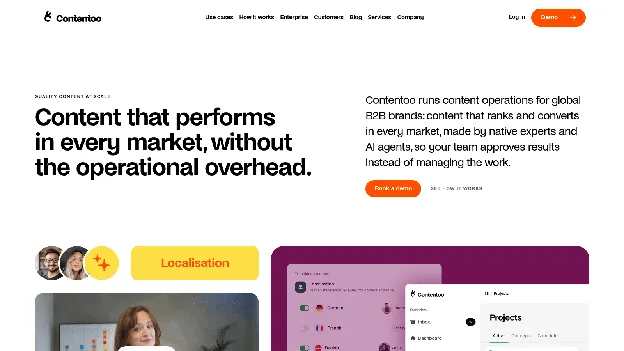
Best for: B2B teams publishing in several languages who want native speakers reviewing every draft.
Based in: Amsterdam, the Netherlands.
Where the AI sits: Writing, SEO and translation. Contentoo is a managed network of vetted freelance specialists working on its own platform, “not a marketplace to manage.”
What the AI produces: “On-brand first drafts built from your brief, tone, and terminology,” and channel versions of an approved asset “with every claim traced back to the source.” Its pages name no model.
Who checks it: “Human editors refine and approve,” and native experts “review every piece before it reaches you.” Your team then approves the result.
Published result (what it counts): No AI-credited figure. Sendcloud “grew content output by 50% and halved creation time,” which Contentoo credits to its freelance network.
Where it’s strong:
- Claims traced to source. Channel versions carry claims back to the approved asset.
- Two review layers. A native expert reads each piece before you do.
Watch for:
- Freelancers do the work. Its Terms define third parties to include freelancers, so ask who your regular writers will be.
- Billing in euros. Budget for exchange-rate swings.
Price: Typical subscriptions range from €3,000 to €9,000 a month, with no tiers published.
6. O8, Best for AI Research and Reporting Signed Off by a Specialist
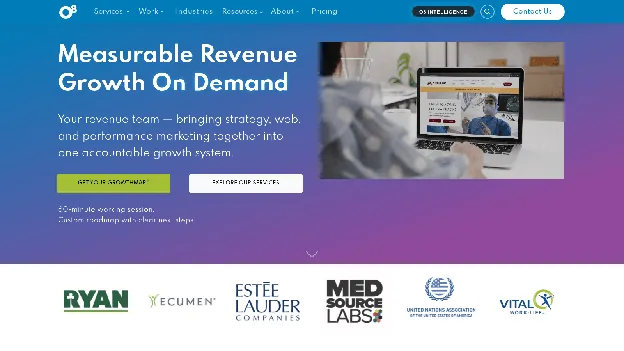
Best for: Teams wanting audits, briefs and weekly reports drafted by AI and approved by a specialist.
Based in: Minneapolis, Minnesota, a mailing address.
Where the AI sits: Research, SEO and reporting. Its B2B fit is mixed, since its homepage title names healthcare and higher education beside SaaS.
What the AI produces: “Automation does the repeatable research and drafting,” producing “an audit, a brief, a wireframe, an analysis.” A HubSpot agent posts a “Weekly Monday digest from HubSpot, GA4 and ads in Slack.” The model behind it goes unnamed.
Who checks it: A named role: “An O8 specialist signs off before anything reaches you.”
Published result (what it counts): Its AI page claims a “60% reduction in manual marketing ops time,” with no client, window or method given.
Where it’s strong:
- Sign-off as a rule. The specialist step covers every deliverable.
- Hours on the invoice. Retainers list their hours at a $190 blended rate.
Watch for:
- An unsourced headline figure. Ask which clients the 60% comes from.
- An onboarding period. Retainers go month-to-month only after an initial three months.
Price: Growth Foundations is $5,700 a month for 30 hours, Multi-Channel Growth $8,550 for 45 hours and Full-Service Partner $11,400 for 60 hours.
AI Inside Account Research and ABM
Account research is easier to check than most AI output, because a claim about an account can be traced to its source. These agencies use AI to research accounts, map buying committees and draft first messages, so the check before a seller uses it matters most. In-house, the same job runs in seven steps, from building the company list to gathering feedback, in our Claude for lead generation process.
7. The ABM Agency, Best for One-to-One ABM Campaigns Without a Production Team
Best for: B2B teams running one-to-one ABM without the people to build assets for each account.
Based in: Atlanta, Georgia.
Where the AI sits: ABM setup and account pursuit, through ABM Velocity, which it calls “an execution service built on software,” and Revenue Velocity.
What the AI produces: The setup work, covering “account research, persona mapping, campaign architecture, and first-draft assets” for landing pages, email, ads and direct mail. No model appears on its pages.
Who checks it: A senior marketer. “The ABM Agency does not send fully automated AI output to channel,” and AI research is labeled “not reviewed, confirm before you say it out loud.”
Published result (what it counts): For The Imagine Group, Revenue Velocity “rebuilt a pursuit plan 24 minutes after a seller shared new field intel.” It counts turnaround time.
Where it’s strong:
- A firm rule on output. Nothing AI-made reaches a channel unreviewed.
- Media at cost. On media spend, it says: “We never mark it up.”
Watch for:
- A speed result. Ask for an AI-credited result tied to pipeline.
- An unexplained ROI claim. Its homepage headline promises “a 9x+ ROI” without showing the basis there.
Price: The Essential pilot is $21,420, Integrated $43,800 and Full managed $64,260. Later managed campaigns cost $15,000 to $25,000 each, with media paid separately.
8. Inverta, Best for Clustering Target Accounts Before an ABM Push
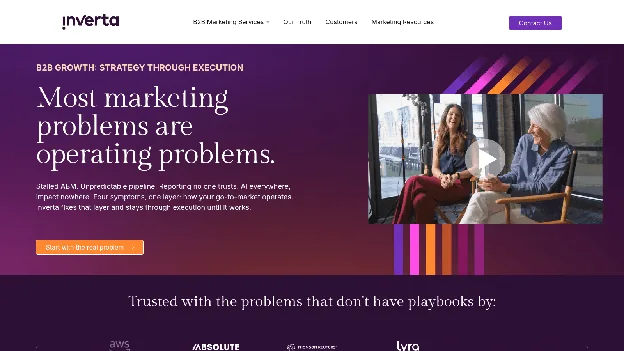
Best for: Enterprise B2B marketers who want accounts clustered by intent, with an AI policy agreed first.
Based in: Newtown Square, Pennsylvania, per the mailing address on its contact page.
Where the AI sits: ABM and signal-based campaigns, plus campaign analysis and AI governance.
What the AI produces: Its pages don’t list each output. One case delivered a clustered account list and an Account Insights dashboard.
Who checks it: Your team, under a policy written first, “ensuring you have ‘humans in the loop’ for all public-facing content.”
Published result (what it counts): A Korean electronics maker the case calls Sanxing had 4,444 accounts analyzed and AI-generated dashboards built in 48 hours. Those figures measure accounts and build time; no pipeline is reported.
Where it’s strong:
- Governance first. Data rules and review are agreed before any tool runs.
- A pilot first. Its ABM page says most engagements start as a 90-day pilot.
Watch for:
- Internal outputs. Its stated check covers public-facing content; ask who checks dashboards.
- No published price. Ask what the 90-day pilot costs and what happens after it.
Price: No published rate on the pages checked. Its ABM page says “Cost scales with scope, not agency size.”
9. The Smarketers, Best for Account Research and Outreach on a Named AI Stack
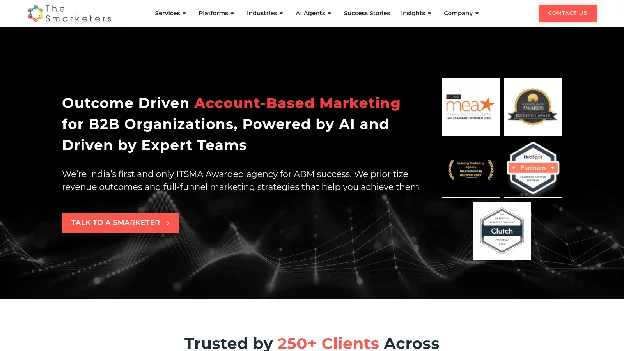
Best for: B2B tech companies wanting account research and personalized email and LinkedIn outreach on a disclosed AI stack.
Based in: Hyderabad, India.
Where the AI sits: Account research and outreach in its managed ABM service, covering ICP research, intent signals and personalized messages.
What the AI produces: “Claude Code processes account data, generates personalized messaging, scores intent, and determines optimal channel and timing.” Clay, n8n and Relevance AI are also named.
Who checks it: Its team, per its AI ABM page: “the strategy, account selection, and quality control remain human-driven.”
Published result (what it counts): Nothing credited to AI. For an unnamed Fortune 500 tech company, targeted ABM produced over 150 sales-qualified accounts within eight months.
Where it’s strong:
- A disclosed stack. You can check each tool against your security rules.
- People pick the accounts. Account selection stays with its team.
Watch for:
- Outbound at the core. AI-written emails go out through Instantly and Smartlead, so confirm whose domains send them.
- An unnamed client. Its ABM case names no company.
Price: No published rate on any page checked.
10. Frontal, Best for Account Research Written Into Your CRM
Best for: Teams wanting every target account researched and summarized in the CRM, for example a software vendor past product-market fit with a real sales team.
Based in: Shanghai (remote team).
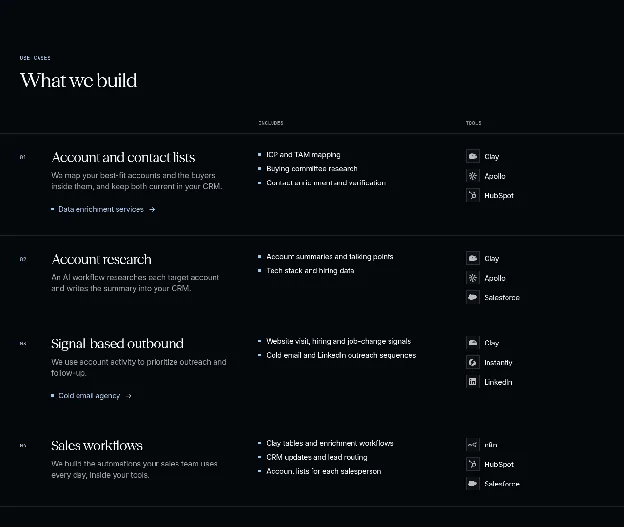
Where the AI sits: Frontal is the firm we run, and its AI work sits mainly inside GTM engineering: account research, CRM records and first drafts of outreach.
What the AI produces: Its account research row lists “Account summaries and talking points” and “Tech stack and hiring data” as outputs. The GTM engineering FAQ adds: “AI workflows do the repetitive work: researching each account, writing summaries into your CRM, enriching new records and drafting first messages.”
Who checks it: Frontal’s engineers “build those workflows and own the targeting and messaging,” the same FAQ answer says. Your team’s step is to “Approve the lists and messages before they go out.” Ask how summaries are sampled before they reach your CRM, the same question this list asks of every firm.
Published result (what it counts): The closest case is Aircall, where Frontal replaced hand-built regional lists with one account database in Salesforce, enriched and refreshed through Clay: 3,655 accounts created and enriched into a self-refreshing TAM in 6 months. That counts accounts and data coverage, and the case credits no figure to AI. Frontal’s work is judged on the qualified pipeline your CRM records.
Where it’s strong:
- Notes where reps already look. Summaries and talking points land in the CRM record, with Clay, Apollo and Salesforce named for the work.
- A Clay Elite Studio Partner. Clay heads the tool list on its account research row.
Watch for:
- No AI step on the ads side. Its paid media and account-based marketing pages name no AI step beyond “using software and AI where they help.”
- Sign-off time is yours. Lists and messages wait for your approval, so decide early who on your team gives it.
Price: No published rate. Most clients start with one service, and Frontal agrees scope and pricing with you on a call.
To talk through which accounts you’d want researched first, book a short call.
What AI Marketing Agencies Charge
€3,000 a month is where Contentoo’s typical subscriptions begin, the lowest monthly figure these ten AI marketing agencies publish. Six of them publish a price, in units that differ.
| Agency | Published price | Unit and terms |
|---|---|---|
| Contentoo | €3,000 to €9,000 | Typical monthly subscription; no tiers |
| O8 | Growth Foundations $5,700; Multi-Channel Growth $8,550; Full-Service Partner $11,400 | Per month for 30, 45 or 60 hours, month-to-month after three months |
| Grizzle | From $6,000 | Per month, full-service engagements |
| Multiply | Growth from $6K; Scale from $12K; Enterprise custom pricing | Per month, tiers set by monthly media spend |
| Superside | From $15,000; Dedicated from $30,000 | Per month on an annual or 12-month term, plus a $1,000 monthly software fee |
| The ABM Agency | Essential pilot $21,420; Integrated $43,800; Full managed $64,260 | Per pilot, then $15,000 to $25,000 per managed campaign |
| Inverta | No published rate | Most engagements start as a 90-day pilot |
| Keenfolks | No published rate | Its FAQ says “There is no minimum” |
| The Smarketers | No published rate | Not stated on any page checked |
| Frontal | No published rate | Scope and pricing set on a call |
The fees don’t buy the same thing. O8 sells hours, The ABM Agency charges per campaign, and Multiply’s tiers follow your media spend, so a lower number can cover less work. Frontal’s scope and price are agreed on a call, and most clients begin with one of its services.
How to Check an Agency’s AI Before You Sign
Three questions on a sales call show more about an AI marketing agency than its homepage does, so ask every finalist all three.
Ask for One AI Draft Before and After Review
Ask for a real output twice: once as the AI produced it, and once as it shipped. The gap shows what the reviewer actually does, and identical versions mean the review is a formality.
Ask, too, how often reviewers approve a draft with no changes, and over what period. A firm that can’t give that rate probably isn’t tracking it.
For AI output a buyer never sees, such as account data, ask how the firm samples it. Our public filings play holds its Claude step to one rule before data enters a CRM: “Open a sample of rows and check each value against the filing it cites.”
Ask Which Model Runs It and Who Signs Off
Ask which model or tool produces each output and which role approves it. A specific answer reads like our target account exec posts play, where Claude checks each post against the themes you sell into and a person writes the LinkedIn comment. Superside and The Smarketers name the AI models and tools they use. Frontal names Claude and Claude Code in its published playbooks, though its service pages don’t say which model runs each client workflow. The other seven name no outside model.
Also ask whether the AI step is something the agency built or a tool you could license yourself. One agency owner put the test on Reddit: “AI should be used to improve the delivery and output of an existing service.” His point, one owner’s view rather than data, was that reselling white-labeled AI software isn’t a service.
Ask What the Result Counts
Ask what each case figure counts, over what window, and whether the AI step gets the credit. Among these ten firms, Multiply’s Vanta figure counts sales meetings, The ABM Agency’s counts minutes, and Inverta’s counts accounts analyzed.
None of the ten publishes a client case that ties an AI-credited figure to pipeline or revenue. So ask each finalist to show one, or to explain how it would measure the AI’s share of a result in your CRM.
Frequently Asked Questions
Who are the best AI marketing agencies in 2026?
For B2B teams, ten stand out by where their AI works. Multiply, Keenfolks and Superside put AI into ads and creative, while Grizzle, Contentoo and O8 use it for content, search and reporting. The ABM Agency, Inverta, The Smarketers and Frontal, our own firm, use it for account research and ABM.
What is the difference between AI marketing companies and AI marketing agencies?
An AI marketing company usually sells software, such as ad generators, content tools or AI agent platforms, that your team runs. An AI marketing agency delivers the work and puts its own people between the AI and your buyers.
Some firms sit in between. Multiply sells a managed service that includes its own AI platform, and Keenfolks sells built products alongside its agency work.
How much does an AI marketing agency cost?
Among ten AI marketing agencies reviewed for B2B teams in November 2026, published fees start at €3,000 a month at Contentoo and $5,700 a month at O8. Grizzle starts at $6,000 a month, Multiply at $6K per month and Superside at a $15,000 monthly minimum.
The ABM Agency prices per pilot, from $21,420, while Keenfolks, Inverta, The Smarketers and Frontal list no price on their sites.
Does Frontal use AI in its marketing work?
Yes, mainly in GTM engineering, and Frontal is our firm. Its AI workflows research each target account, write summaries into your CRM, enrich new records and draft first messages, while its engineers own the targeting and messaging. You sign off on each list and message before it goes out.
Its content engineering service also uses AI for research and first drafts, which its writers edit and check against what your team said in interviews. Its RevOps service builds workflows that do research, enrichment and data entry.
Which AI tools do AI marketing agencies use?
Few publish them. Superside lists ChatGPT, DALL-E, Midjourney, Craft, Pika and Adobe, and The Smarketers names Claude Code, Clay, n8n and Relevance AI. Frontal’s published playbooks use Claude and Claude Code alongside Clay. Multiply runs its own agents, including one called Dot.
Ask each finalist which model drafts your work, which data sources feed its account research and where your data goes. The ABM Agency, for one, says client data stays in its own data lake and is “not retained by LLM providers.”
Should an AI marketing agency’s results credit the AI?
Only when the case says so. Multiply, Superside, The ABM Agency and Inverta credit AI in a published B2B case, and the other six on this list don’t.
Meetings, engagement rates and turnaround minutes are useful signals, but none of them is pipeline.
Can an AI marketing agency write content without a human editor?
Technically yes, but none of the three content, search and reporting firms here works that way. Grizzle has senior editors write the first pieces by hand, Contentoo has native experts review every piece, and O8 has a specialist approve each deliverable.
If an agency describes no editor at all, ask who reads each draft before it publishes and what they’re allowed to change.
Book an Intro Call with Frontal
Before you sign with any of these AI marketing agencies, ask each finalist for one AI draft as it came out and as it shipped. Then ask who approved it.
If your gap is account research written into your CRM, our GTM engineering builds the AI workflows, and your team has the final say on lists and messages. Whoever you hire, ask for the rule our CRM hygiene play runs on: “Nothing touches the CRM without a human yes and a way back.”