Key Takeaways
- Frontal is best for post-PMF B2B teams that want a CRM implemented as a working revenue system, built into your HubSpot or Salesforce and tied to the pipeline.
- RevPartners is best for HubSpot teams that want implementation and an ongoing RevOps team.
- Aptitude 8 is best for enterprise teams that need custom HubSpot engineering, deep integrations, and governance.
- New Breed is best for HubSpot teams that want the CRM implemented and the demand generation to fill it.
- Dig RevOps is best for B2B SaaS teams that want a strategy-first HubSpot build.
- CloudMasonry is best for enterprise teams implementing, migrating to, or consolidating Salesforce across the US and UK.
If you’re tired of patching the same messy CRM and want to know which CRM implementation service can take it off your plate, you’re in the right place.
This guide covers the 6 best CRM implementation services for B2B SaaS in 2026, including their key services, where they shine, where they fall short, and who each is best for.
How we built this list: every CRM implementation service provider here earns its spot based on its work, the platforms and stages it serves, and the client results it publishes. Frontal is included in this comparison and held to the same criteria as every other provider. Ultimately, the right one for you will depend on your setup, whether you want a one-time build, ongoing support, or a system someone implements and then keeps running.
Top 6 CRM Implementation Services for B2B SaaS in 2026
| Provider | Best For | Standout Strength | Starting Price |
|---|---|---|---|
| Frontal | Teams that want their CRM built in HubSpot or Salesforce, with the option to keep it run for them | Builds inside your HubSpot or Salesforce and can stay on to run it, tied to pipeline | Custom, scoped on a call |
| RevPartners | HubSpot teams that want implementation and a RevOps team on subscription | One of the most certified HubSpot teams, building and running from one team | RevOps as a Service from $9,850/mo |
| Aptitude 8 | Enterprise teams needing custom HubSpot engineering and deep integrations | Deep in-house technical bench with governance built into every build | Custom, scoped per engagement |
| New Breed | HubSpot teams that want implementation and demand generation from one partner | HubSpot’s top partner, holding every available accreditation | Custom, scoped per engagement |
| Dig RevOps | B2B SaaS teams that want a strategy-first HubSpot build | Diagnosis-first builds and deep recurring-revenue architecture | Custom, scoped per engagement |
| CloudMasonry | Enterprise teams implementing or consolidating Salesforce | Dedicated multi-cloud Salesforce specialist across the US and UK | Custom, scoped per engagement |
What Does CRM Implementation Include?
A CRM implementation covers more than switching the software on. A full build usually spans five things:
- Discovery and architecture: mapping how your team sells, then designing the data model, objects, pipelines, and permissions to match.
- Data migration and cleanup: moving records in, deduping and normalizing them, and enriching what's missing so the system starts on clean data.
- Automation and routing: building the workflows, lead scoring, and routing that move each record to the right person at the right time.
- Reporting and dashboards: wiring up the pipeline, forecast, and attribution views leadership will actually use.
- Training and adoption: documenting the build and getting each team using it, since a system nobody adopts produces nothing.
How deep each one goes depends on your platform, the state of your current data, and whether you want the partner to keep running it after launch.
1. Frontal: Best for Teams That Want Their CRM Implemented and Run
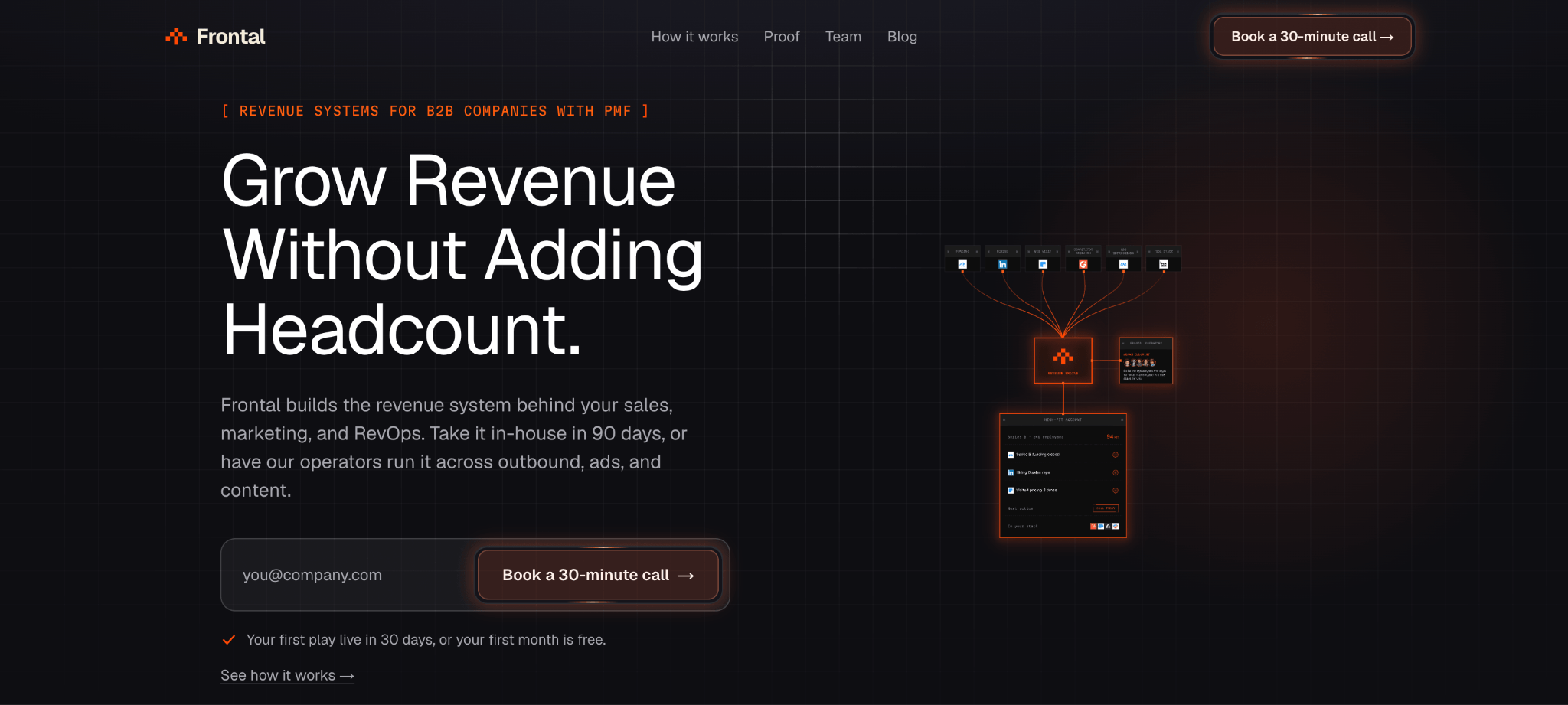
Frontal is a go-to-market partner for B2B tech companies past product-market fit. We implement your CRM in HubSpot or Salesforce and build it into the system your revenue team runs on. We’re a HubSpot Solutions Partner, a Salesforce Partner, and one of a small number of Clay Elite Studio Partners, with 250+ B2B companies served.
Frontal Key Services
A Frontal CRM implementation runs in four stages, from the data model underneath your CRM through to reporting and ongoing operation:
1. CRM Architecture and Setup
We shape the CRM around how your team sells, so the structure reflects your pipeline and puts the data your reps need in front of them. This covers:
- Data model, custom objects, and fields mapped to your sales process
- Pipeline and lifecycle stages that match how deals move
- Permissions and views set per role, so each team sees what it needs
For example, on a recent HubSpot build, we reviewed every custom object and field, removed what nobody used, and rebuilt the rest. With the right tooling, a cleanup that once took months ran in about a week.
2. Data Cleanup and Enrichment
Clean data is the difference between a CRM people trust and one they work around. At Frontal, we fix the records you already have, then set up enrichment so new ones come in clean too:
- Dedupe and normalize, so one account is one record and every field means the same thing everywhere
- Waterfall enrichment across multiple outbound data sources, so a missing title, headcount, or tech-stack detail gets filled from the next source when the first comes up empty
- Auto-enrichment on new records, so imports and form fills arrive enriched
We run this in Clay or the tools agreed for the engagement and write the results straight back to your CRM. If you’re exploring outside help for data enrichment and workflow automation, check out our guide to the best Clay automation agencies.
3. Signal Scoring, Lead Routing, and Workflow Automation
A clean database still sits idle unless the CRM knows what to do with it. We score every account on two things: how well it fits your market and what it’s doing right now, then turn a strong score into a next step:
- Live signals tracked, from funding rounds and hiring changes to website visits and a champion switching companies, using B2B intent data providers to identify accounts showing buying signals
- A human check before anything moves, so a competitor, a current customer, or a weak fit never gets routed to a rep
- Automatic routing and alerts, dropping the account, the signal, and the context into the right owner's queue in the CRM and Slack
Marketing-to-sales handoffs run the same way, so a qualified lead reaches the right person without waiting on a manual step.
4. Reporting, Attribution, and Ongoing Operation
We wire reporting and attribution to the clean data underneath, so the pipeline figure reads the same for marketing, sales, and RevOps, and every number traces back to the activity behind it. All of it lives in your own CRM.
From there, you choose: run the system with your team, or keep our operators on to run the day-to-day across outbound, ads, and content.
All four workstreams sit within our RevOps service. You can start there or connect it with our GTM Services, Ads, and Content Engineering so your whole go-to-market runs on one system. See how our RevOps work compares in our guide to the best RevOps agencies.
Frontal Pricing
Frontal doesn’t publish set pricing, since the scope depends on your platform, the state of your data, and how much you want us to run after launch. The initial build is a fixed-scope engagement, and ongoing operation after it is month-to-month. Book a 30-minute call, and we’ll walk through exactly what we’d build and what it would cost to set up.
Where Frontal Shines
- We build it and run it: Senior operators across data, RevOps, and GTM embed in your team to build the system, and you can keep them on after launch to run it and tune it week after week as real results come back. When GTM Services, Ads, or Content Engineering are also in scope, the same team keeps those connected to the CRM, so the whole setup gets better the longer we run it.
- You own everything we build: The whole build lives in your HubSpot, Salesforce, or whatever else you run. There’s no proprietary layer you rent and no black box you lose access to when the engagement ends. The working system stays with you, fully yours, so you never feel locked into us to keep it alive.
- The build is scoped to pass your security and compliance review: Security reviews sink plenty of implementations three weeks in, when IT flags a tool that can’t connect in your environment. We get ahead of it, surfacing data and compliance constraints up front and designing the setup around what your security team will approve, so the build clears review and holds up long after it goes live.
Where Frontal Falls Short
- A migration-only or deep systems-integration project is better served elsewhere: If what you need is a large, purely technical build, like moving years of data across a dozen connected systems or standing up custom CPQ, a dedicated systems integrator will go deeper than we do. We implement the CRM to produce pipeline, so a heavy integration job with no go-to-market work attached sits outside what we do best.
- Pre-PMF teams should wait: We’re strongest once you already have customers and a repeatable way of selling to them. If you’re still testing who your buyer is and why they buy, a polished CRM mostly organizes a question you haven’t answered yet. You’ll get far more from this build once you've proven the sales process and it’s worth scaling.
Frontal Client Results
- For Aircall, we created and enriched 3,655 accounts into a self-refreshing database over six months, so the team’s target market stayed current on its own, with no manual upkeep to keep it from going stale.
- For AirOps, the system we built inside their own HubSpot generated $7.83 million in qualified pipeline and $1.52 million in closed-won revenue over 10 months, a combined-program result across the channels running on top of it.
- For Hemlane, we built and enriched a precise target list of property owners with live rental listings, and the clean, validated data kept the bounce rate at 0.5% against an industry norm of 2 to 5%, turning one campaign into 830 qualified contacts.
- For Teikametrics, the system we built produced more than $300,000 in pipeline over nine months and handed the team back over 100 hours a month that used to disappear into manual work.
Read more Frontal case studies →
Who Frontal Is Best For
- Post-PMF B2B tech companies whose CRM has become something the team works around, where they pay for the license every month, but the setup underneath keeps breaking.
- A newly appointed revenue or growth leader carrying a number with no time or headcount to build the system needed to hit it, who needs reporting they can trust from week one.
- Teams on HubSpot or Salesforce that want to implement, run, and improve the CRM long after launch day.
- Companies already paying for HubSpot, Salesforce, or Clay but missing the people to design, build, and run the workflows inside them.
Want your CRM rebuilt into a system your team reaches for every day? Tell us where it’s breaking, and we’ll walk through what Frontal would build and run for you. Book a call.
2. RevPartners: Best for HubSpot Teams That Want Implementation and an Ongoing RevOps Team
RevPartners is a RevOps firm built around the HubSpot ecosystem. It positions itself as technical revenue engineers rather than a marketing agency.
Key Services
- Fixed-scope HubSpot onboarding: They offer productized onboarding and fast-track packages for individual Hubs (Sales, Service, and Marketing) and the full Growth Suite, so teams can stand up a specific Hub within a defined scope and timeline.
- CRM migration and stack integration: RevPartners moves teams from other CRMs to HubSpot and connects it to surrounding tools. This helps in rebuilding the data model, pipelines, and automation as part of the switch.
- RevOps as a Service after launch: Once the build is live, an embedded team continues on a monthly subscription sized by hours per week, handling configuration changes, reporting, and adoption through a structured maturity model that benchmarks the system and prioritizes what to fix next.
Pricing
| Plan | Pricing |
|---|---|
| HubSpot Implementation | From $1,500 |
| RevOps as a Service | $9,850 to $27,000/mo by tier, plus a $5,000 one-time onboarding fee (6-month minimum) |
| Allbound Marketing | From $12,900/mo |
| Clay Implementation | $25,000 one-time payment |
Where RevPartners Shines
- Predictable, productized setup: Onboarding is packaged into defined Hub and fast-track offerings, so the scope, timeline, and deliverables are clear before the build begins, which suits teams that want a known quantity going in.
- No gap between build and operation: Implementation and the ongoing subscription come from the same team, so there’s no handoff to a separate group once the system goes live, and the people who built it are the ones who maintain it.
Where RevPartners Falls Short
- Built entirely on HubSpot: Everything runs on HubSpot, and they migrate teams onto it, so companies committed to Salesforce or another core CRM fall outside their model.
- Weighted toward ongoing retainers: The RevOps subscription carries a six-month minimum starting at $9,850 a month, so a team that needs a one-time implementation and little else may find the commitment heavier than the job calls for.
Who RevPartners Is Best For
- Mid-market and enterprise HubSpot teams that want a technically deep partner to implement the CRM and then keep running it on a subscription.
3. Aptitude 8: Best for Enterprise Teams That Need Custom HubSpot Engineering and Deep Integrations
Aptitude 8 is a technical consulting firm that architects HubSpot as the center of the go-to-market stack. It builds custom HubSpot systems for enterprise and technically complex teams, delivered entirely by an in-house, US-based team.
Key Services
- HubSpot implementation and architecture: Custom deployments across Marketing, Sales, Service, and portals, run through a staged process from discovery and data modeling to configuration, validation, and a controlled launch. Every build includes structured data models, role-based permissions, and validation safeguards.
- CRM platform migration: Controlled migrations into HubSpot from Salesforce, Marketo, Pardot, and others, with field mapping, deduplication, association preservation, and reporting continuity planned before any records move.
- AI services for GTM: As a HubSpot Elite and Registered Claude Partner, they run a focused 90-day program that builds and deploys AI agents into one GTM team’s workflows, with governance and ROI tracking, then manage and expand them from there.
- Systems integration and custom development: Connecting HubSpot to ERPs, data warehouses, and internal tools through iPaaS, custom-coded actions, hosted integrations on AWS or Azure, and reverse-ETL, plus private apps, serverless functions, and custom CRM cards for needs that run past standard configuration.
Pricing
Aptitude 8 keeps pricing off its site. They quote work per engagement, either project-based for a build or migration, or as a monthly retainer for ongoing RevOps and managed services, with the amount set by the system's complexity. You’ll get a figure after a scoping conversation with their team.
Where Aptitude 8 Shines
- A technical bench most partners can’t match: Solutions architects and full-stack HubSpot developers build private apps, serverless functions, and custom-coded integrations in-house, so complex requirements stay in scope even when they run past what configuration can do.
- Governance built into every build: Structured data models, role-based permissions, and validation safeguards come standard, which keeps the system stable and reporting reliable as teams and integrations multiply.
Where Aptitude 8 Falls Short
- No marketing, content, or creative work: They state plainly that they don’t provide inbound marketing, campaigns, content, or creative, so the demand generation that fills the pipeline needs a separate partner.
- Overbuilt for simple needs: Their depth is aimed at enterprise and technically complex work, so a team with a straightforward setup is paying for engineering firepower it won't fully use.
Who Aptitude 8 Is Best For
- Enterprise and technically complex B2B teams that need custom HubSpot architecture, deep integrations with ERPs or data warehouses, and in-house engineering.
4. New Breed: Best for HubSpot Teams That Want Implementation and Demand Generation From One Partner
New Breed is an Elite HubSpot Solutions Partner and a three-time HubSpot Partner of the Year in North America, operating for over two decades. It pairs HubSpot implementation with the demand generation that fills the pipeline, all built and run inside HubSpot.
Key Services
- HubSpot implementation and migration: They configure any Hub or the full platform on a RevOps-driven foundation, run clean migrations onto HubSpot, and follow a structured Strategize, Execute, Measure, and Adjust process that includes documentation and team training.
- CRM strategy and RevOps: They design the data model, automation, and reporting around how your teams sell and serve, holding every available HubSpot accreditation, including CRM Implementation, Data Migration, and Custom Integration.
- AI readiness and custom integrations: They build the clean, governed data foundation HubSpot AI depends on, activate Breeze agents, and design hosted custom integrations that connect the stack to HubSpot.
- Demand generation, ABM, and web: Full-funnel programs across content, SEO and AEO, paid media, and account-based marketing, plus conversion-focused HubSpot websites, structured on HubSpot's Loop Marketing model. They also build Distributely, their own HubSpot-certified lead-routing app.
Pricing
New Breed doesn’t publish pricing. Engagements start with a free assessment and are scoped to the services and complexity involved, so you’ll get a figure after a planning conversation with their team.
Where New Breed Shines
- HubSpot’s top partner, with every accreditation: Named North America Partner of the Year three times and holding all available HubSpot accreditations, they bring over 500 implementations and 475-plus certifications, plus early access to HubSpot product teams, alphas, and betas.
- The build and the demand that fills it from one team: They implement the CRM and run the content, SEO, paid, and ABM on top of it, so the system and the programs feeding it stay aligned under a single partner.
- Adoption built into the engagement: Change management, documentation, and training come standard with the RevOps work.
Where New Breed Falls Short
- HubSpot only: They state plainly that they build exclusively on HubSpot, so a Salesforce-committed or multi-platform team is a poor fit.
- Marketing-led at its core: Their strength runs through demand generation, content, paid, and ABM, so a team that mainly needs signal-driven outbound to a tight account list will find that outside their model.
Who New Breed Is Best For
- HubSpot-committed B2B companies that want one top-ranked Elite partner to implement the CRM and run the demand generation that fills it.
5. Dig RevOps: Best for B2B SaaS Teams That Want a Strategy-First HubSpot Build
Dig RevOps is a HubSpot Gold Solutions Partner that builds RevOps architecture in HubSpot for B2B SaaS and other recurring-revenue businesses.
Key Services
- HubSpot implementation and onboarding: Strategic onboarding across Marketing, Sales, and Service Hub, aligned to business goals and delivered through their staged process of diagnosis, design, execution, testing, and handoff.
- Portal audits and rescue: Health checks that find the dirty data, broken pipelines, and low adoption inside an existing HubSpot instance, aimed at rescuing misconfigured or legacy setups.
- Recurring-revenue architecture: Data models for subscription businesses that connect product telemetry, such as trial, freemium, and PQL signals, and billing tools like Stripe and Chargebee, so MRR, ARR, LTV, and churn all live inside the CRM.
- AI agents and integrations: Deployment of HubSpot’s Customer and Prospect agents for qualification and outreach, plus custom API integrations to the surrounding stack, including SaaS and MSP tooling.
Pricing
Dig RevOps doesn’t publish pricing. Engagements are scoped to the state of your portal and the modules involved, so you’ll get a quote after a scoping conversation with their team.
Where Dig RevOps Shines
- Strategy before configuration: Every engagement starts with a business diagnostic, their answer to implementations that get built technically but never adopted.
- Deep recurring-revenue expertise: They wire product usage, billing, and subscription metrics into HubSpot, so SaaS and MSP teams get real MRR, churn, and expansion visibility inside the CRM itself.
- Built for the rescue case: Their portal audits target messy, low-trust HubSpot instances, so a team sitting on a broken setup gets a clear path to fix it.
Where Dig RevOps Falls Short
- No Salesforce or multi-platform support: Their work lives inside the HubSpot ecosystem, so a Salesforce-committed or multi-platform team falls outside their lane.
- Smaller bench than enterprise shops: As a focused firm, a very large, highly complex global build may require more scale than they have.
Who Dig RevOps Is Best For
- Mid-market B2B SaaS, MSP, and other recurring-revenue teams that want a strategy-first HubSpot build.
6. CloudMasonry: Best for Enterprise Teams Implementing or Consolidating Salesforce
CloudMasonry is a full-service Salesforce consultancy with multi-cloud expertise, serving clients across the US and UK through onshore teams.
Key Services
- Technology roadmapping and solution design: Aligning leadership on goals, assessing the current org, and designing the architecture, requirements, and configuration before the build begins.
- Implementation across the Salesforce clouds: Sprint-based delivery spanning Sales and Service Cloud, Revenue Cloud and CPQ, Marketing Cloud and Account Engagement, Data 360, and Commerce, built native-first with custom code only where it's needed.
- Data migration and integrations: Moving legacy data cleanly into Salesforce and connecting it to surrounding systems, including MuleSoft-based integrations, for multi-system enterprise environments.
- Training, change management, and managed services: Role-based adoption support at launch, plus a dedicated ongoing team that keeps improving the org month to month.
Pricing
CloudMasonry doesn’t publish pricing. Work is scoped per engagement, whether a new implementation, a migration, or ongoing managed services, so you’ll get a quote after a scoping conversation with their team.
Where CloudMasonry Shines
- Salesforce is all they do: A dedicated Salesforce consultancy with 70-plus consultants, 350-plus certifications, and more than 559 projects and 347,000 hours delivered, so deep multi-cloud expertise comes standard.
- Two clear ways to engage: A defined, sprint-based project model for the build and a flexible monthly model for ongoing improvement, so the commercial setup fits whether you’re implementing or maintaining.
Where CloudMasonry Falls Short
- Salesforce only: They work exclusively in Salesforce, so a team on HubSpot or another CRM is outside their scope.
- Built for enterprise: Their model suits mid-to-large and complex organizations, so an early-stage team with a simple setup will likely find them more firepower than the job needs.
Who CloudMasonry Is Best For
- Enterprise and mid-to-large B2B teams implementing, migrating to, or consolidating Salesforce who want a dedicated Salesforce partner.
How to Choose a CRM Implementation Service
The right partner depends on your platform, how much you want off your plate after launch, and what you need the CRM to produce. These three questions will narrow your choices:
1. Decide Whether You Need It Built, or Built and Run
Some teams need a one-time implementation: a partner configures the CRM, documents it, trains the team, and hands over the keys. Others want that partner to keep operating the system long after go-live. Most firms here can do both, but their center of gravity differs:
- Project-first, support available after: Aptitude 8 and CloudMasonry build in defined engagements, with managed services on offer once you’re live.
- Ongoing programs: RevPartners and New Breed lean toward longer-term, retained relationships.
- Strategy-first build: Dig RevOps opens with a diagnostic and architects the system before configuring anything.
Be honest about whether your team can own the CRM once the build team leaves. If it doesn’t, weight your shortlist toward a partner whose model includes running it, so the setup doesn’t drift a few months in.
Frontal sits firmly on the “built and run” side. We implement the CRM and can keep senior operators in the system afterward to run the day-to-day and improve it as results come back, so the build keeps paying off.
2. Match the Partner to Your Platform
Your CRM decides most of the shortlist. Start there:
- On HubSpot, or moving to it: RevPartners for an ongoing RevOps team, Aptitude 8 for complex custom builds, New Breed for implementation plus the demand generation to fill it, and Dig RevOps for a strategy-first SaaS build.
- On Salesforce: CloudMasonry is the dedicated specialist, with deep multi-cloud expertise across the enterprise.
- Weighing a migration: Factor in your appetite for it, since some partners do their best work moving you onto a single platform, which only pays off if you’re ready to switch.
Frontal is the option for teams that want to stay flexible. We work across HubSpot, Salesforce, and Clay, so the build fits your existing stack, and we can tie in the enrichment layer underneath as a Clay Elite Studio Partner.
3. Look for a Build Tied to the Outcome You’re After
A clean CRM is only worth the spend if your team uses it and it produces something: pipeline you can see, quotes that go out faster, reporting leadership trusts. A technically correct setup that nobody adopts delivers none of that. When you talk to a prospective partner, press on two things:
- The outcome: Ask how the build connects to the number your team is chasing, not just which features get configured.
- Adoption: Ask who owns usage and training after go-live, and how they keep the system from decaying.
The strongest engagements wire the data model, scoring, routing, and reporting to a commercial result from day one.
Frontal is built around this point. We scope the implementation around the pipeline it’s meant to produce, keep a human reviewing the accounts that matter, and stay on to operate the system so results compound over time.
For teams that need broader support beyond CRM implementation, our guide to the best GTM consulting services compares partners across strategy, execution, and ongoing revenue operations.
How Much Do CRM Implementation Services Cost in 2026?
CRM implementation pricing varies by platform, scope, and how much you want run after launch. One-time builds are usually priced per project, while ongoing support and RevOps run on a monthly retainer. Here’s what the providers in this guide charge as of October 2026:
| Provider | Pricing (as of October 2026) |
|---|---|
| Frontal | Custom, scoped on a call |
| RevPartners | HubSpot Implementation from $1,500; RevOps as a Service from $9,850/mo |
| Aptitude 8 | Custom, project or managed services |
| New Breed | Custom, scoped per engagement |
| Dig RevOps | Custom, scoped per engagement |
| CloudMasonry | Custom, scoped per engagement |
Scope, the state of your existing data, and your platform decide the final number, so most of these firms will quote you after a short scoping call. It’s worth getting two or three to compare like for like.
So, Which CRM Implementation Service Is Right for You?
The right CRM implementation service depends on the platform you run, whether you need the system built or built and run, and how closely the work ties to the pipeline.
Frontal is the option for teams that want their CRM implemented as a working revenue system and kept running. We build inside your own HubSpot, Salesforce, and Clay, wire in the clean data, scoring, and routing that make the CRM worth using, and stay on to operate it after launch.
If your CRM has become a system your team fights and you want to rebuild it into something they actually use, book a call with Frontal, and we’ll walk through what to fix first.
FAQs
1. What is a CRM implementation?
A CRM implementation is the structured setup of a CRM to match how your business works. It covers designing the data model, configuring pipelines and automation, migrating and cleaning your data, building reporting, and training your team, so the system is ready to use from the get-go.
2. How long does CRM implementation take?
It depends on scope and the state of your data. A focused, single-platform build can take a few weeks, while a complex, multi-system or enterprise implementation can run several months. Messy or incomplete data is the most common reason timelines slip, so cleanup usually takes the most time.
3. What is the difference between CRM implementation and RevOps?
CRM implementation is the one-time work of setting up and configuring the platform. RevOps is the ongoing discipline of keeping the systems, data, and processes behind revenue aligned as the business changes. Many partners do both, building the CRM and then operating it, which you can read more about in our guide to the best RevOps agencies.
4. Should I hire a CRM implementation partner or set it up in-house?
It depends on your team’s capacity and how complex your setup is. An in-house admin can handle a simple configuration, but a partner is usually faster and lower-risk for migrations, custom objects, and integrations. Many teams bring in a partner like Frontal to build the foundation and run it, then take it in-house once it’s stable.