Key Takeaways
- The fastest way to sort fintech marketing agencies is by who buys from you: consumers, businesses or regulated institutions. Experience with one of those buyers doesn’t automatically carry over to the others.
- Frontal, the go-to-market partner we run, takes the top spot. The other nine sit in groups by that buyer, starting with agencies built for B2B fintech.
- Of these ten, we found only Mint Studios, Omnius and Brighter Click saying on their own sites how their work reaches your compliance team, and Brighter Click says every partnership ad runs through compliance review before it goes live.
- Mint Position ($2,600 a month) and CSTMR (from $15,000 a month) are the only two here that publish a fee on their own site.
Proof starts with a simple question: have you worked with a company like ours? It’s the right question to put to any agency, but “fintech” is too broad a word to answer it. A neobank, a payments API and a wealth platform have different buyers, and the people who approve their copy read it differently.
This list of the best fintech marketing agencies is sorted by that difference, because an agency’s experience transfers best within the same buyer. Each entry covers what the agency does, who it suits, what it charges where that’s public and what it says about compliance. You should be able to leave with two or three names to call.
We run Frontal, which is why it sits at number one, so read that entry with that in mind. The other nine are grouped by the buyer they fit best, with no ranking inside or between groups.
What Does a Fintech Marketing Agency Do?
A fintech marketing agency plans and runs the brand, content, paid media and PR that make a financial product credible to the people who might buy it. Some cover all of that, while most lead with one or two and bring in partners for the rest.
The specialist’s advantage is that nobody has to teach them the category or the review process. They should already know what your product does, what your buyers worry about and which claims will come back from legal with a line through them.
Marketing agencies are a different purchase from outbound vendors, though the two get mixed up on most shortlists. Fintech lead generation services go after named accounts and are judged on the pipeline those accounts become, while the agencies here are judged on the demand and credibility they build.
Start With Who You Sell To
Sort fintech marketing agencies by your buyer before you compare anything else, because your buyer decides who checks your marketing before it reaches them.
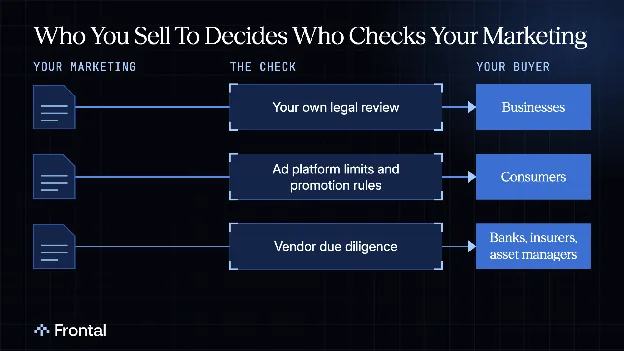
The check your marketing has to pass changes with who buys from you.
In a Reddit thread on r/fintech about choosing an agency, a commenter who disclosed working at a UK financial services agency made the point well: payment processing, B2B lending software and consumer investing have very different marketing dynamics, so good work for a neobank says little about a payment processor.
It’s one person with a stake in the answer, but the case studies these agencies publish point the same way: almost every one is about a single type of buyer.
The table below shows how the job changes with the buyer, and where to start in this list for each one. The rules named here are examples to raise with your own counsel, since which ones bind you depends on what you’re licensed to do.
| If you sell to | What the agency has to get right | Rules and limits to raise | Start with |
|---|---|---|---|
| Businesses | Content and demand that reach finance and product buyers over a long cycle | Your own legal review, plus any license you hold | Frontal, Mint Studios, Omnius, Mint Position, Evara, SAGE Marketing |
| Consumers | Cost per verified or funded user across paid and creator channels | Meta’s financial ad limits, Google verification, FCA rules in the UK | Growth Gorilla, Brighter Click |
| Banks, insurers and asset managers | Reputation, press and answers for due diligence | Third-party risk guidance, FINRA Rule 2210 for broker-dealers | Vested, CSTMR |
Selling to businesses usually puts the fewest rules on the copy itself, unless you hold a license, so the check is your own legal review and the calendar it sets. What to find out is how an agency plans around that review.
Consumer campaigns run into platform limits first. Meta restricts audience options on financial product ads for advertisers based in or reaching the US, including age, gender, ZIP code, exclusion targeting and lookalike audiences. Google requires verification to advertise financial services in some locations, which usually means providing your licenses and registration numbers. In the UK, the FCA requires promotions to be fair, clear and not misleading.
Selling to institutions changes who reads the marketing. The US banking agencies’ third-party risk guidance tells banks to run due diligence on a vendor before signing, including its ability to comply with applicable laws, so your site and sales material will be read by people checking for exactly that.
Inside a broker-dealer, FINRA Rule 2210 requires a qualified registered principal to approve each retail communication before it’s used or filed, and “retail” starts at more than 25 retail investors in 30 days. An agency that hasn’t worked under that step will plan your calendar without it.
The Best Fintech Marketing Agencies in 2026
The grid below puts all ten side by side. Its last column reports what each agency says about compliance on its own site, which is more useful than the words “compliance-friendly” on a homepage.
| Agency | Best if you sell to | Main work | Pricing (from) | What its site says about compliance |
|---|---|---|---|---|
| Frontal | Businesses, with a sales team | GTM engineering, ABM, paid, content, RevOps | Not published; three-month start | You approve lists and messages; no compliance process published |
| Mint Studios | Businesses | Content, SEO, AI search | Not published | Public guide to working with compliance, including articles that never ran |
| Omnius | Businesses | SEO and AI search | Not published | Fact-checks content and joins your compliance team’s review |
| Mint Position | Businesses and consumers | Interview-based SEO content | $2,600 a month (own site) | Blog advice on compliance-aware copy |
| Evara | Businesses and institutions | CRM, RevOps, SEO, lead generation | $5,000+ project (Clutch) | ISO 27001 and ISO 9001 certified; public trust center |
| SAGE Marketing | Businesses | Outsourced CMO, HubSpot, brand | Not published | No compliance process found |
| Vested | Institutions | Financial PR, content, advertising | $10,000+ project (Clutch) | Teams FINRA and CFA trained; public guide to regulated content |
| CSTMR | Institutions, businesses and consumers | Brand, web, content, paid, PR | $15,000 a month (own site) | SOC 2 Type 1, covering data security, not copy review |
| Growth Gorilla | Consumers | Paid media, creators, creative | Not published | Blog advice on influencer work under FCA rules |
| Brighter Click | Consumers | Paid media and creator ads | $10,000+ project (Clutch) | Written creator briefs; compliance review before each partnership ad goes live |
A Clutch label means the price is from that firm’s Clutch profile, read in October 2026, and the other facts come from the firm’s own pages. In the entries below, 2 to 6 mainly fit B2B fintech, 7 and 8 fit institutions and multi-audience brands, and 9 and 10 fit consumer acquisition.
1. Frontal
Best for: B2B fintech teams that need qualified pipeline
Overview: Frontal is the go-to-market partner for B2B tech companies past product-market fit with a real sales team, fintech among them, and it isn’t a fintech-only shop. It works as an extension of your team across GTM engineering, ABM, ads, content and RevOps, inside your CRM and Slack, and most clients start with one service.
Palico is its published fintech example. The private equity marketplace had a sales team of fewer than 20, personalizing by hand and sending from its main domain. Frontal moved sending to dedicated outreach domains, enriched contacts through Crunchbase by fund type, size and region, and ran Clay and Smartlead sequences with a weekly reporting loop.
The Palico case study reports 6 to 15 positive replies every week from week two, and three clients closed from early replies within the first weeks, with no new hires. Head of Sales Paloma Hernandez called it “almost like expanding the sales team.” ColdIQ Agency became Frontal.
Frontal’s ads proof sits outside fintech. In a 10-month program for AirOps, ads and outbound ran against one account list, and the combined program produced $7.83M in qualified pipeline and $1.52M in closed-won revenue. HockeyStack attributed $3.6M of that qualified pipeline to $233.8K in ad spend.
Core services:
- GTM engineering that builds your account lists and sends from inboxes set up for your company.
- Account-based marketing that runs ads and outbound against one target list and shows each account’s engagement to your sales team.
- LinkedIn and Google ads that feed CRM conversions back to each platform, in ad accounts that stay yours.
- Content engineering that turns founder and team interviews into LinkedIn posts and SEO articles.
- RevOps on data, routing and attribution, with CRM implementation in HubSpot or Salesforce.
- Reporting on qualified pipeline and closed-won revenue by account.
Industries served: Fintech, SaaS, legal tech, proptech, healthtech
Pricing: Frontal publishes no rate card. Work begins with a three-month engagement, and the fee is set on the intro call according to scope and your existing stack. Ads are paid for separately.
Pros: Five services you can start one at a time, reporting from your CRM, a named fintech result with no new hires, a Clay Elite Studio Partner, ad accounts that stay yours
Cons: One published fintech case study and it’s outbound, no PR service or published compliance process, no public pricing
Notable clients or projects: Palico, and Frontal has worked with Agicap, Digital Asset, AQ Metrics and Vestd
Engagement model: The first three months run from audit and setup to a live program, with scope, milestones and owners written into a statement of work. What happens after month three is settled before the work starts.
How to start working with them:
- Use the intro call to explain who buys from you.
- Bring the person who approves your copy, or their rules.
- Sign a statement of work naming scope and owners.
- Open your CRM and ad accounts to the team for the audit.
- Review lists and messages with your compliance reviewer before launch.
Why it’s a good fintech marketing agency: It suits a B2B fintech whose sales team can take more pipeline and whose channels are split across vendors. When more than one service is in scope, the same team runs them from one account list. The numbers come from your CRM, which is where a CFO will check them.
Final verdict: Choose Frontal when pipeline is the job and you sell to businesses, knowing the team reports qualified pipeline, not a meeting count. If you need PR, a rebrand or consumer sign-ups, the agencies further down are a better fit. Otherwise, book a call.
2. Mint Studios
Overview: Mint Studios is a content agency that works mostly with B2B financial services companies, with addresses in Edinburgh and Austin. Every engagement opens with a two-week Diagnostic of what your content, SEO and AI search visibility are doing commercially.
Core services:
- Bottom-of-funnel content written for technical financial buyers.
- SEO and visibility in AI answers on buying-intent topics.
- Conversion tracking through HubSpot or Salesforce, so content can be tied to leads and deals.
Industries served: Payments, open banking, invoice financing
Pricing: Mint Studios publishes no rates, and its proposal follows the Diagnostic.
Pros: Reports leads and SQLs instead of traffic, named fintech clients, a candid public guide to compliance
Cons: Content-led, so PR and paid social need another partner, no public pricing
Notable clients or work: Yapily, Fiska, WorldFirst. Yapily saw 2.8x growth in organic inbound website leads, and Fiska went from 0 to 25 inbound leads a month, with 38.5% marked as opportunities.
Where it fits: Your product is technical, and editing drafts from writers who don’t understand payments is eating your team’s week.
Final verdict: A first call for B2B fintech that wants content judged on deals.
3. Omnius
Overview: Omnius is a B2B SEO and AI search agency for SaaS, fintech and AI companies, remote-first with bases in London and Belgrade. It says it takes on up to eight clients a year and uses only internal staff.
Core services:
- Fintech SEO that separates a consumer comparing rates from a compliance officer evaluating vendors.
- Visibility in AI search answers alongside Google.
- Financial content built on sourced claims, dated fact-checks and named authors.
Industries served: Neobanks, risk technology, SaaS
Pricing: Omnius quotes per project from the deliverables involved and says it has no minimums.
Pros: A stated route through your compliance team’s review, a narrow vertical focus, an all-internal team
Cons: Built around organic search, so paid and PR sit elsewhere, limited client intake, no public pricing
Notable clients or work: ANNA Money, WorldFirst, Payoneer. Its ANNA Money case study reports a 60% increase in total signups and top-three rankings for over 1,900 company formation keywords in six months.
Why buyers shortlist it: Search and AI answers are where your buyers research vendors, and nothing can go live without your legal team’s approval.
Final verdict: Strong for organic growth in B2B fintech, if it has room for you this year.
4. Mint Position
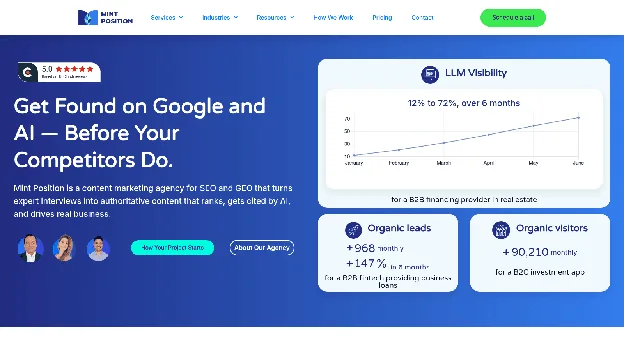
Overview: Mint Position is a small content agency for SEO and AI search that builds articles from interviews with subject experts. Fintech is a large part of its work, on both the business and consumer sides, and it publishes its prices.
Core services:
- SEO articles, three a month on the core package, with one to three expert interviews.
- Guest posting at $1,750 a month for two placements.
- One-off AI search audits and white papers.
Industries served: Business lending, real estate financing, investing
Pricing: The core package costs $2,600 a month with a three-month minimum, and an extra article adds $700. Graphic design, backlinks and social media management aren’t included.
Pros: Prices on the site, interview-based writing, audits available without a retainer
Cons: Clutch lists 2 to 9 employees, content only, and its homepage results name no client
Notable clients or work: Hubpay, Sarwa. Its homepage reports 968 more organic leads a month, up 147% in six months, for an unnamed B2B fintech providing business loans.
What it does best: You need an approved content budget this quarter and don’t want a sales call to learn the number.
Final verdict: The most transparent starting point on this list for a small content budget.
5. Evara

Overview: Evara is the new name of Inbound FinTech, which some lists still use. The London and New York consultancy works only with financial services and fintech companies, and it leads with revenue systems more than campaigns.
Core services:
- HubSpot and Salesforce implementation and architecture.
- SEO, AI search and signal-based lead generation.
- Go-to-market strategy and attribution reporting.
Industries served: Banking and lending, payments, wealth management
Pricing: Evara’s site lists no prices. Its Clutch profile, still under the old name, shows a $5,000+ minimum project and no reviews.
Pros: A financial-only client base, ISO 27001 and ISO 9001 certificates, a trust center that answers procurement questions
Cons: Case studies favor CRM work over campaigns, no published prices, nothing reviewed on Clutch so far
Notable clients or work: Paysend, TransferGo, 1623 Capital. For Paysend it configured HubSpot to calculate fees across currencies and flag compliance checks, and one unnamed UK lender saw an 809% increase in search visibility.
Why it earns a place here: Marketing can’t prove what it produced because the CRM underneath doesn’t track it, and your procurement team will want security answers first.
Final verdict: Hire Evara when the system under your marketing is the actual problem.
6. SAGE Marketing

Overview: SAGE Marketing works as an external CMO for B2B tech companies, with offices in Tel Aviv, London and Dubai. Fintech is one of its case study categories, alongside manufacturing, defense and law.
Core services:
- CMO as a service, combining the roadmap with hands-on execution.
- HubSpot setup and management.
- Brand strategy, messaging, events and trade shows.
Industries served: Fintech, manufacturing, defense
Pricing: SAGE publishes no rates on its site.
Pros: Senior marketing leadership without a full-time hire, events in scope, HubSpot in-house
Cons: Not fintech-only, no compliance process found on its site, its Gaviti figures date from 2020 and 2021
Notable clients or work: Gaviti, Ezbob, LeapXpert. Gaviti’s leads rose 400% in the first 18 months, and Ezbob’s organic traffic rose 26% within four months of a rebrand aimed at banks.
Its real strength: You have a product and a sales team but no marketing leader yet, and a full-time hire can wait a year.
Final verdict: A sensible stopgap for early B2B fintech with no one running marketing.
7. Vested
Overview: Vested is a financial marketing and communications firm with offices in New York, London and Toronto, serving banks, asset managers and fintechs. It says its teams are FINRA and CFA trained, and its staff includes former reporters and investment professionals.
Core services:
- Financial PR and executive communications.
- Financial services content: editorial strategy, white papers and thought leadership.
- Branding, advertising and digital marketing.
Industries served: Banking, fintech, wealth and asset management
Pricing: Vested publishes no rates. Its Clutch profile sets the minimum at $10,000+ and carries no reviews.
Pros: Finance-trained staff, press and content in one firm, a public guide to regulated content
Cons: Published results measure visibility more than pipeline, fees only available on request, little third-party review data
Notable clients or work: Elliptic, Pagaya, Finastra. Elliptic’s share of high-quality media voice rose from 10 to 12% in the first half of 2021 to over 26% in early 2022.
Why buyers shortlist it: You sell to banks and asset managers, and what they read about you in the financial press shapes whether they take the meeting.
Final verdict: The natural pick when reputation with institutions matters most.
8. CSTMR
Overview: CSTMR focuses only on financial services and fintech, across banking, payments, lending and investing, for both business and consumer audiences. Its founder is based in Austin, and it works as a monthly retainer partner from strategy through execution.
Core services:
- Brand strategy, identity and positioning.
- Website and experience design.
- Content, performance marketing, social and PR.
Industries served: Banking, payments, lending
Pricing: Its own site says engagements typically start from $15,000 a month. On Clutch, it shows $50,000+ as the minimum project, with hourly rates of $200 to $300.
Pros: A published starting price, one partner from brand to campaigns, experience with both B2B and consumer brands
Cons: The highest published floor on this list, results that report traffic and registrations more than pipeline, a SOC 2 report that doesn’t cover copy review
Notable clients or work: Pursuit, AccessOne, American Bankers Association. Pursuit merged three brands into one, and organic search traffic rose 30% in the three months after launch.
What it is genuinely good at: A merger, a new product or a repositioning means the brand, the site and the campaigns all have to change together.
Final verdict: Worth the floor when the whole brand needs rebuilding, not one channel.
9. Growth Gorilla
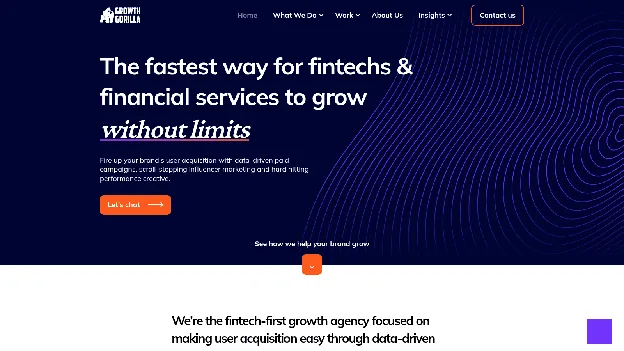
Overview: Growth Gorilla calls itself a fintech-first growth agency, with addresses in London and New York. Its work centers on user acquisition through paid media, influencers and creative, mostly for products people sign up for themselves.
Core services:
- Paid media across Google, Meta, TikTok, YouTube and Bing.
- Influencer marketing and creator content.
- Performance creative and conversion rate optimization.
Industries served: Investing, trading, credit
Pricing: Growth Gorilla publishes no fee. Its contact form’s lowest monthly budget option is £5,000 to £10,000, so ask whether that includes media.
Pros: A fintech-first focus, ads and creators under one team, named results with stated costs
Cons: Mostly consumer work, little built for long enterprise cycles, no published fee
Notable clients or work: Mintos, Finbits, Credit Passport. Mintos’s cost per verified user fell from €600 to €134, and Finbits, one of its few B2B examples, gained 285 leads in three months.
Why it’s a good fintech marketing agency: Your funnel ends in a verified sign-up, and cost per verified user is the number your board watches.
Final verdict: A strong call for consumer fintech scaling past search.
10. Brighter Click
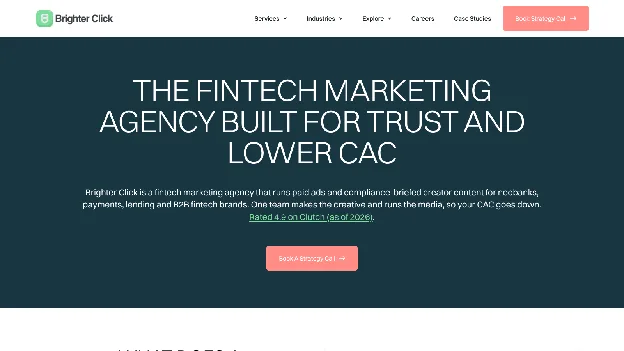
Overview: Brighter Click runs paid media and creator ads for fintech and healthcare brands from Raleigh, North Carolina, per Clutch. It’s plain about scope: it sends you elsewhere for brand strategy, PR or a new website.
Core services:
- Paid media across Meta, Google, TikTok, YouTube and Pinterest.
- Creator content from written briefs with approved claims, required disclosures and phrases to avoid.
- Creative analytics that tag each ad’s hook, angle and creator.
Industries served: Neobanks, payments, lending
Pricing: Retainers vary by scope. Clutch shows rates of $150 to $199 an hour on projects of $10,000 or more.
Pros: A written creator compliance workflow, one team for creative and media, clear limits on what it takes
Cons: No fintech case study among those it publishes, shared focus with healthcare and clinical trials
Notable clients or work: Gelato, a SaaS platform rather than a fintech, where it cut CAC by 17.6% while ad spend grew 117% over three years.
Where it beats the alternatives: Your compliance team has approved the claims, and you need many creator ads made inside them.
Final verdict: Good for consumer fintech, though ask for a fintech reference first.
How We Chose These Fintech Marketing Agencies
Our starting point was the fintech marketing agency lists on page one of Google. We then tested each candidate against its own website, because several of those lists are out of date or written by an agency that ranks itself first, as this one does. Five checks decided who stayed:
- The firm’s own site still sells to fintech or financial services.
- It names at least one client and publishes a result that says what it measured.
- Its current name and ownership come from its own site, since directories lag behind rebrands.
- A price counts only if it’s on the firm’s site or on a Clutch profile confirmed as the same firm.
- The compliance column comes from what it says on its own pages.
Some firms that appear on more than one list didn’t pass. Powered by Search ranks itself first on its own fintech roundup, but its homepage and client results page sell B2B SaaS work and never mention fintech. mvpGrow’s homepage now sells to B2B startups and doesn’t mention financial services.
Old and lookalike names were the other trap. Inbound FinTech is now Evara and Fiat Growth is now FGV, and both old names are still in circulation. Clutch also lists a “Mint Studios” that is an Austin video producer and a “SAGE Marketing” in Lexington, Kentucky, neither of them the agency reviewed here, so confirm you’re reading the right profile.
What to Ask a Fintech Marketing Agency on the First Call
The first call should test how the work runs under review, because that’s where a generalist and a specialist differ most. These questions separate the two quickly, and you can put them to any of the fintech marketing agencies above:
- Show me a case study from a company with my buyer, and tell me what its headline number counts.
- Who on my side do you expect to review copy, and how many review rounds does your plan assume?
- What happens to a piece my compliance team rejects: is the rewrite included, and who decides what changes?
- Has your work ever been blocked or pulled, and what did you change afterward?
- Which targeting options will you lose on my ad accounts, and how does your plan work without them?
- Who interviews our experts, and who’s accountable for a technical error in a published piece?
Ask about security before anyone touches your ad accounts or CRM: an NDA, an infosec questionnaire, and who on the agency side gets access. Evara’s public trust center shows what a prepared answer looks like.
Reporting also relies on your own data. When your CRM can’t record where a deal came from, sort out CRM implementation first, or any agency’s pipeline number will rest on data nobody trusts.
What Financial Services Content Marketing Agencies Do Differently
The best financial services content marketing agencies plan for review before anyone writes a word. Mint Studios says it has had articles never published because of compliance issues, including some built on interviews with a compliance professional, because the topic hadn’t been pre-approved. Vested makes a similar case in its guide to regulated content, arguing for feedback throughout the process over one final review.
How to Run Content Through Compliance
You can ask any agency to work this way, whichever of the financial services content marketing agencies you choose:
- Get the topic list approved by compliance before any drafting starts.
- Name the required reviewers and put scheduled check-ins with them on the calendar.
- Interview your own experts, so claims come from people who can defend them.
- Send a brief for review first, then the draft, so objections arrive early.
- Date every regulatory claim and name its source, so it can be re-checked later.
Vested’s guide adds that AI drafting doesn’t remove the compliance step, even when the tool has been given your requirements. That applies if your team already writes with Claude Code or anything like it, since a faster first draft only moves the wait to the reviewer’s desk.
How Much Do Fintech Marketing Agencies Cost?
Fintech marketing agencies rarely print a fee, and only Mint Position and CSTMR do on this list. The table below collects every public figure we found for these ten, and each kind of figure tells you something different.
| Pricing signal | What these agencies publish | How to read it |
|---|---|---|
| Monthly fee on its own site | Mint Position $2,600; CSTMR from $15,000 | The closest thing to a real price, though scope varies |
| Minimum project (Clutch) | Mint Position $1,000+; Evara $5,000+; Vested and Brighter Click $10,000+; CSTMR $50,000+ | The smallest job the firm says it accepts |
| Hourly band (Clutch) | Brighter Click $150 to $199; CSTMR $200 to $300 | Useful for pricing a defined project |
| Budget option on a form | Growth Gorilla £5,000 to £10,000 a month | Ask whether it includes ad spend |
| No public figure | Frontal, Mint Studios, Omnius, SAGE Marketing | Ask for a range on the first call |
Where a firm’s own page and its Clutch profile differ, trust the page. Mint Position’s $1,000 Clutch minimum sits well below its $2,600 monthly package, and CSTMR’s $50,000 minimum is roughly three months at its stated starting fee.
Frontal is in that last row too: the quote comes on the intro call, and ads are billed apart from the fee. Ask every agency here how it treats ad spend, because on a paid program it can be the largest number in the budget. On a B2B fintech program that spend often lands on LinkedIn, and specialist LinkedIn ads services are a separate purchase from anything on this list.
Turn Your Buyer Into a Three-Agency Shortlist
Three agencies are enough to compare properly, and you can pick them in an afternoon. Write down who buys from you, then use the first table to choose the group of agencies that fits. From that group, take the two or three that say the most in the grid’s compliance column.
Send each one the questions above before the call, and watch the answer about a rejected draft most closely, since that’s the work you’ll live with every month.
If you sell to businesses and no one owns pipeline across your channels, Frontal is built for that job, from paid media to RevOps.
Frequently Asked Questions
How much do fintech marketing agencies charge?
Mint Position’s content package costs $2,600 a month and CSTMR’s engagements typically start from $15,000 a month, the only two fees published on their own sites among these ten. Clutch minimums on this list run from $1,000 to $50,000 a project. Most others quote after a call, so ask whether ad spend sits inside the fee.
Do fintech marketing agencies handle compliance review?
Usually they support it rather than own it. Brighter Click says every partnership ad runs through compliance review before it goes live, and Omnius says it works inside your compliance team’s existing review process rather than replacing it. Get the answer in writing, and keep final approval with your own legal or compliance reviewer.
Should a B2B fintech hire a specialist or a generalist agency?
Hire a specialist when your product or regulation takes months to learn, or when review will shape the calendar. A broad go-to-market partner makes more sense when your real problem is channels nobody owns, as long as it can show work with your type of buyer.
How long does a fintech marketing agency take to show results?
It depends on the channel. Mint Position says most clients see organic traction within five to six months, past its three-month minimum, and Omnius reports its ANNA Money results over six months. Paid programs show results sooner, while pipeline from institutions can take far longer, so agree what you’ll judge and when before the work starts.
What is the difference between fintech marketing and fintech lead generation?
Fintech marketing builds credibility and demand through brand, content, ads and PR, so buyers come to you. Lead generation goes out and finds specific buyers, usually through outbound, and should be measured on the qualified pipeline those buyers become. Many B2B fintechs need both, but you’ll usually hire different agencies unless one team runs them together.