The constraint
Modash is an influencer marketing platform for e-commerce brands that run on Shopify. Its market is easy to describe and hard to reach: Shopify brands that already run an influencer program.
Demand was not the issue. Modash performs well in organic search and on LinkedIn, and sales ran on the inbound those channels create. Earlier outbound attempts had been small and under-supported. The gap was the rest of the market.
But of course, there are other people who are not searching and there are people who are not on LinkedIn or at least not active on LinkedIn. So our event program is one of the ways that we reach those people and cold email fits in as a way to bring people to those events.
What we built
The kickoff was on March 12, 2026. New inboxes warmed for two weeks, and the first campaign went live on March 30.
The stack: Instantly for email, lemlist for LinkedIn, Clay for enrichment, and Modash's HubSpot as the record. Every contact was checked against HubSpot before a send, so customers and open pipeline stayed out of the sequences, and every outbound lead was tagged there.
- Instantly
- lemlist
- Clay
- HubSpot
The market map: Shopify brands running influencer programs, in the US and the UK first. Contacts were sorted into tiers, people with influencer marketing in their title first, then the broader marketing roles that oversee the creator program. Every title went through two checks: a rule-based filter, then a read of the full title against one question. Is this person realistically responsible for the brand's influencer, creator, UGC, seeding, gifting or affiliate program?
Modash's own data did the qualifying. Its API shows how many distinct creators a brand has actually partnered with. A brand already working with hundreds of creators runs exactly the program Modash is built for, so it moved to the top of the list.
Then the pivot. Within about three weeks, the replies showed a pattern: many came from people who already knew Modash. So the focus moved to education: inviting the market to Modash's free virtual events. When the direct offers (pricing, a booked call) kept underperforming into the summer, the invitations became the main campaign. Two weekly check-ins, one for the platform and later one for the API, kept the plan moving.
The plays that ran
Event invitations
Cold email inviting Tier 1 and Tier 2 contacts to Modash's virtual events, from the May and June sessions to the Return on Influence Festival on October 21. By September they were the best-performing campaign type in the account, and most of the positive replies came from them.
Registration inside the reply
A reply asking to be added gets the contact registered and a confirmation sent back automatically. Anything with a real question surfaces in Slack for a person to answer.
Re-engaging the interested
People who replied positively but never registered got their own follow-up campaign, and anyone who replied positively was blocked from every other sequence on both email and LinkedIn.
A second product: the API
Modash added a second project for its influencer marketing API. It runs on separate lists at lower volume, built vertical by vertical (agencies, influencer platforms, AI tools, then startups from accelerator directories), with email plus LinkedIn from Modash's own team.
Results
| Metric | Result |
|---|---|
| Positive replies from ICP companies | About 650 |
| Time window | 6 months |
| Where most replies came from | Event invitations |
| Second project | Outbound for the influencer marketing API |
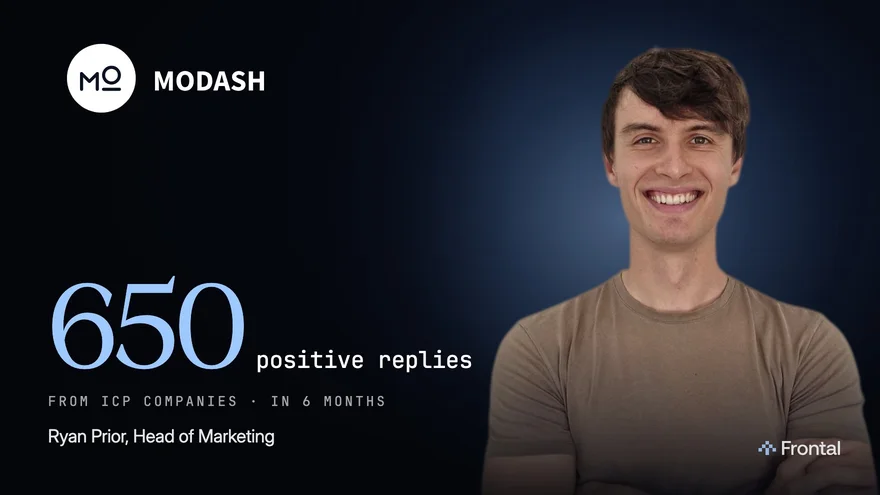
We've already had around 650 positive replies over six months, which is really meaningful because these are from ICP companies we were not previously reaching with our other marketing channels.
Ryan's verdict on the channel: cold email is "one of, if not the best channel that we have to drive ICP attendees to those events."
What this means for you
If inbound already works, outbound that pitches the same buyers the same way mostly reaches people who would have found you anyway. The useful job for cold email is the rest of the market: the people who do not search and are not active on LinkedIn. Give them a reason to show up that is not a sales call, qualify them on real data about the program you serve, and let the follow-up run on its own.