Last Updated: May 26, 2026
Most B2B SaaS companies don't fail because they lack tools or channels. They fail because their go-to-market motion is fragmented.
Outbound runs separately from paid ads, marketing warms accounts, sales never contacts, and pipeline becomes inconsistent as a result. That's why go to market services have become far more important in 2026, especially for SaaS companies trying to build predictable revenue instead of isolated campaign wins.
A strong GTM agency doesn't just generate leads. It builds a coordinated system around the accounts most likely to buy. The best go-to-market agencies align outbound, LinkedIn Ads, content, RevOps, and targeting into one motion so every touchpoint compounds instead of competing for attention.
According to Gartner, the average B2B buying group now involves 6-10 decision-makers, which makes disconnected outreach far less effective than coordinated GTM execution.
That's also why choosing the right go to market strategy service partner matters more than ever. The right agency builds pipeline, attribution, and revenue consistency. The wrong one leaves you with disconnected channels, vanity metrics, and no clear path to scalable growth.
This guide covers 10 of the strongest go to market agency options in 2026: what each one does, who it's built for, what it costs, and where each fits best.
Key Takeaways (TL;DR)
- The Best Overall Go To Market Services: Frontal is the strongest fit for B2B SaaS companies doing $100K+/month that need an integrated GTM system, not isolated channels. We connect outbound, LinkedIn ads, and content into one "GTM flywheel" that generates SQLs, not just activity metrics.
- Why Do You Need It: Most B2B SaaS companies run GTM in silos: ads over here, outbound over there, content disconnected from both. The result is an inconsistent pipeline, wasted ad spend, and a sales team that can't tell what's working.
- Who It's For: VPs of Sales, Heads of Demand Gen, and Founders at mid-market B2B SaaS companies who need predictable pipeline and are done with agencies that report meetings booked instead of revenue created.
- How to Choose the Right One: Prioritize agencies that measure SQLs and pipeline contribution over raw lead volume. Check whether their model integrates channels or runs them separately. Plus, make sure to confirm speed to execution. The industry standard is 6-8 weeks to launch, and some agencies (like Frontal) move faster.
- Pricing Model: Monthly retainer with a risk-reversed 90-day pilot. Custom pricing, typically 30-50% of the cost of an equivalent in-house team, delivered 4.6x faster.
Table of Contents
- Top Go To Market Services in 2026 at a Glance
- What Are Go To Market Services?
- Why Do You Need a Go To Market Agency?
- Who Needs Go-To-Market Services?
- Best Go To Market Services: In-Depth Review & Comparison
- How to Choose the Best Go To Market Agency?
- Everything You Need to Know About Go-To-Market Agencies
- Scale Your GTM Efforts with Frontal
- FAQs About Go To Market Services
Top Go-To-Market Services in 2026 at a Glance
| Company | Best For | Key Strengths | Model | Pricing |
|---|---|---|---|---|
| Frontal | B2B SaaS $100K+/mo needing integrated outbound, ads, and content | GTM Flywheel (Outbound + LinkedIn Ads + Content); Elite Clay partner; 2-week launch; SQLs not vanity leads | Done-for-you retainer | Custom; 90-day pilot |
| Growthspree | Series A-C SaaS needing full-funnel GTM at a fixed price | Full-funnel demand gen; growth experiments; CRO + SEO | Done-for-you retainer | $3,000/month flat |
| Ironpaper | B2B companies needing content-led demand generation | Content + ABM; HubSpot expertise; strong pipeline attribution | Done-for-you retainer | Custom |
| The Kiln | Tech companies needing AI-native GTM strategy + execution | AI-powered GTM; deep ICP research; outbound + content | Done-for-you retainer | Custom (discovery call) |
| Growth Engine X | B2B tech companies needing revenue-focused GTM strategy | RevOps + GTM alignment; funnel architecture; fractional GTM | Fractional/retainer | Custom |
| SalesCaptain | B2B SaaS teams needing outbound prospecting with RevOps | Signal-based outbound; Clay automation; data enrichment | Done-for-you retainer | Custom |
| C17 Lab | Mid-market SaaS needing performance-based outbound | Performance-based meetings booked; multi-channel outbound | Performance + retainer | Custom (per meeting) |
| CIENCE | Enterprises needing SDR-as-a-service with dedicated reps | Dedicated SDR teams; graph8 intent data; multi-channel | SDR-as-a-service | $5,000 setup + $2,000/mo + SDR costs |
| Belkins | Companies needing omnichannel prospecting with volume guarantees | 1,000+ clients; appointment guarantees; multi-channel outbound | Done-for-you retainer | From $8,000/month |
| StackOptimise | B2B SaaS needing technical GTM with RevOps and CRM setup | RevOps infrastructure; HubSpot/Salesforce setup; GTM ops | Consulting/retainer | 3-tier custom pricing |
What Are Go To Market Services?
Go to market services are specialized B2B services that help companies build, execute, and scale the programs they need to acquire customers, enter new markets, or generate predictable revenue.
A go to market agency is different from a generalist marketing agency because it ties every activity back to pipeline and revenue. Not impressions, clicks, or follower counts.
The category covers a wide range of service models. Some agencies are primarily outbound-focused, building cold email and LinkedIn prospecting systems. Some are ABM specialists running account-based ad campaigns. Others take a fractional GTM approach, embedding senior operators into your team. In contrast, a growing number, like Frontal, operate as integrated systems that coordinate multiple channels into one program.
The output that distinguishes strong go-to-market strategy services from weak ones is consistent: SQLs (Sales Qualified Leads) and pipeline contribution. A GTM agency that reports meetings booked without qualification, or impressions without attribution, is measuring the wrong things.
For B2B SaaS companies specifically, the relevant subsets of this category include outbound prospecting, LinkedIn ads, ABM, demand generation, and content. The most effective programs treat these as one coordinated system rather than separate campaigns.
Why Do You Need a Go To Market Agency?
The most common reason B2B SaaS companies seek a go to market agency is a pipeline problem that internal teams can't solve at speed. According to Gartner, the average B2B purchase now involves between 6 and 10 decision-makers.
That complexity makes single-channel outreach increasingly ineffective. A cold email alone won't move a buying committee.
There are four specific problems that a strong GTM agency is built to solve:
Inconsistent pipeline: Most SaaS companies experience feast-or-famine revenue cycles. Pipeline spikes when the team is focused on outbound, then dries up when they're focused on closing. A system-based GTM agency builds the infrastructure to run continuously, not in bursts.
Disconnected sales and marketing: Sales runs its own outbound. Marketing runs ads to different audiences. Content sits in a blog nobody reads. None of it compounds. An integrated go-to-market agency coordinates all of these against the same target account list, so every touchpoint reinforces the others.
No attribution or visibility: Marketers spend money on ads that sales can't trace to the pipeline. Sales runs outbound without visibility into which accounts are already engaged with content or ads. Without attribution infrastructure, it's impossible to know what's working.
Speed constraints: Building an in-house GTM function from scratch takes months and costs significantly more than an agency retainer. A SaaS company that just closed a Series B and needs a flowing pipeline in the next quarter doesn't have that time.
Across these four problems, the companies that consistently outperform their peers aren't the ones with the biggest teams. They're the ones with the most coordinated systems.
That's the gap that purpose-built go to market services are designed to fill.
Who Needs Go-To-Market Services?
1. VPs of Sales at Mid-Market B2B SaaS
A VP of Sales at a SaaS company doing $100K-$500K per month needs one thing: a predictable flow of SQLs. They've likely already tried basic outbound and found it inconsistent.
They're not interested in agencies that report meetings booked without qualification. They need a service that treats accounts as the unit of work, builds a tiered target list from the TAM down, and delivers qualified opportunities to a sales team that can actually close them.
2. Heads of Demand Generation
The Head of Demand Gen owns the attribution problem. They need to show that marketing spend translates into pipeline, not just impressions and MQLs that never convert.
A strong GTM agency gives them the infrastructure to connect ads, content, and outbound to the same account list, so they can report pipeline contributions with confidence rather than defending click-through rates to a skeptical CFO.
3. Founders and CEOs at Growth-Stage SaaS
A Founder or CEO who just raised their Series A or B has capital and a mandate to grow fast. They don't have time to build an in-house GTM team, train them, and wait 6-9 months for results.
They need a specialized agency that can build and operate the full GTM motion from day one, with enough technical depth to use intent signals, data enrichment, and coordinated channels, not just spray-and-pray email blasts.
4. RevOps and GTM Leaders Rebuilding Their Stack
Some companies come to a go to market agency not because they have no system, but because their existing system is broken. The CRM data is dirty. The ICP definition is too broad. Outbound campaigns are bouncing. Attribution is a mess.
These buyers need an agency that can diagnose the infrastructure problems, rebuild the foundation, and then run the system, not just an agency that executes tactics on top of a broken base.
5. Scale-Stage Companies Entering New Markets
B2B SaaS companies entering a new vertical, geography, or buyer persona face a specific GTM challenge: their existing motion doesn't map to the new ICP. They need research, messaging, account targeting, and coordinated outreach built specifically for the new market.
A strong go to market strategy services provider can run a controlled pilot motion in the new segment without disrupting what's already working in the core business.
Best Go To Market Services: In-Depth Review & Comparison
1. Frontal
Overview
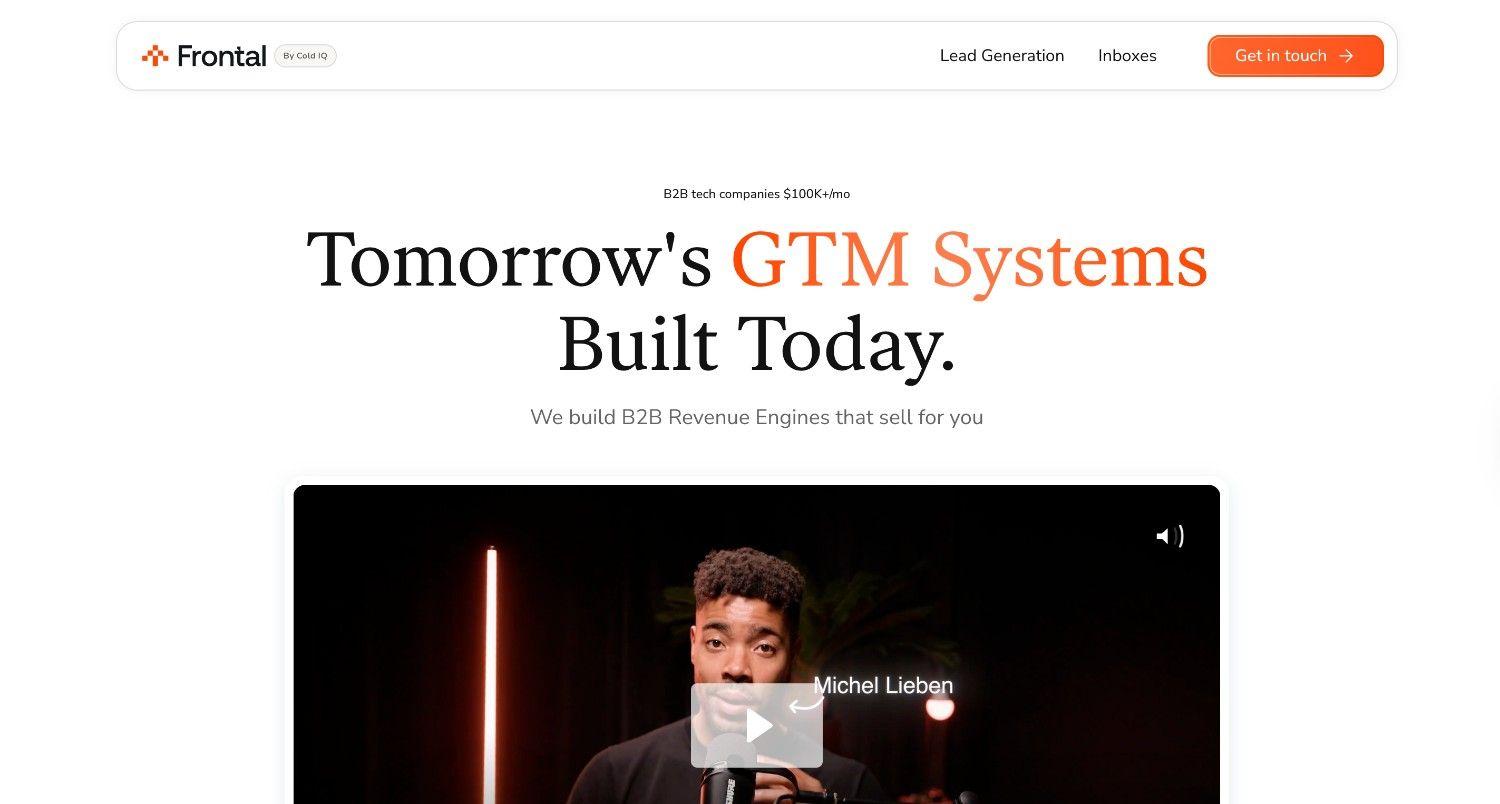
Frontal (formerly ColdIQ) builds B2B revenue engines for tech companies doing $100K+ per month. We deliver a GTM Flywheel System that integrates three channels (Outbound Prospecting, LinkedIn Ads, and LinkedIn Content) into one coordinated motion that targets the same accounts across every touchpoint.
The core problem we fix is channel silos. Most B2B SaaS companies run ads separately from outbound, with content disconnected from both. The result is wasted spending and inconsistent pipeline. We solve this by treating accounts, not individual leads, as the primary unit of work.
We build a 3-tier account list (TAM, TAL, and tiered account list), warm the accounts using ads and content, and then activate them through signal-driven outbound, so that every channel reinforces the other.
On top of that, we're one of the only 4 'Elite Studio' Clay partners globally, which enables us to build personalization and enrichment workflows with a technical depth most agencies can't match. With us, your first campaigns go live in 2 weeks, and pipeline typically begins appearing within 30-60 days.
Ideal For
- VP of Sales or Head of Demand Gen at a B2B SaaS company doing $100K+/month who needs a full integrated GTM system, not isolated channel execution
- Founder or CEO who just raised Series A/B and needs pipeline fast without building an in-house team
- Growth-stage SaaS companies where sales and marketing are running in silos and need a coordinated account-based motion
- Companies that have tried single-channel outbound and found it inconsistent, and want a system that compounds across channels
- RevOps leaders who need clean ICP definitions, accurate data, and proper attribution infrastructure before scaling
Top Features
GTM Flywheel (Content + LinkedIn Ads + Outbound): All three channels run against the same target account list. Ads warm accounts that outbound then activates. Content builds authority that supports both. This isn't three separate campaigns; it's one compounding system.
Signal-Driven Outbound with Elite Clay Execution: Every outreach action is triggered by intent signals and engagement data. We use Clay workflows to build personalized sequences at scale, pulling from 10+ data sources. The result is contextual, relevant outreach, not mass email blasts.
2-Week Launch Speed: First campaigns go live in approximately 2 weeks from contract signing. That's the infrastructure built, lists created, sequences drafted and approved, ads live. Industry standard is 6-8 weeks.
Why Do We Stand Out?
Most agencies run either outbound or ads. Some run both, but in separate tracks with no account overlap.
What separates the best go-to-market services from the rest is whether channels compound or just coexist. We build a single coordinated system where the same accounts see our clients in their LinkedIn feed, receive relevant outbound, and engage with content that speaks to their specific pain, in a sequenced motion from awareness to pipeline.
Our Elite Clay partnership isn't a marketing credential. It's a technical capability that lets us build enrichment and personalization workflows that competitors can't replicate. That's why AirOps went from $536K monthly pipeline to $7.83M in qualified pipeline over 10 months working with us.
We also protect our clients' domain reputation by default. We never send from primary domains. We build secondary domain infrastructure with proper warming, so whatever happens in the outbound motion, the client's main brand stays clean.
Our lead generation services are designed around SQLs, not raw leads. Every metric we report connects back to your sales pipeline.
Pros
- Integrated GTM Flywheel: Outbound + LinkedIn Ads + Content targeting the same accounts
- Elite Clay Expert partner (1 of 4 globally), advanced personalization at scale
- 2-week launch speed vs. industry standard 6-8 weeks
- Signal-driven, account-based execution. No spray-and-pray.
- Weekly live dashboards with full attribution; no black-box reporting
Cons
- Purpose-built for B2B SaaS and tech companies at $100K+/month with a defined ICP and a pipeline to accelerate, not the right starting point for companies still finding product-market fit
- Custom pricing means no instant self-serve option for companies that want to start without a sales conversation
- We focus on B2B SaaS and tech; we're not the right choice for e-commerce, consumer brands, or non-SaaS businesses
Final Verdict
Frontal is the strongest fit for mid-market to enterprise B2B SaaS companies that need an integrated GTM system, not isolated channel execution.
If you're done paying for meetings booked and want to measure pipeline created and revenue closed, this is where we'd point you.
2. Growthspree
Overview
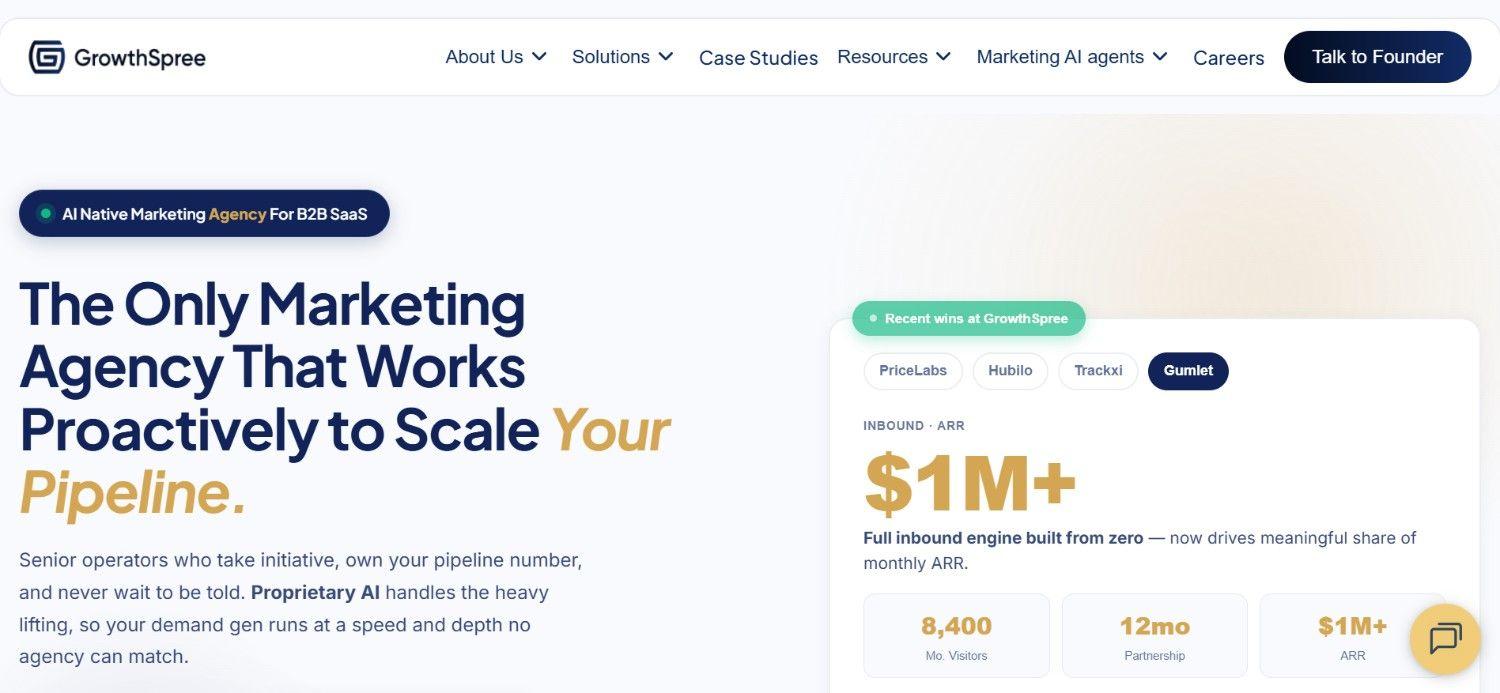
Growthspree is a full-funnel B2B demand generation agency purpose-built for Series A-C SaaS companies that need to test and scale multiple go to market strategy services without paying specialist agency rates for each channel separately.
Their service menu covers SEO, paid advertising, cold outreach, CRO, and content strategy, all under a flat $3,000/month retainer.
What makes that model work in practice is their sprint-based methodology: rather than committing client budget to a fixed channel mix from day one, Growthspree runs short experimentation cycles to identify which channels and messages generate actual pipeline for that specific company's ICP before scaling spend and effort.
As a go to market agency operating at the $3,000/month flat rate, Growthspree occupies a rare and useful position in the market: broad coverage at a predictable, fixed cost, with a methodology designed to find what works before scaling it.
Ideal For
- Series A-C SaaS founders who want a single agency managing multiple GTM channels at a predictable flat fee
- Early-to-mid-stage SaaS companies that haven't yet identified their highest-performing demand channels and need structured experimentation
- Marketing leaders who need coverage across SEO, paid, and outbound without hiring dedicated channel specialists
- Companies with a $3,000/month budget looking for measurable output across multiple marketing functions
Top Features
Growth Sprint Model: Growthspree runs short experimentation cycles to test channel performance before scaling, reducing wasted spend on channels that don't work for the client's specific ICP.
Multi-Channel Coverage at a Fixed Price: SEO, cold email, paid ads, and CRO covered under one flat retainer, a practical option for companies that can't afford separate agency specialists for each channel.
SaaS-Specific Focus: The team builds their service delivery around SaaS growth metrics (MRR, churn, CAC, LTV) rather than generic marketing KPIs.
Why Do They Stand Out?
Growthspree is one of the stronger choices in this comparison for early-to-mid stage SaaS companies that need broad demand gen coverage at a known monthly cost. The $3,000 flat fee is among the most transparent pricing structures in this market, and the sprint model is a credible approach to testing before scaling.
Pros
- $3,000/month flat fee, the most affordable fixed-price option in this comparison
- Multi-channel coverage (SEO, paid, cold email, CRO) under one retainer
- SaaS-specific metrics and growth experimentation approach
- Accessible for companies at earlier revenue stages
Cons
- At $3,000/month across multiple channels, execution depth per channel is shallower than specialists
- No evidence of the integrated account-based coordination that ABM-focused agencies provide
- Less suited for companies doing $500K+/month that need a dedicated, senior-level GTM system
- Limited technical depth in Clay-based personalization and intent-signal workflows
Final Verdict
Growthspree is a credible option for Series A-C SaaS companies that need multi-channel demand generation at a fixed and predictable cost. The sprint model is sensible, and the price point is hard to find elsewhere.
For companies that have already identified their best GTM channels and need deep, integrated execution at scale, Growthspree's breadth-over-depth model may become a constraint.
3. Ironpaper
Overview
Ironpaper is a B2B growth agency with a specific thesis: most B2B content fails because it was never designed to drive pipeline.
They work with technology, SaaS, industrial, and healthcare B2B companies on the intersection of content strategy, ABM, and demand generation, building programs where every asset is mapped to a specific buyer stage, persona, and account-level engagement signal.
Their methodology is built around proving content ROI in terms that sales leaders recognize: pipeline contribution, opportunity creation, and account progression, not page views or social shares. HubSpot is the native operational layer for almost all of their client work, which means attribution is built directly into CRM workflows rather than living in a separate analytics tool that sales never looks at.
What distinguishes Ironpaper as a go-to-market agency is their focus on complex B2B buying cycles: specifically the multi-stakeholder, multi-touch scenarios where a single good email or one compelling piece of content isn't enough to move a deal.
Ideal For
- B2B SaaS and tech companies with long sales cycles where content plays a significant role in educating the buying committee
- HubSpot users who want content strategy, ABM, and demand gen managed in one system with full CRM integration
- Marketing leaders who need to prove content ROI in terms of pipeline, not page views
- Mid-market B2B companies where multiple decision-makers need to be educated before a deal moves forward
Top Features
Content-Led ABM: Ironpaper builds content strategies mapped to ICP personas and buyer stages, then uses ABM tactics to distribute that content to specific target accounts, creating pipeline-connected content rather than general awareness.
HubSpot-Native Execution: Deep HubSpot expertise means attribution is built directly into CRM workflows, making it easier to show content's contribution to the pipeline in the same tool the sales team uses.
Long Sales Cycle Specialization: Ironpaper's methodology is specifically designed for B2B businesses with complex, multi-stakeholder buying processes, relevant for enterprise SaaS and industrial tech.
Why Do They Stand Out?
Ironpaper is one of the stronger choices for B2B companies where content quality and educational depth are central to moving deals forward.
Their HubSpot integration and pipeline attribution model addresses a specific gap: content teams that can't prove their ROI to sales and leadership, making them one of the top go-to-market agencies on this list.
Pros
- Strong content-to-pipeline methodology with HubSpot-native attribution
- ABM capability that connects content distribution to target accounts
- Specialist in complex B2B buying cycles with multiple stakeholders
- Credible track record across technology and industrial B2B verticals
Cons
- Less focused on outbound prospecting and signal-driven personalization
- HubSpot dependency means less value for companies on Salesforce or other CRMs
- Not the right fit for companies that need fast-launch outbound campaigns as the primary pipeline driver
- Content-led approach requires a longer ramp before pipeline impact becomes visible
Final Verdict
Ironpaper is one of the top companies globally, offering go-to-market strategy services for B2B SaaS and technology companies with a long sales cycle.
It is a great fit for companies where content plays a central role in the buying process, particularly for HubSpot users who need clearer pipeline attribution.
It is, however, less appropriate for companies that need fast-launch outbound or signal-driven prospecting as their primary GTM motion.
4. The Kiln
Overview
The Kiln is an AI-native go to market agency that builds GTM strategy and execution programs for technology companies, with a distinct research-first methodology that separates it from most execution-first agencies. Before any campaign or outbound sequence is built, The Kiln invests in structured market intelligence work: ICP validation, buyer persona mapping, competitive positioning analysis, and messaging architecture.
The argument is simple and credible: agencies that skip the strategy layer and go straight to execution end up scaling the wrong message to the wrong accounts, burning budget and damaging sender reputation in the process. By front-loading the research, The Kiln builds programs that are grounded in actual buyer behavior rather than assumptions carried over from the client's last sales deck.
What sets The Kiln apart from more traditional GTM agency models is their native integration of AI tools into the delivery workflow, not as a cost-cutting measure, but as a genuine capability multiplier.
AI-assisted ICP research, content generation, and message personalization are built into their standard process, reducing time-to-launch while maintaining quality and relevance.
Ideal For
- Tech companies entering a new market or vertical that need rigorous buyer research before building outbound or content
- Founders or CMOs who want a strategy-first agency that builds the rationale for every channel decision before executing
- Mid-market SaaS companies that have plateaued and need a fresh GTM perspective built on market intelligence rather than recycled playbooks
- Companies evaluating AI-native GTM approaches and wanting an agency that builds AI-assisted workflows natively
Top Features
Research-First GTM Architecture: The Kiln starts every engagement with structured market and buyer research (ICP validation, persona mapping, competitive positioning) before any campaign launches.
AI-Assisted Content and Messaging: Uses AI tools natively in the content and messaging workflow, not as an afterthought, reducing production time while maintaining quality and relevance.
Outbound + Content Coordination: Builds outbound sequences and content in parallel against the same ICP definition, creating message consistency across channels.
Why Do They Stand Out?
The Kiln is one of the stronger options for tech companies that need to think carefully before scaling a GTM motion, particularly those entering new markets, repositioning, or unsure whether their current ICP definition is correct.
The research-first model is a differentiator in a market full of agencies that start building immediately.
Pros
- Research-first approach reduces risk of scaling the wrong message or targeting the wrong ICP
- AI-native workflows built into delivery, not bolted on as a feature
- Strong fit for companies entering new markets or repositioning
- Coordinated outbound and content against unified ICP definition
Cons
- Strategy-first model means slower time to campaign launch compared to execution-focused agencies
- Custom pricing with no public rate card makes it harder to evaluate without a discovery call
- Less emphasis on the LinkedIn Ads layer compared to integrated ABM-first agencies
- Case studies are less publicly detailed than some competitors in this comparison
Final Verdict
The Kiln is recommended for tech companies that need to build GTM strategy from a research foundation before scaling execution, especially those entering new markets, repositioning, or rebuilding after a plateau.
It is, however, less suited for companies that need campaigns live in 2 weeks or need a clearly defined starting price before beginning a sales conversation.
5. Growth Engine X
Overview
Growth Engine X is a revenue-focused go-to-market agency that works at the architecture layer of B2B go-to-market, building the systems, processes, RevOps infrastructure, and channel programs that create repeatable revenue before scaling them.
Their model blends fractional GTM leadership with hands-on execution, making them a practical option for B2B tech companies that need senior strategic thinking but can't justify, or don't yet need, a full-time VP of GTM or VP of Marketing on the payroll.
What makes the agency relevant as a go to market agency specifically is their emphasis on diagnosing the funnel before designing programs to fill it. They build full-funnel pipeline architecture models: mapping where deals are actually being lost, not just where the team suspects they're being lost, and then design GTM programs to address the real drop-off points.
For companies where the CRM is a mess, attribution is nonexistent, and sales and marketing are looking at different numbers, running more campaigns without fixing the infrastructure first is a waste of budget. GEX addresses that problem by aligning RevOps foundations with GTM execution from the start.
They're a strong fit for B2B tech companies building their first real GTM function, or companies that have grown through product-market fit and now need the operational foundation to scale their revenue motion deliberately.
Ideal For
- B2B tech companies that need RevOps and GTM strategy aligned before scaling pipeline programs
- Founders or VPs who want senior fractional GTM leadership alongside hands-on execution
- Companies that have grown through product-market fit and need to build their first structured GTM infrastructure
- SaaS companies where the CRM, attribution, and pipeline reporting are broken and need to be rebuilt before scaling
Top Features
RevOps + GTM Integration: Growth Engine X connects the revenue operations layer (CRM setup, pipeline stages, attribution) with GTM execution, ensuring that campaigns are built on a foundation that can actually track results.
Fractional GTM Leadership: Senior operators embedded in the client's business at a fraction of the cost of a full-time VP, bringing both strategic input and day-to-day execution.
Funnel Architecture: Builds full-funnel pipeline models from awareness through closed-won, defining where the business actually loses deals before designing programs to fix those drop-off points.
Why Do They Stand Out?
Growth Engine X is one of the stronger choices for companies that recognize their GTM problem starts in the infrastructure layer, not just in the campaigns. If attribution is broken, the CRM is a mess, and sales and marketing aren't looking at the same pipeline numbers, running more campaigns won't fix the underlying problem.
Pros
- Strong RevOps-GTM alignment capability, addresses infrastructure before tactics
- Fractional leadership model gives companies senior expertise without full-time cost
- Funnel architecture approach diagnoses where the pipeline is actually leaking
- Good fit for companies building their first structured GTM function
Cons
- Less focused on high-volume outbound prospecting than pure outbound agencies
- Fractional model may not suit companies that need dedicated full-time execution resources
- Custom pricing with no disclosed rate card
- Case study visibility is more limited than higher-profile agencies in this comparison
Final Verdict
Growth Engine X is recommended for B2B tech companies that need GTM infrastructure built correctly before scaling campaigns, particularly those with broken attribution, misaligned sales and marketing, or founders who want senior fractional GTM leadership. Less suited for companies that need high-volume outbound execution as a primary near-term deliverable.
6. SalesCaptain
Overview
SalesCaptain is a B2B outbound and RevOps agency that builds signal-based prospecting systems for SaaS and tech companies, with Clay-powered personalization at the technical core of their delivery.
Their thesis is straightforward: outbound doesn't fail because the channel is dead. It fails because of poor data, generic messaging, and sequences sent to the wrong accounts at the wrong time. SalesCaptain addresses all three by building the ICP definition, data enrichment infrastructure, and intent-triggered sequences that most in-house teams lack the technical resources to build correctly.
They use Clay to pull from multiple data sources, enrich contact and account records, and generate personalized outreach at a scale and accuracy level that manual processes can't match. The result is outbound that reads like it was written specifically for the recipient, because the enrichment workflow actually surfaces relevant, contextual signals before a single word is drafted.
What makes SalesCaptain a credible entry in any comparison of go to market services is their RevOps-alongside-execution model. They don't just run campaigns on top of whatever CRM setup a client already has. They build or improve the attribution infrastructure so that outbound's contribution to pipeline can actually be tracked.
They're a strong fit for mid-market SaaS companies that want the technical sophistication of a dedicated GTM engineer combined with outbound execution, without the cost and hiring delay of building that capability in-house.
Ideal For
- B2B SaaS companies that need technically sophisticated outbound programs with clean ICP data and signal-based personalization
- RevOps leaders who want outbound infrastructure built correctly from the start, with proper enrichment, ICP definition, and attribution
- VP of Sales who has run outbound before and found it inconsistent, and wants a data-driven rebuild
- Mid-market SaaS companies that want Clay-powered personalization at scale without hiring a full-time GTM engineer
Top Features
Signal-Based Outbound: SalesCaptain builds outbound sequences triggered by intent signals and engagement data rather than static contact lists, reducing noise and improving relevance.
Clay-Powered Personalization: Builds enrichment workflows using Clay to pull data from multiple sources and generate personalized messaging at scale.
RevOps Foundation: Alongside outbound execution, builds the CRM and attribution infrastructure needed to track outbound's contribution to pipeline accurately.
Why Do They Stand Out?
SalesCaptain is a great choice for companies that want technically sophisticated outbound with Clay-based personalization, a capability that most outbound agencies can't deliver at the same depth.
Their RevOps-plus-execution model also addresses the infrastructure problem that undermines many outbound programs.
Pros
- Signal-driven outbound reduces spray-and-pray and improves reply rates
- Clay expertise enables personalization at scale that most agencies can't replicate
- RevOps infrastructure built alongside outbound execution
- Strong technical depth for SaaS companies with complex ICP definitions
Cons
- Primarily focused on outbound; less coverage of LinkedIn Ads and content as coordinated channels
- Custom pricing means no immediate price visibility without a sales call
- Less established public case study library than larger agencies in this comparison
- Not the right fit for companies that need a broad multi-channel GTM motion managed from one agency
Final Verdict
SalesCaptain suits B2B SaaS companies that want technically sophisticated, signal-driven outbound prospecting with Clay-powered personalization and RevOps infrastructure. For companies that need outbound as the primary channel, it's a credible option.
For companies looking for an integrated multi-channel GTM system that includes LinkedIn ads and content coordination, a broader agency is the right fit.
7. C17 Lab
Overview
C17 Lab is a performance-based outbound and multi-channel prospecting agency built for mid-market SaaS companies that want direct accountability built into the pricing structure rather than a flat monthly retainer regardless of output.
Their model is structured around meetings booked and held per quarter, a specific pricing approach that shifts some execution risk from the client to the agency, and creates direct alignment between what the agency earns and what the client receives.
This addresses a genuine tension that many VPs of Sales experience with traditional retainer agencies: paying a consistent fee month after month while pipeline performance fluctuates without consequence for the agency.
As a go to market agency model, C17 Lab is most relevant for companies that have been disappointed by agencies optimizing for activity over quality, and want to align their cost structure to outcomes rather than effort.
The performance-based element creates a shared interest in meeting quality, provided the qualification criteria are defined explicitly upfront before the engagement begins.
Ideal For
- Mid-market SaaS VP of Sales or Founder who wants outbound accountability built into the pricing structure rather than paying a flat retainer regardless of output
- Companies that have had bad experiences with agencies that delivered activity metrics without qualified outcomes
- B2B SaaS teams that need outbound infrastructure built and managed without committing to a fixed monthly fee regardless of performance
- Companies that want to pilot outbound with a pricing model that scales with results
Top Features
Performance-Based Pricing: C17 Lab's pricing is structured around meetings booked and held per quarter, creating direct alignment between agency output and client cost.
Multi-Channel Outbound: Builds cold email and LinkedIn outreach sequences coordinated against the same target account list.
Technical Infrastructure Setup: Builds the domain infrastructure, enrichment workflows, and sequence tooling needed for clean outbound execution.
Why Do They Stand Out?
C17 Lab is one of the more interesting agency models in this comparison because the performance-based pricing structure addresses a genuine tension in the agency market: clients want accountability, agencies want predictable revenue.
The per-meeting model shifts some risk to the agency while keeping the client focused on output quality rather than activity volume.
Pros
- Performance-based pricing creates direct output accountability
- Multi-channel outbound (email + LinkedIn) against unified account list
- Technical infrastructure setup included in engagement
- Good option for companies that are skeptical of flat-retainer agencies after poor past experiences
Cons
- Per-meeting pricing can create incentives to book low-quality meetings to hit targets. Quality of meetings needs to be defined clearly upfront
- Custom pricing means no immediate cost visibility
- Less coverage of LinkedIn Ads and organic content than integrated GTM agencies
- Smaller public profile and case study library than larger competitors
Final Verdict
C17 Lab is recommended for mid-market SaaS companies that want outbound execution with performance accountability built into the pricing model. The per-meeting structure is a genuine differentiator for companies burned by agencies that deliver activity without qualified outcomes.
Ensure meeting qualification criteria are defined explicitly upfront to avoid volume-over-quality incentive misalignment.
8. CIENCE
Overview
CIENCE is one of the largest and most established B2B go-to-market agencies in the market, operating on a 'SDR-as-a-service' model that provides dedicated human sales development representatives supported by proprietary data infrastructure and multi-channel outreach programs.
Their graph8 intent data layer enhances targeting by surfacing accounts showing purchase signals across the web, adding an intelligence layer on top of standard contact list-based prospecting. CIENCE's scale is significant: they've served hundreds of clients across multiple industries and have developed operational processes that newer agencies are still building.
For enterprises where high-touch, human-led prospecting is the right approach, particularly in complex sales cycles with high ACV where a phone call from a trained rep matters. CIENCE's dedicated team model is more appropriate than fully automated sequences.
Ideal For
- Enterprise and mid-market companies that need a dedicated SDR team without the overhead of hiring, training, and managing full-time reps
- Sales leaders who want dedicated human outbound execution with management oversight included
- Companies with complex enterprise sales cycles that need high-touch, human-led prospecting rather than automated sequences
- Businesses that need significant outbound volume and want established infrastructure with proven operational processes
Top Features
Dedicated SDR Teams: CIENCE provides trained SDR reps who work exclusively or primarily on a client's account, with human execution and management included.
graph8 Intent Data: Proprietary intent data layer that enhances targeting by identifying accounts showing buying signals across the web.
Multi-Channel Outreach: Combines cold email, LinkedIn, phone, and sometimes paid channels into a coordinated outbound program.
Why Do They Stand Out?
CIENCE is one of the strongest options for companies that want dedicated human SDR execution at scale.
For enterprises where high-touch, human-led prospecting is a requirement, particularly in complex sales cycles with high ACV. The dedicated SDR model is more appropriate than fully automated outbound.
Pros
- Dedicated human SDR teams with management oversight
- Proprietary graph8 intent data improves targeting quality
- Large operational scale; proven processes across hundreds of clients
- Good fit for enterprise companies needing high-touch, high-volume outbound
Cons
- Higher cost structure: $5,000 one-time GTM setup + $2,000/month + $499/month graph8 + $1,500-$5,500/month per SDR adds up quickly
- Human SDR model is less technically sophisticated than Clay-powered automation for personalization at scale
- Less suited for companies that want a fully integrated GTM system (ads + content + outbound) rather than SDR-focused execution
- Onboarding and ramp time for dedicated SDRs can delay time-to-pipeline
Final Verdict
CIENCE suits enterprise and mid-market companies that need dedicated human SDR execution at volume, particularly where complex sales cycles require high-touch prospecting.
The total cost can be significant depending on SDR headcount, and the model is less appropriate for companies that want technically sophisticated, Clay-based personalization or a fully integrated multi-channel GTM system.
9. Belkins
Overview
Belkins is one of the most recognized names in B2B appointment-setting and outbound prospecting, with 1,000+ clients served across industries including SaaS, fintech, professional services, and manufacturing.
Their omnichannel outbound model coordinates cold email, LinkedIn outreach, and phone calling into a single prospecting program, and their service includes guaranteed appointment volumes as part of the engagement terms, which is a structural differentiator that few agencies offer.
The guarantee model matters for VPs of Sales who need to show their leadership team that a real prospecting program is running, not just that an agency is doing its best. Belkins backs their execution with defined output commitments, and their track record across a large client base gives them pattern recognition across industries that newer agencies are still developing.
What Belkins brings as a go to market agency is reliability and operational depth at scale. They've refined their delivery processes through hundreds of engagements and built onboarding infrastructure that reduces the ramp time compared to boutique agencies.
Ideal For
- B2B companies that need a proven, high-volume appointment-setting agency with a significant track record
- VP of Sales or Founder who wants outbound execution with appointment volume guarantees included
- Mid-market companies in competitive markets where an established prospecting program is a prerequisite for consistent pipeline
- Businesses that have failed with smaller or newer outbound agencies and want the reliability of an established provider
Top Features
Appointment Guarantees: Belkins' model includes guaranteed appointments per year as part of the engagement terms, adding a layer of output accountability to the retainer.
Omnichannel Outbound: Covers cold email, LinkedIn outreach, and phone calling in an integrated outbound program.
Scale and Track Record: 1,000+ clients served gives Belkins process depth and industry pattern recognition that newer agencies lack.
Why Do They Stand Out?
Belkins is one of the more reliable recommendations for the top GTM automation service providers, especially for companies that need proven outbound execution at volume, and want the reassurance of an agency that has delivered at scale across varying client types.
The appointment guarantee is a practical differentiator for VPs of Sales who need to show their board that they're running a real prospecting program.
Pros
- Appointment guarantees built into engagement terms
- Large-scale track record across 1,000+ clients and multiple industries
- Omnichannel outbound coverage (email, LinkedIn, phone)
- Established processes reduce onboarding uncertainty
Cons
- Starting at $8,000/month for 100 guaranteed appointments per year (3 channels), one of the higher entry costs in this comparison
- At scale, execution can become more templated and less personalized than agencies using advanced Clay workflows
- Less integration between outbound and paid ads/content in a unified account-based motion
- Appointment quantity focus can occasionally conflict with appointment quality if qualification criteria aren't tight
Final Verdict
Belkins is recommended for mid-market B2B companies that need proven, high-volume appointment-setting with output guarantees and the reassurance of an established provider.
The $8,000/month entry point is significant, and companies should verify that appointment qualification criteria are clear to ensure volume doesn't come at the expense of SQL quality.
10. StackOptimise
Overview
StackOptimise is a B2B SaaS GTM agency that operates at the technical foundation of go to market strategy services, building the CRM infrastructure, RevOps architecture, and attribution systems that most demand gen agencies assume are already in place.
Their core argument is that GTM programs built on top of broken or absent infrastructure will consistently underperform, regardless of how good the campaigns are.
If the CRM data is dirty, pipeline stages are undefined, attribution is broken, and HubSpot or Salesforce isn't configured to track what matters, the best outbound sequences and LinkedIn ads in the world won't produce reliable pipeline reporting.
StackOptimise fixes the foundation before building on it, combining technical CRM setup and RevOps infrastructure with the outbound and paid programs that run on top.
This dual-layer model makes them a distinctive option in the go-to-market agency market for Series A & B SaaS companies building their first proper GTM infrastructure from scratch.
Ideal For
- B2B SaaS companies whose CRM data is messy, attribution is broken, or tech stack is inconsistent, and who need the infrastructure fixed before scaling demand gen
- RevOps leaders who need HubSpot or Salesforce configured correctly alongside a GTM execution partner
- Series A & B companies building their first proper GTM infrastructure and wanting technical expertise included
- Sales and marketing leaders who are starting from scratch and need both the plumbing and the pipeline programs built together
Top Features
RevOps Infrastructure + GTM Execution: StackOptimise covers both layers in one engagement: tech stack, CRM, attribution, and the outbound/paid programs that run on top of it.
HubSpot and Salesforce Configuration: Deep CRM setup and optimization capability that most GTM agencies don't offer.
Tiered Service Model: Three pricing tiers allow companies to start at a scope that matches their current stage and expand as needs grow.
Why Do They Stand Out?
StackOptimise is one of the stronger options for SaaS companies at early-to-mid stage that need technical GTM infrastructure built before scaling campaigns. The combination of RevOps and execution in one agency reduces the coordination overhead of managing separate infrastructure and campaign partners.
Pros
- Combines RevOps infrastructure with GTM execution in one engagement
- HubSpot and Salesforce expertise included, rare in pure GTM agencies
- Tiered pricing model provides flexibility across growth stages
- Strong fit for companies starting from a broken or non-existent GTM infrastructure
Cons
- Three-tier custom pricing model means cost clarity still requires a demo
- Less emphasis on advanced outbound personalization (Clay-based workflows) compared to outbound-specialist agencies
- Smaller public profile and limited publicly available case studies
- Less suited for companies that already have solid infrastructure and need high-volume execution at scale
Final Verdict
For companies already running on solid infrastructure that need execution volume and channel integration, agencies with deeper outbound or ABM specialization are likely a better fit.
How to Choose the Best Go To Market Agency?
Define Whether You Need a System or a Service
There's an important difference between agencies that run individual campaigns and agencies that build GTM systems.
If you need cold email sent, you need a service. If you need an integrated program where outbound, ads, and content all target the same accounts and reinforce each other, you need a system.
Most agencies in this comparison provide services. Frontal builds a system. Be clear about which one your growth stage requires.
Look at What They Measure
The most reliable signal of whether a GTM agency will deliver results is what they report. The best go-to-market services report on SQLs, pipeline created, cost per opportunity, and closed-won revenue.
Agencies that lead with meetings booked, email open rates, and impressions are optimizing for activity.
Ask every agency you evaluate: what will you report, and how does it connect to the pipeline?
Check Technical Execution Depth
The quality of go to market services in 2026 is increasingly differentiated by technical capability, specifically the ability to use intent signals, data enrichment, and personalization at scale.
Agencies that manually build prospect lists and send generic sequences will underperform against agencies that use Clay workflows, intent data, and signal-based triggers.
Ask what tools they use and how they build personalization at scale.
Validate Speed to Launch
Industry standard for most GTM agencies is 6-8 weeks before first campaigns go live. For companies that raised funding last quarter and need pipeline this quarter, that timeline is a real constraint. Some agencies launch in 2 weeks.
That difference isn't trivial. It's a month of additional pipeline runway.
Confirm launch timelines upfront and ask to see examples of recent client onboarding processes.
Evaluate Pricing Against Total Cost of Alternatives
A $3,000/month agency retainer sounds cheap until you factor in that shallow execution produces shallow results.
The best go-to-market services are rarely the cheapest on paper. They're the ones with the lowest cost per SQL and the highest pipeline contribution relative to spend. Compare retainer costs against the total cost of alternatives: in-house SDR headcount typically runs $120K-$180K/year per rep before they're fully ramped.
A single missed quarter of pipeline is often more expensive than a year of agency fees.
Everything You Need to Know About Go-To-Market Agencies
| Category | Key Considerations |
|---|---|
| Top 3 Go-To-Market Agencies | Frontal (integrated GTM Flywheel for $100K+/mo SaaS), Growthspree (multi-channel at flat fee for Series A-C), Belkins (volume outbound with appointment guarantees) |
| Who Is It For? | VPs of Sales, Heads of Demand Gen, Founders, and RevOps leaders at mid-market to enterprise B2B SaaS companies needing predictable pipeline |
| Use Cases | Outbound prospecting, LinkedIn Ads (ABM), content-driven demand gen, SDR-as-a-service, RevOps infrastructure, multi-channel pipeline generation |
| How to Choose? | Prioritize agencies that report SQLs and pipeline (not vanity metrics); check channel integration; validate technical depth; confirm launch timelines |
| Mistakes to Avoid | Choosing based on price alone; accepting meetings booked as the primary success metric; skipping attribution setup; not defining ICP before campaigns launch |
Scale Your GTM Efforts with Frontal
Most B2B SaaS companies come to us running channels in silos. Outbound disconnected from ads, content disconnected from both, and attribution that's mostly guesswork. The result is inconsistent pipeline and no clear picture of what's working.
If you're evaluating the best go-to-market services for your stage, the question worth asking isn't just who's cheapest or who has the longest client list. It's who builds a system where every channel compounds.
That's what we do with the GTM Flywheel, coordinating outbound, LinkedIn ads, and content against the same target accounts in a sequenced motion from awareness to pipeline.
Three things that set us apart:
Elite execution at speed. First campaigns live in 2 weeks, pipeline flowing in 30-60 days. The industry standard is 6-8 weeks to launch.
Technical depth competitors can't match. We're one of only 4 Elite Studio Clay partners globally, using signal-driven enrichment and personalization workflows at a scale most agencies can't replicate.
Outcomes, not activity. We report on SQLs, pipeline created, and closed revenue. Not meetings booked. Not emails sent. AirOps went from $536K to $7.83M in qualified pipeline in 10 months working with us.
If you're a B2B SaaS company doing $100K+/month and done paying for vanity metrics, our go-to-market services are built for exactly that situation.
See what a GTM Flywheel looks like for your business.
FAQs About Go To Market Services
What is the best go-to-market service in 2026?
The best go to market service in 2026 for B2B SaaS companies doing $100K+/month is Frontal, specifically because of our integrated 'GTM Flywheel' process that coordinates outbound, LinkedIn ads, and content against the same target accounts, generating SQLs rather than vanity leads. On top of that, we're among the top 1% of "Elite Studio" Clay partners, which gives us access to enrichment and personalization workflows that no other agency or service provider can match.
What should I consider when choosing the right go to market agency for me?
When choosing a go to market agency, the three most important factors are what they measure (SQLs and pipeline vs. meetings and impressions), whether they integrate channels or run them in silos, and how fast they can launch. Confirm whether their execution includes technical depth (Clay-based personalization, intent data, signal-driven triggers) or relies on manual list-building and generic sequences.
How does Frontal differ from similar go to market alternatives?
Frontal differs from other go to market services primarily through the GTM Flywheel model: we run outbound, LinkedIn ads and content as one coordinated system against the same account list, rather than managing each channel independently. We're also fast and execution-friendly, with most campaigns going live in 2 weeks versus the industry standard of 6-8 weeks minimum. We've perfected our processes over 5+ years, and have used this same system to drive meaningful revenue and pipeline growth for 500+ GTM teams across the globe.
How do I get started with Frontal?
Getting started with Frontal begins with a discovery conversation at frontal.so. We'll scope a 90-day pilot based on your ICP, revenue stage, and pipeline goals. Weeks 1-2 cover infrastructure setup: writing down your ICP, account mapping, messaging, tools, and dashboard. Post that, weeks 3-4 are dedicated to launching the first campaigns. Month 2 is mostly about amplifying what's working, and then finally building a repeatable system by the third month.
How easy is it to switch to Frontal from an existing GTM agency?
Switching to Frontal from an existing agency is straightforward because we take full ownership of the system: infrastructure, sequences, lists, and reporting. We don't require you to hand us a working system; we build it. The 90-day pilot structure means you're not locked into a long-term commitment while evaluating the fit. Most clients see initial engagement data within the first 30 days of campaigns going live.
Will Frontal's outbound damage our domain reputation?
No. Frontal never uses your primary domain for outbound. We build secondary domain infrastructure (domains that redirect to your primary) with proper inbox warming, dedicated mailboxes, and volume controls. Whatever happens with the sending domains, your main domain reputation stays protected. This is a standard part of our setup process, not an optional add-on.
What is the difference between a GTM agency and a demand generation agency?
A GTM agency is typically broader than a demand generation agency. Demand gen focuses on creating awareness and pipeline through marketing channels. A full go-to-market agency covers: strategy, ICP creation, account targeting, outbound prospecting, paid programs, and sometimes RevOps infrastructure, treating the entire revenue acquisition system as one program. The clearest signal is what an agency reports: a demand gen agency reports MQLs and CPL; a true GTM agency reports SQLs, pipeline created, and closed revenue.